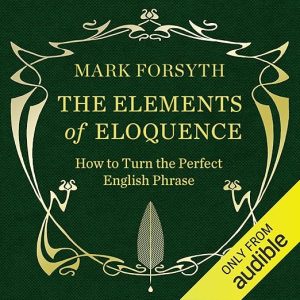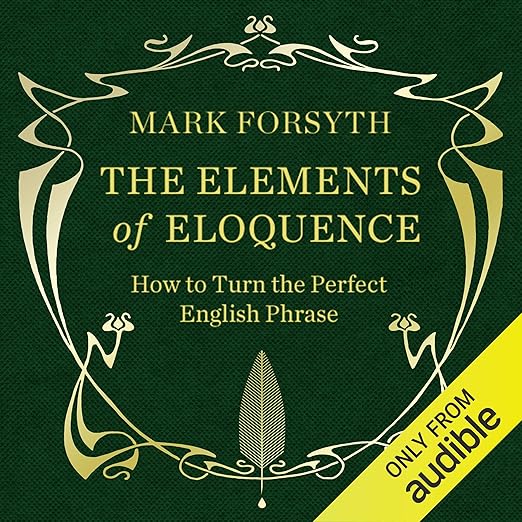
Rhetoric carries a faint smell of the debate club, and ruining that prejudice is the first thing this audiobook does. Mark Forsyth's proposition is blunt and a little rude: in an age unhealthily obsessed with substance, what makes a phrase stick has almost nothing to do with having something to say. Tiger, Tiger, burning bright. To be or not to be. Neither line survives on the strength of its argument. Under six hours later you have a working vocabulary for why they survive at all, plus a permanent suspicion about every advertising slogan you have ever absorbed without noticing.
The Figures Don't Care About Prestige
The most methodical account in the written column counts the whole thing out for you: the book runs as a sequence of thirty-nine short chapters, each naming one figure of rhetoric, defining it, and then piling on examples until the pattern becomes impossible to unsee. Alliteration opens the sequence, on the reasonable grounds that everybody already half knows it. Polyptoton follows, the trick of taking a single word and running it through different parts of speech. By the fourth or fifth figure the structure has taught you how to use itself, and the chapters start functioning as a reference you happen to be listening to in order.
What keeps this from becoming a glossary is Forsyth's refusal to be reverent about any of it. He puts the King James Bible next to pop lyrics and advertising copy without apology, because the figures do not care about the prestige of the sentence they are living in. That flattening is the argument. If the same device is doing the work in Shakespeare and in a jingle, then the device is the thing worth studying, and the cultural ranking we place on top of it is decoration. His stated promise, that you do not need to have anything to say and simply need to say it well, is delivered as a joke and meant more or less literally. I came away from it unable to hear a campaign speech without counting the devices in it, which is either a gift or a mild affliction.
Simon Shepherd's Unusually Exposed Job
A book about why certain arrangements of sound lodge in the memory has an obvious claim on the format, and this one presses it harder than most. Every figure Forsyth names is an auditory effect first and a printed pattern second. Read on the page, alliteration is a row of matching letters. Heard aloud, it is the reason a phrase arrives already half memorized. The demonstration lines are the whole payload of the book, and hearing them delivered rather than scanning them is a genuinely different transaction.
That puts the weight on Simon Shepherd, whose job here is unusually narrow and unusually exposed. Each chapter builds toward quoted examples, and an example that is read flatly stops being a demonstration and becomes a definition. The reader has to switch registers constantly, between Forsyth's dry explanatory voice and lines from four centuries of poets, preachers and copywriters, and mark the switch clearly enough that a listener never loses track of who is speaking. Sample a passage where an example gets quoted rather than the opening minutes, because the introduction tells you nothing about how the quotations land.
One Rating, Five Paragraph-Length Assessments
The reception data on this listing does not describe a single coherent population. The counter reads one rating, while five people have written paragraph-length assessments underneath it, one of them long enough to enumerate the contents chapter by chapter. Two columns are being maintained on the same page and they are plainly not measuring the same set of people, which makes the displayed average a number to ignore rather than a number to weigh.
More useful is a warning the record itself never issues. One enthusiastic write-up pauses to note that some readers were offended by explicit sexual language and by irreverent treatment of Biblical phrasing, then argues the irreverence is more complicated than it looks. Whether you agree is beside the point. No content note appears anywhere on this listing, and a book that ransacks the King James Bible for rhetorical examples in a comic register is a book some buyers would want flagged before purchase, particularly as a gift.
The one dissenting grade is the most interesting entry of the five, and it is also the one you cannot fully read. It holds back a star on the grounds that the prose occasionally turns into a display of its own cleverness, then breaks off mid-word before finishing the thought. Worth noticing too that not one of these accounts is describing this recording. They talk about finishing it in a week, going back through it slowly, and using it like a coffee-table book for the brain. That is a reading pool attached to an audio edition, and it tells you a great deal about the material and nothing at all about the performance.
From Scripture to Smut, No Change in Tone
Writers chasing a better sentence are the audience here, and so is anyone who speaks for a living. Copywriters, speechwriters, teachers of English and people who have to name things professionally will find this closer to a toolkit than to entertainment, and the short chapters make it easy to return to one figure at a time. It also suits the curious general listener who likes Forsyth's register, dry and quick and slightly mischievous, and who wants five hours of company rather than a course.
Skip it if you want a style manual with rules. Nothing here tells you when to use a device or how to structure an essay, and the book is cheerfully uninterested in clarity as a virtue. The same applies if you need your examples sanitized, since the range runs from scripture to smut with no change in tone. Where you are buying this hoping it will improve your writing on its own, the honest answer is that it gives you names for things you will then have to practice on your own time.
Frequently Asked Questions
Does a book about how sentences sound actually gain anything as an audiobook?
It gains the thing it is about. Every device Forsyth names is an effect of sound, and the quoted examples that carry each chapter are written to be heard rather than scanned. The format converts the book's central demonstration from something you infer on the page into something that happens to you directly.
How is the audiobook organized across its running time?
Five hours and thirty-nine minutes, arranged as a long sequence of short self-contained chapters, each built around one named device. The description's own range gives the shape: classic poetry, pop lyrics, the King James Bible and advertising slogans all appear as source material, which keeps any single chapter from running long.
Do I need any grammar or classical rhetoric background to follow it?
None. The promise on the record is that you can learn to write like Shakespeare or Oscar Wilde without knowing the terminology first, and each chapter defines its own term before using it. The technical names look forbidding written down and stop mattering roughly one example in.
Should I hear Forsyth's other books before this audiobook?
No sequence is implied. The description names two earlier bestsellers by the same author without explaining how they relate to this one, and nothing in the chapter structure assumes prior reading. This works as a standalone, and its subject, why phrases stick, is self-contained by design.