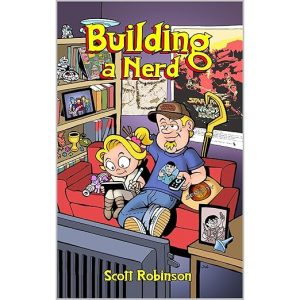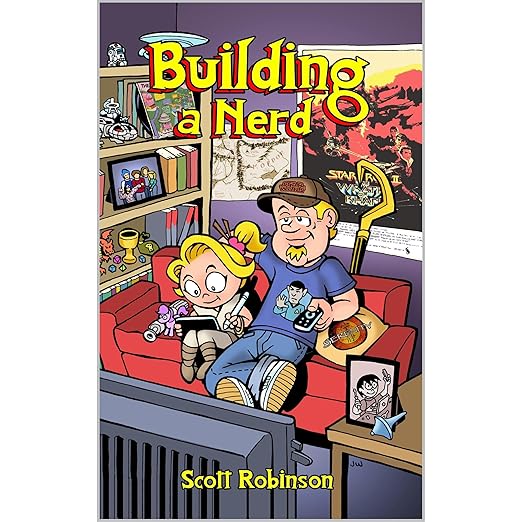
Nerd taxonomy is the first promise on the contents list, and it sets the register for the whole audiobook. Scott Robinson has written a comic parenting manual for people raising the kind of child who memorizes things nobody asked about, and the pitch arrives at a shout: exclamation marks, ellipses, and a running gag about nurturing your progeny toward supremacy. Five hours and fifteen minutes of that is a commitment. Whether it is a pleasure depends almost entirely on whether the joke of the premise is one you already share.
Intelligent, Obsessive, and Socially Inept
The definition arrives early and does the heavy lifting: a nerd, the copy says, is intelligent, obsessive, and socially inept, and all three of those traits require considerable fine-tuning. That sentence is the book in miniature. It is affectionate, and delivered deadpan it is also an odd thing to tell a parent about their child. Robinson is clearly writing for readers who will hear the wink, and the contents list backs that up, running from the legacy of The Big Bang Theory through Saturday morning cartoons, comic books, cosplay, reflections on Batman, and a section on preparing for nose-to-nose debate with other nerds.
What caught me off guard is how much of the material is cultural memory rather than parenting advice. The copy reaches back to what it calls pre-Boomer origins and treats nerd history as a hallowed lineage worth passing down. Career options and a skill set get their own headings, so the practical frame is not entirely a joke, but the ratio leans hard toward nostalgia. Anyone arriving with a genuine question about a socially anxious child will find that the tone answers a different question than the one they brought.
A Text-to-Speech Voice Where a Reader Belongs
Where a reader's name belongs, this record puts a text-to-speech voice. That matters more here than it would on a straight informational title, because the writing runs almost entirely on comic timing: the ellipses that set up a punchline, the exclamation marks that land it, the mock solemnity of a phrase like achieving nerd supremacy. Synthesis treats punctuation as pacing rather than as attitude, and attitude is the entire product. Play a few minutes of the taxonomy material rather than the opening pitch, because the pitch is written to survive any delivery and the jokes are not.
The case for pressing play anyway is that the material is genuinely specific. A guide to nerd romance, a section on how to accumulate useless knowledge and random information, a defense of trivia as a life skill: these are not the generic beats of a humor book about parenting, and the specificity is what makes them funny. Five hours is also a sane length for something with no plot. You can take it in short pieces on the days you want it and lose nothing by setting it aside for a week.
Shelved as a Memoir, and It Is Neither
The shelving is wrong in a way that will cost this book listeners. The record files it under biographies and memoirs and tags it Art. It is neither. Nothing in the description recounts a life, and the only art involved is comic-book art discussed at a fan's remove. Somebody hunting for a humorous parenting title will never meet this page, and somebody who does meet it arrives expecting a life story. That is a clerical detail with a real consequence for a book whose audience has to find it by browsing.
Two other fields deserve a glance before you buy. The series slot names this the fourth entry in something called Uncle Scott Overshares!, while the description never mentions a series at all, so nothing on the page tells you what the other three are or whether they connect to this one. The score, meanwhile, reads five stars over exactly one rating, on a file released in March 2026 with no written responses beneath it. That is not a suspicious figure. It is simply a figure with nothing behind it, and the sensible move is to treat the score as absent rather than as a recommendation.
One more absence is worth naming, because it is structural rather than clerical. Comic books, cosplay and Batman are all subjects here, and every one of them is visual. Nothing on the record mentions accompanying artwork or any supporting file. Five hours of talk about pictures, with no pictures attached, is the whole of the offer. For a book that spends a chapter on the lost world of Saturday morning cartoons, that is a real limitation of the format rather than a flaw in the writing.
The Word Guide Is Working Overtime
The household that already owns the comic books and the cosplay photographs will get the joke fastest. If cartoon nostalgia and a child who corrects you about continuity are the ordinary texture of your life, the affection in this is real and the recognition will carry you through five hours without effort. It also works as a gift for the parent of a newly obsessive kid, provided that parent has a sense of humor about the label being applied to their family.
Skip it if you came looking for actual guidance. The word guide is working overtime in the copy, and the promise that you will learn all the right tips and tricks is a comic promise rather than a real one. The same applies if the framing bothers you, since the opening definition calls its subject socially inept and means it fondly, and a parent worried about a child's friendships is unlikely to find that fondness soothing. Synthetic narration on a comic text is the last risk, and it is the one the sample settles fastest.
The Short Version
- Themes: Nerd identity as inheritance, pop-culture nostalgia, parenting by affectionate stereotype
- Mood: Loud, fond, relentlessly jokey
- Verdict: Funny if you are already in the club, and close to useless as advice if you are not.
Good to Know
Is this audiobook a parenting guide or a comedy routine?
The contents list decides it: a nerd taxonomy, Saturday morning cartoons, cosplay, nerd romance, and a section on debate technique. Career options and a nerd skill set give it a practical spine, but the register stays comic throughout. Treat it as humor using parenting as its frame rather than as advice with jokes attached.
How is the audiobook paced across five hours and fifteen minutes?
As a list rather than an argument. Taxonomy, then nerd history, then skills, then careers, then romance, then debate preparation: each topic is announced separately in the copy and none depends on the one before it. Short sessions work well, and skipping around costs you very little in comprehension.
What visual material does the audiobook include?
No supplementary file is listed anywhere on the record. Comic books, cosplay and Batman all come up as subjects and all of them are described rather than shown. If the visual side of nerd culture is what you want, this format gives you commentary on it and nothing else.