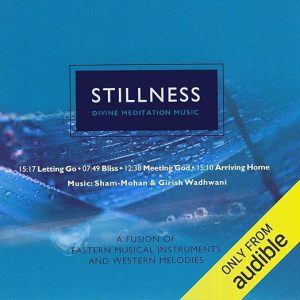
Fifty minutes of Indian flute, and not one word of it. Whatever else this release is, it is not an audiobook in the ordinary sense, and the record barely pretends otherwise. The description opens by explaining that particular attention went to the Indian Flute in creating the music, then names Rakesh Chaurasia of the Chaurasia family as the featured player. No line on the page mentions a text, a reading or a spoken guide. What occupies this slot in the catalog, under Arts and Entertainment with a topical tag reading Art, is a meditation music collection issued by M-Y Books in March 2013, and the fields around it are stranger than the recording itself is likely to be.
An Organization Where a Narrator Should Be
Two of the three credit fields on this record disagree with the copy sitting beside them. The author line reads Rachel Rose, and that name appears nowhere in the description, which attributes the music to an approach and a player rather than to a writer. The narrator line reads Brahma Kumaris, which is an organization rather than a person, and the second half of the description confirms it by sliding into the first-person plural of an institutional mission statement. Nothing about this is dishonest. A meditation music release genuinely has no narrator, and a catalog built for spoken word has nowhere to put a flutist. But a buyer reading credits gets a personal name where a composer or producer probably belongs, and an organization's name where a voice belongs.
The description itself splits cleanly in two, and only the first half concerns the recording. Two sentences cover the music, the flute and Rakesh Chaurasia's involvement. Everything after that is the Brahma Kumaris World Spiritual Organization describing itself: the intrinsic goodness of all people, a practical method of meditation, a worldwide family committed to spiritual growth, leadership with integrity, elevated action toward a better world. All of it sincere, none of it informative about what fifty minutes of audio will sound like. If you want to know whether this is ambient drift, structured classical playing or something with a pulse under it, the page will not say, and the reception column is empty.
Rakesh Chaurasia Is the Strongest Signal Here
Fifty minutes is a deliberate length for this material and it is the right one. Long enough to hold a full sitting, short enough to loop without turning into wallpaper. The Indian flute the description names is arguably the instrument best suited in the world to this particular job. It has almost no attack, its tone begins and ends like breathing, and it never demands the analytical attention a plucked or struck instrument extracts whether you want to give it or not. Meditation recordings built around it tend to work on the sort of listener who finds synthesized ambience either sterile or faintly ridiculous.
The strongest signal on the whole page is the performer credit. Rakesh Chaurasia is named as the featured player, and the description places that player in the Chaurasia family, which it calls internationally acclaimed. That is a real credential rather than marketing filler, because a named instrumentalist from a named lineage is precisely the sort of detail a label includes when it can be checked. For anyone choosing among a shelf of anonymous meditation releases, one specific musician is worth more than any quantity of language about inner strengths and values. The organization behind the release also runs a working meditation practice, which at least suggests these fifty minutes were shaped for use rather than for background.
One Vote Wearing the Costume of a Verdict
Categorization is the practical hazard. This record sits under Arts and Entertainment with a topical tag reading Art, inside a catalog otherwise full of spoken-word titles, which means it surfaces in searches run by people hunting for books about art. It is not that. Anyone arriving from a list of audiobooks may reasonably expect narration, chapters, or at minimum somebody talking, and will get instrumental music instead. That is a shelving error rather than a fault in the recording, but it is the kind of shelving error that ends in a returned purchase and a one-star, which is why it deserves naming before anybody spends money.
The score is the other thing to discount. A 5.0 average sounds authoritative until you notice the counter beside it reads one and that no written response exists at all. One person clicked five stars in the years since March 2013 and moved on. That is not a bad sign and it is not a good one. It is an absence of information wearing the costume of a verdict. Add that the copy never states a track count, never says whether the fifty minutes run continuously or break into pieces, and never confirms whether any spoken guidance is included, and you are being asked to buy a meditation tool with no specification sheet attached.
Fifty Minutes as a Timer You Don't Need
Meditation practice is the setting this was built for, and practitioners are the buyers least likely to be disappointed. If you already sit and want something with a defined end, so that the session finishes when the music does, fifty minutes is a well-judged container and a timer becomes unnecessary. Listeners drawn to Indian classical instrumentation rather than to synthesized pads will find the flute credit reason enough on its own. It carries an obvious secondary use too: the length and the absence of words make it viable underneath reading, writing or sleep, where any vocal line becomes an obstacle within minutes.
Words are the thing this recording does not offer, so anyone hoping for guided meditation, instruction or teaching should look at a different title entirely. The method described in the second half of the copy is not on the file; only the organization's name is. Listeners who need a track count and a structure before committing are equally out of luck, since the page supplies neither. Arriving here from a list of audiobooks calls for one act of clarity about the purchase: this is a music release that landed in a spoken-word catalog and has stayed put ever since.
The Short Version
- Subjects: instrumental meditation, Indian flute, stillness treated as a practice rather than a mood
- Tone: unhurried, breath-paced, wordless
- Bottom line: a fifty-minute flute recording worth owning if you already sit, filed in a catalog where almost nobody looking for it will find it.
Good to Know
Is this audiobook spoken word or purely music?
Purely music. The copy makes the Indian flute the focus of the arrangement and names Rakesh Chaurasia as the featured player, with no mention of a text, a reading or spoken guidance anywhere on the record. A narrator field carrying an institution where a reader's name belongs is the clearest signal that nobody reads anything here.
Why does an organization appear where a narrator should be?
Because a music release has no narrator and the catalog has no field for a musician. The Brahma Kumaris World Spiritual Organization commissioned and released the collection, so its name landed in the credit slot a reader would ordinarily occupy. The author field carries a different name again, one the description never mentions at any point.
Does this audiobook include guided meditation or instruction?
Nothing on the record suggests so. The closing paragraph of the copy sets out the organization's teaching method in general terms, but it describes the institution rather than the fifty minutes on offer. Anyone who needs a voice talking them through a practice should buy a guided title instead of this one.