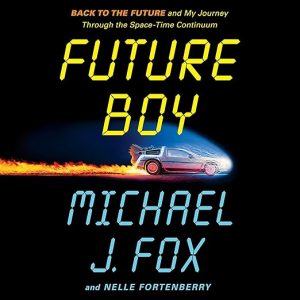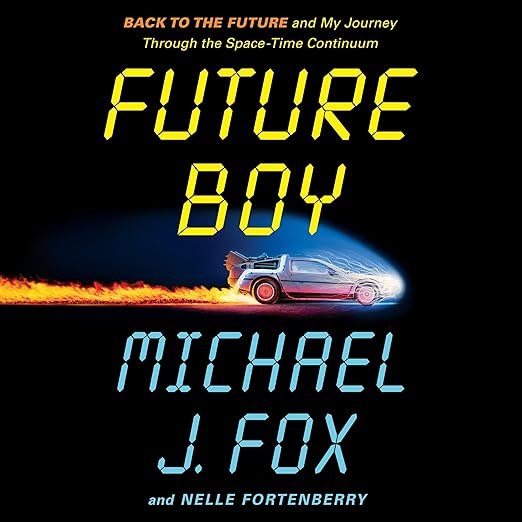
Michael J. Fox spent the first months of 1985 holding two jobs that would each have been somebody else's career highlight, and this audiobook is his account of the stretch when they overlapped. Days at Paramount taping Family Ties, nights on the Universal back lot shooting Back to the Future, and a drive between the two that he calls his own space-time continuum. Three and a half hours is what Macmillan Audio gives the story, read by Fox and built around licensed clips from the film plus new interviews with cast and crew from both productions.
Keaton Handed the Baton to McFly
Sitcom during the day, movie at night, day after day, for months: the description's own summary doubles as the book's whole engine. What makes it more than a scheduling anecdote is that Fox was not a struggling actor grabbing at anything within reach. He was already one of the biggest stars on television, which means the risk he took was not obscurity but overreach. Alex P. Keaton handed the baton to Marty McFly somewhere on that nightly drive while the man playing both tried to steal a few minutes of sleep. That image comes from Fox himself, and it does more work than any quantity of behind-the-scenes trivia could.
Zemeckis and Spielberg are named in the description as the director and the producer of the film that landed in the middle of an already full television schedule, and the detail matters because it explains the yes. This was not a gamble on an unknown quantity. It was a gamble on stamina, taken by somebody who already held the job most actors are gambling to reach. The copy calls the result a slice of entertainment history that has never been told, which is publisher language, though the narrower claim underneath it is fair: the logistics of running both productions at once have not been laid out from inside the car before.
A Four-Star Reader Wanted It Longer
Length is the honest complaint, and it comes from inside the responses rather than from me. A four-star from November calls the book far too short, notes that other titles covering the same ground run three times longer, and does not think the price matched what arrived. That is a fair objection to a printed volume, and in audio it lands differently: three and a half hours is one afternoon, and the compression keeps the story moving where a longer treatment would have to pad. Whether that reads as discipline or as a thin package depends entirely on what you wanted from it.
Licensed Clips, and Fox's Own Voice
Macmillan Audio's production is the argument for choosing the recording over the printed edition. The publisher's note specifies excerpts and quotes from Back to the Future, licensed from Universal, sitting alongside new interviews with the cast and crew of both projects. That turns a short memoir into something structurally closer to a radio documentary. Fox sets a scene, and then the scene itself arrives in the room. A printed page can quote a line of dialogue and hope you hear it. A recording can simply play it, which is a difference in kind rather than degree.
Megan B's five-star, posted two days after release, gets at the other reason. That response says Fox pulls you along for the ride as if you were life-long friends, which is an observation about voice, and voice is exactly what survives the move into audio when the author is also the reader. A five-star from January makes the same point from the opposite direction, describing the book as Michael talking to you in his living room, just telling it like it is. Both are reaching for the same quality, and both are describing something a recording delivers more directly than a page.
One Voter, and a Rating That Doesn't Add Up
One rating is what the counter beside the 4.7 badge reports, and a single voter chooses from five whole values, one star through five, with 4.7 nowhere among them. Five graded responses sit on the same page in plain view. Something feeding this listing is counting wrong, and it is worth naming rather than repeating the average as though it carried information. Judge the book from the written column, which is doing the honest work here.
Delivery is the other tell. One five-star response praises the cover design and calls the layout clean and organized, then states plainly that the writer has not read it yet and is looking forward to starting, rating the gift value highly in the meantime. That is a grade for an unopened package pooled with genuine reading experiences. That same response also supplies the full title, Future Boy: Back to the Future and My Journey Through the Space-Time Continuum, while the page above the cover shows two words, so the subtitle has gone missing somewhere between the publisher and the listing.
For Fans of the Film, Not the Full Career
Fans of the film are the obvious audience, and the responses confirm it without much subtlety. A five-star from February puts it as directly as anyone could: whoever loved Back to the Future will love this book. That is not analysis, but it is accurate about the shape of the appeal. The pleasure on offer is recognition, and the archival clips are engineered to trigger it on cue. If the DeLorean means nothing to you, the memoir will read as a competent account of a busy year.
Whoever wants a full account of Fox's career should look elsewhere, because this is deliberately one stretch of it. The subject is 1985 and the two productions that collided inside it, nothing before and nothing after. What you get is an actor at the precise moment his luck and his stamina were being tested against each other, told with the punchlines intact and with the benefit of long hindsight, plus a supporting cast of colleagues brought in to corroborate or complicate the memory. Budget an afternoon, and expect to want the film again afterward.
Does the Future Boy audiobook include clips from Back to the Future?
Yes. The publisher's note credits excerpts and quotes from the film, licensed from Universal, and the program is assembled with those alongside newly recorded conversations with people who worked on both productions. That archival material exists in no other edition of the book, which is the practical reason to choose audio over print here.
Is the audiobook too short at three and a half hours?
That depends on what you came for. The runtime covers a few months of 1985 rather than a life, so the compression is a design choice rather than an omission. If you want an exhaustive production history of the film, the length alone tells you this is not it. If you want the story from the person in the car, it fits.