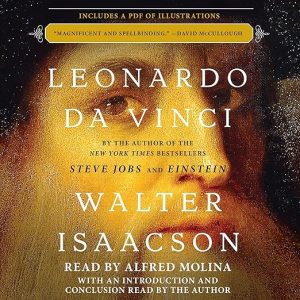
Walter Isaacson never appears in the byline on this record, and yet four of the five written entries beneath it are praising a biography of Leonardo da Vinci by Walter Isaacson. What the listing actually sells is something else: a capsule life credited to Jasmine Dyggan, published by Zentara UK in August 2025 inside a series called Behind the Name, read by Derek Monaghan, and running two hours and forty-seven minutes. That audiobook and the reviews stacked under it are not the same book, and the gap in scale between them is roughly the gap between a pamphlet and a doorstop.
Ten Aspects of Genius in Under Three Hours
Ten aspects of Leonardo's genius organize the whole thing, and the selection is sensible for a listener starting from the Mona Lisa and not much else. The mirror script he used in his notebooks. The corpses he dissected to get human anatomy right. The helicopters, tanks and diving suits sketched over five hundred years ago. The Last Supper treated as a change in how a story could be told inside a single picture. Around those runs the biography proper: born outside marriage, given no formal education, and rising through Renaissance society on talent and restlessness with nothing else behind him.
Under three hours is a hard constraint, and the copy is honest about how it spends them. This is a portrait rather than an argument, closer to a very good museum guide than to a scholarly life, and its recurring claim is that Leonardo matters now less for what he finished than for how he thought. The unfinished projects, the shifting patrons, the refusal to publish any of the discoveries: the book treats those as the interesting part rather than as footnotes to the paintings. Anyone wanting documentation will meet assertion instead, which is the trade every capsule biography makes.
Painter, Sculptor, Engineer, Anatomist, All at Once
Curiosity as a working method is the through line, and it is why the short format holds up better than it should. The argument the copy keeps returning to is that Leonardo refused the boundary between science and art and used each to illuminate the other, that he observed with care, asked questions other people ignored, and treated failure as part of discovery. Those are portable claims. They survive compression in a way that a chronology of patrons and commissions would not, and they give a short listen a spine that is not merely a list of achievements.
Mirror writing, a dissection table, a flying machine drawn five centuries before anyone could have built one: the hooks are strong, and short audio is the right container for them. The book leans on that, and it also lands one genuinely useful frame for a modern listener, which is the cost of specialization. A world that pushes people to pick one field gets held up against a man who was painter, sculptor, engineer, anatomist and stage designer at once, and the comparison does more work in three hours than a longer book would need a chapter to set up.
Entries From 2017 Praising a Different Isaacson Book
Not one of the five written entries was filed later than January 2025, and this recording was released in August 2025. Every response on the page predates the product it is attached to. The four-star among them opens by praising Isaacson as a biographer, then praises his book on Albert Einstein, and reaches da Vinci only in its third line. The reception column belongs to a different biography of the same man, attached to this record by nothing more than a shared subject.
Ninety-eight ratings hold up a 5.0 badge on a recording that has existed since August 2025, while the written column beneath it was assembled between 2017 and the start of 2025. Nothing proves those ninety-eight clicks came from the same displaced source as the paragraphs, and nothing separates them either. The sensible move is to treat the badge as unattributable rather than as praise, which is an unusual thing to have to say about a five-star average carrying nearly a hundred votes.
Derek Monaghan has to move through five centuries of context and a dozen disciplines inside under three hours, so pace is effectively the entire assignment: no time to linger over a painting, no room to rush an invention either. One more inconsistency is worth noting while you are checking the fields. The copy names the book Leonardo da Vinci: The Mind Behind the Masterpieces, while the title displayed on the record is simply Leonardo da Vinci, and that shortening is precisely what lets a record collide with every other book about the same subject.
A Reasonable Capsule and a Genuine Mess
Curious listeners with a free afternoon are the right buyers, along with anyone who wants a briefing before a gallery visit or a documentary, and younger listeners who would abandon a full-length biography early. The ten-part structure makes it usable in pieces, which matters more in audio than people admit: each facet closes, so stopping between them costs nothing. As an introduction that leaves you able to ask better questions, it is properly aimed.
Anyone hunting the definitive Leonardo should keep hunting, and should be especially careful on this record, because the praise sitting underneath it belongs to a longer and far more heavily illustrated book. Anyone after primary sources, scholarly caution or an argument about attribution will not find them in under three hours. My honest read is that the capsule is a reasonable object and the record around it is a mess, and those two judgments have to stay separate, since the fault in the reception is not the fault of the recording.
- Narrator: Derek Monaghan is credited with the reading, and pace is what a buyer notices, since ten facets of a life have to clear inside under three hours.
- Subjects: Renaissance genius, curiosity as method, notebooks and unfinished work
- Tone: Brisk and admiring
- Bottom line: A serviceable short introduction sitting under a reception column that belongs to somebody else's biography.
Frequently Asked Questions
How does the audiobook split its time between the paintings and the inventions?
The copy promises ten facets, with the Mona Lisa and The Last Supper on one side and the notebooks, machines and anatomical studies on the other. Both are covered, and the notebooks act as the connective tissue, since the argument running through the book is that the drawings explain the paintings.
Does the audiobook suit younger listeners?
The copy says listeners young and old, and the format supports that claim: short facets, concrete hooks like mirror writing and flying machines, no scholarly apparatus. Nothing on the record states an age range, though, so parents get no guidance on how the dissection material is handled.