
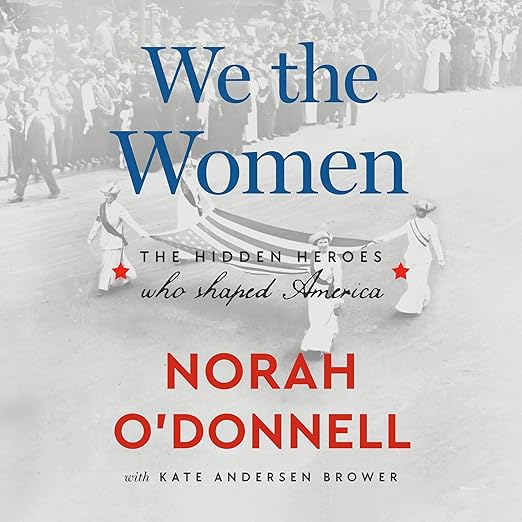
Mary Katherine Goddard printed the first signed copy of the Declaration of Independence, and if that name is new to you, this audiobook was built for exactly that gap. Norah O'Donnell reads her own account of American women from 1776 to the present, ten hours and thirty-seven minutes of it, released by Random House Audio in February 2026 in honor of the country's 250th birthday. The question the book keeps circling back to belongs to the women themselves: the Declaration promised unalienable rights, so why did those rights not apply to us?
Standing Inside Promises Meant for Somebody Else
O'Donnell's structure is curatorial rather than argumentative, and the description says as much: extensive research, interviews, and historical documents assembled into a portrait rather than a thesis. The figures are chosen to cover the whole span, from Goddard at the founding to the Forten family women, active in the abolition and suffrage movements and described in the copy as the Black Founders of Philadelphia, through to the first women who served in the armed forces before they had the right to vote. What holds them together is not a movement but a repeated position: standing inside a country's promises and being told the promises were meant for somebody else.
Gadavis's five-star describes the book as an outstanding account of the hidden women who shaped American history from the revolutionary era through the present, and recommends it to anyone wanting knowledge of their biographies. Biographies is the accurate word. This is a book of lives rather than an argument about them, and the choice has consequences for a listener. You are not being asked to hold a thesis in mind across ten hours. You are being introduced, repeatedly, and the introductions carry the whole load.
O'Donnell Chose These Particular Lives Herself
Short profiles are what make the book work in audio, and one five-star names the structure exactly, calling them wonderful short reads about women in US history. That shape solves the problem that sinks a lot of narrative history in this format. A book building one argument across ten hours punishes you for losing the thread on a noisy street. A book of self-contained lives does not, so you can set it down for a week, come back, and forfeit nothing beyond the name you happened to be on.
Goddard herself is the kind of entry point that justifies the whole project. A printer whose name went on the first signed Declaration is not an obscure figure by any reasonable standard, and most people have never heard of her, which is the argument the book makes without needing to state it. The Forten women make the same case from another direction, since a family described as the Black Founders of a major city ought not to need introducing. The copy's word for all of this is unsung, and the word choice is doing real work.
Random House Audio put the author behind the microphone, which for this material is the load-bearing decision. O'Donnell has spent a career reporting, and the description frames the project as an extension of a long-standing mission to bring untold women's stories forward. A book of profiles read by its own author carries an implicit claim that the selection was personal, that somebody chose these particular lives out of two and a half centuries of candidates. That is a different proposition from a hired reader working through a list, whatever the delivery ends up sounding like.
Humanize the Story a Little More
Every visible response landed inside a two-week stretch in March 2026, within weeks of a February release, and all five are positive: four five-star grades and a single four. The badge reads 4.8 across 100 ratings, which is coherent arithmetic sitting on an extremely young sample, and a young sample is a different thing from a settled reputation. This page has not yet been read by anyone who came to it without enthusiasm, and the ninety-five ratings you cannot see are all you have.
Richard Parker's four-star declines to join the chorus, and its objection is specific. That response calls the research well done and the information meaningful, then explains the reservation: at seventy-seven, with a great deal of this history already known, the book did not land the way it would for a younger reader. The title says the same thing, calling it a great start for a younger reader, and the response closes by asking the author to humanize the story a little more next time. That is the clearest statement anywhere on this page about who the book is for, and it arrives from outside the target.
Built for a Syllabus and a Classroom
Readers who want a way into American history through people rather than periods are the core audience. A five-star from mid-March says the book makes it proud to be a woman, credits O'Donnell with representing the strife, intelligence, and perseverance of these women to a tee, and then turns to the present, arguing that what is happening to our gender in today's political atmosphere would make those women cringe. That reaction is part of what the book is for. A history of unfinished business reads differently depending on the year you hear it in.
Younger listeners and classrooms are where this will do the most work. The profile structure fits a syllabus, the runtime divides into sessions without doing violence to the material, and the founding documents quoted throughout give a teacher something solid to anchor on. Anyone who already knows the period well should calibrate accordingly, because the book introduces rather than reinterprets, and a specialist will meet more familiar names than new arguments. How unfamiliar those names are to you is the best available predictor of how much this will give you.
Questions Listeners Ask
Does the We the Women audiobook credit a co-author?
The byline names Norah O'Donnell alone, and the narrator field names her as well. One written response, though, signs off by congratulating both authors, which points at a collaborator the listing does not display anywhere. Nothing in the description resolves it, so check the publisher's own credits first if authorship matters to you.
Is the audiobook chronological or organized by theme?
The description presents a sweep from 1776 to today, and the figures it names run in roughly that order, from a printer at the founding through the abolition and suffrage movements to the first women in uniform. Expect a forward chronology built out of self-contained lives rather than thematic chapters jumping across centuries.







