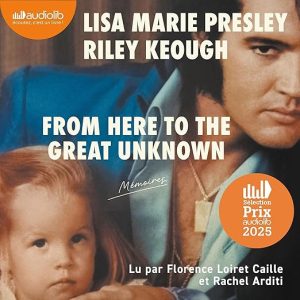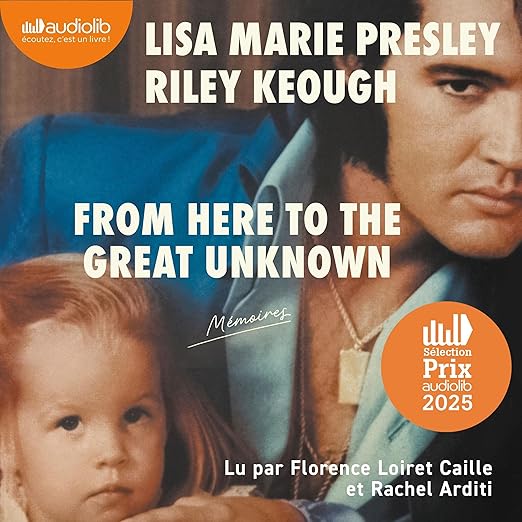
Lisa Marie Presley began recording her memories in 2022, speaking into cassette tapes with the intention of finally telling her own story. A month after asking her daughter Riley Keough to help her finish the project, Lisa Marie died. From Here to the Great Unknown is what Riley built from those recordings, a memoir that crosses the boundary between the living and the dead, shaped by both voices in a structure that is fundamentally unlike any conventional celebrity memoir. The audiobook, narrated by Florence Loiret Caille, is the edition of this title available in French, which means listeners seeking the English-language version with Riley Keough's own narration will need to seek out that separate edition. This review covers what this audiobook represents as a listening experience and what the text itself achieves.
Lisa Marie's recorded memories are extraordinary in their specificity and pain. The golf carts demolished with friends in Graceland's gardens. The unconditional love of her father, the floor they shared just between the two of them. And then the moment she describes rushing toward the bathroom when Elvis died, screaming, being pulled back. These are not the polished memories of a publicist-managed celebrity account. They are raw, personal, and rendered with a directness that the recorded format preserved and the book's co-authorship with Riley maintains.
Writing While Mourning, Mourning While Writing
Riley Keough's contribution to this book is its structural and emotional heart. She took the cassette recordings of her mother's voice, listened to them in Lisa Marie's bed, and then assembled the memoir with her own sections woven between her mother's words. The result is a document of grief and love operating simultaneously across two generations, a daughter finishing what her mother began, mourning while writing, writing while mourning. Few memoirs manage this kind of doubled authorship with genuine effect. This one does, because the stakes are real and Riley does not insulate the reader from them.
Lisa Marie's life carries an unusual weight for a memoir subject. She is Elvis's only child, which means her early childhood was defined by one of the most documented lives of the twentieth century, but from the inside. Her account of Graceland is not the fan pilgrimage account but the child's account, the private spaces, the particular intimacy her father maintained with her amid the circus of his public existence. The contrast between that intimacy and what happened on August 16, 1977, when she was nine years old, gives the book its emotional structure.
Loiret Caille Holds Two Registers of Grief
Florence Loiret Caille narrates the French-language edition with sensitivity and emotional intelligence. The material demands a narrator who can hold both registers, Lisa Marie's raw confessional and Riley's measured grief, without collapsing them into a single emotional mode. Loiret Caille navigates this with care. French-speaking listeners will find the narration responsive to the text's unusual structure, moving between mother and daughter voices with enough tonal differentiation to maintain clarity about who is speaking.
The French reviews available reflect consistent admiration for the book's emotional honesty. One reviewer describes being 'truly surprised by what I learned about Lisa Marie's life,' suggesting the memoir reveals dimensions of her experience that even longtime followers of her family's history had not encountered. Another notes it as simply 'superb to read', modest praise that nonetheless reflects the quality of the underlying writing, which manages to feel both intimate and crafted across its joint authorship.
A Cassette Format Gives the Book Its Texture
Listeners expecting a linear celebrity biography will find something considerably stranger and more demanding here. The book covers Lisa Marie's relationships, with Danny Keough, with Michael Jackson, with substance dependency, with grief as a chronic condition following her father's death and later her son Benjamin's death in 2020, but not in a neat chronological narrative. It circles and returns, the way memory actually works when it is being recovered rather than reconstructed for narrative convenience.
The memoir's deepest subject is the experience of being the child of someone so outsized that even his death becomes a cultural event rather than a private one. Lisa Marie spent decades negotiating the public ownership of her grief. This book is her attempt to reclaim that grief and her own identity within it. Riley's presence as co-author and interlocutor gives the project its shape without sanitizing its subject.
The cassette recording format of Lisa Marie's contributions gives the memoir an unusual documentary texture even in its written and audio forms. These are not memories reconstructed in retrospect for publication, they are memories captured in real time, in her own voice, with the specific asides and circlings-back that characterize speech rather than composed prose. Riley's work in shaping these recordings into a readable text necessarily involved editorial judgment about what to preserve and what to condense, and she has described that process as involving her own grief at every stage. The resulting book reads differently from memoirs written by their sole surviving author, not because it lacks control but because it carries the weight of two people's investment in what gets said and what stays private.
French Speakers Get This Specific Edition
Listeners who want an honest, structurally unusual memoir about grief, celebrity inheritance, and the complicated love between a parent and child will find this audiobook genuinely affecting. French-speaking listeners can access this edition with Florence Loiret Caille's narration. Those preferring the English-language version, which features Riley Keough's own narration, a significant additional layer of emotional resonance, should seek that separate edition. Listeners looking for a conventional Elvis biography or a breezy celebrity memoir will find neither here; this is harder and more personal than either of those genres suggests.
Questions Listeners Ask
Is this the French-language edition of the audiobook, and is an English version available?
Yes, the edition reviewed here is in French, narrated by Florence Loiret Caille. An English-language edition exists, narrated by Riley Keough herself, which adds considerable emotional resonance for English-speaking listeners. Confirm your language preference before purchasing.
Does this audiobook cover Lisa Marie's relationship with Elvis Presley in depth?
Yes, significantly. Lisa Marie's memories of Graceland and her father, the private spaces they shared, the unconditional love he held for her, and the trauma of his death when she was nine, form the emotional core of the memoir. But the book also covers her adult life, relationships, and her son Benjamin's death in 2020.
Is the audiobook suitable for listeners who have no particular connection to Elvis Presley or his legacy?
Yes. While the Elvis context is central, the memoir's deeper subjects, grief, parental loss, complicated family love, finding identity inside inherited fame, are universal in ways that make it affecting regardless of personal connection to Presley's music or legacy.