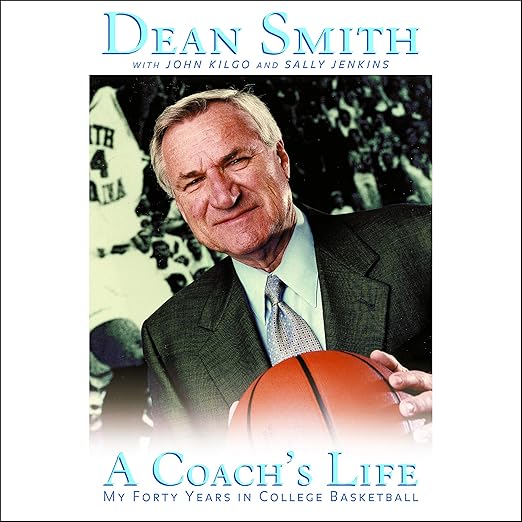
Does a coaching philosophy survive being turned into an audiobook, or does it flatten into slogans the moment nobody can see the whiteboard? Dean Smith ran the University of North Carolina men's basketball program for close to forty years and insisted throughout that the fundamentals of good basketball were the fundamentals of character: passion, discipline, focus, selflessness, responsibility. Eric Conger reads the memoir in four hours and forty-eight minutes, which is a compact container for four decades of one of the most scrutinized jobs in American sport.
A Memorial Arriving Five Weeks After His Death
Death shadows this record in a way the publisher never planned. A response posted on February 16, 2015 mourns Smith outright, calls him the greatest college basketball coach who ever lived, and reports that a North Carolina childhood left no other team worth following. Random House Audio issued the recording on March 24, 2015, five weeks after that entry went up. Whatever the memoir was when it was written, the audio edition arrived as a memorial, and the reverence stacked underneath it is not the ordinary reverence sports books collect.
Underneath the eulogy sits a plain book. A February 2023 account describes it as a very straightforward autobiography that works through Smith's earliest start, his departure and the life that followed retirement, and notes that the admiration runs past basketball to how the man himself was regarded. That reading matches the shape of the thing. This is not a season-by-season chronicle or a tactical treatise; it is a career told in order, with the philosophy stated rather than dramatized, which turns out to be both its restraint and its limit.
Conger Must Keep a Level Register Alive
Forty years in a single job is rare enough in any profession to earn a few hours of attention, and college coaching is a profession that eats people. The description sets out Smith's actual claim, which is sharper than the usual coaching-wisdom package: passion, discipline, focus, selflessness and responsibility are simultaneously the fundamentals of good basketball and the fundamentals of character, and treating them as two separate lists is the error. That is a testable proposition rather than a poster, and a memoir is the right instrument for testing it.
Delivery is where a book like this can quietly fail. A memoir built on restraint hands a reader almost nothing to perform: no set pieces, no villains, and a subject whose defining trait was declining to raise his voice. Eric Conger's assignment is to keep a level register from going inert across nearly five hours, and to carry the passages where a principle gets explained without letting them slide into the cadence of a motivational seminar. Skip to a chapter about a rivalry rather than one about Michael Jordan, and ten minutes will tell you whether the tone suits you.
Compression is the real surprise, and one response gets at why it works. A July 2018 account praises a style it calls easy and engaging, and says the writing mirrors the coach's own humility and decency. That is the mechanism exactly: a plain style, kept plain, holds four decades in under five hours because it never stops to admire itself. The same entry offers the sport's favorite Dean Smith line, that only one person could hold Michael Jordan under twenty and it was his college coach, in a sentence the listing has partly garbled.
Listen for Whether the Book Keeps It
Every one of the five posted comments lands on the same two subjects: the prose and the man. The single dissenting note is a September 2015 four-star saying the book is not without its faults, similar to the coach himself, and then declining to name even one of them. That is a generous way to be critical and an unhelpful one for a buyer. The complaint most likely folded inside it is that a memoir written by somebody allergic to self-promotion will underplay the very moments that built the career.
A runtime of four hours and forty-eight minutes is short for a life this long, and the record carries no edition label in either direction. Nothing on it says unabridged and nothing says abridged. Anyone who wants the text exactly as published should treat the runtime as the only clue available, because forty years of games, players, strategies and rivalries compressed into under five hours is worth a moment's arithmetic before buying.
Timing shapes what the book is allowed to be as well. The description leads with Michael Jordan calling Smith his second father and wearing UNC shorts under his NBA uniform, which is the anecdote that sells the memoir and also the one that bends it out of shape. Smith coached hundreds of players who did not become the most famous athlete on earth, and the copy makes the harder promise too, that the last man on the bench of the least talented team mattered equally. Listen for whether the book keeps it.
A Leadership Book Set on a Basketball Court
Coaches at any level are the obvious audience, and so is anyone managing people in a job where results are public and turnover is brutal. The leadership material is not dressed up as leadership material, which is why it lands better than the airport-shelf version: principles get stated in the middle of describing an actual decision about an actual roster, rather than in a chapter with a takeaway box at the end. Listeners who follow the history of the college game get the period as a bonus.
Nobody should come here for tactics. The description promises strategies, but the memoir's curiosity runs toward why a program was operated the way it was rather than how a defense got built, and anyone hoping for the coaching manual will feel that gap by the second hour. Listeners allergic to reverence should weigh the tone too, since the book and the column beneath it both treat their subject as close to unimpeachable. Fans of the program get a memoir; everybody else gets a leadership book that happens to be set on a basketball court.
Key Details
- Narrator: A hired reader rather than the coach himself, which is the first thing a Carolina listener will register on a memoir this personal.
- Subjects: Forty years at one program, character treated as coaching method, the long shadow Michael Jordan casts.
- Tone: Measured and reverent, closer to a eulogy than to a locker room.
- Bottom line: Strong on philosophy and on the man, thin on tactics, and short for the life it covers.
Questions Listeners Ask
Is Dean Smith the narrator of this audiobook?
No. Random House Audio credits Eric Conger with the reading. The memoir speaks in Smith's first person while a professional reader carries it, which is the standard arrangement for a book of this kind and something worth knowing if you were hoping to hear the coach's actual voice.
Is this audiobook a leadership book or a sports memoir?
Deliberately both. Smith's central claim is that the two sets of fundamentals are one list rather than two, so career events double as management examples throughout the book. Anyone buying purely for scores and seasons will find the balance tilted a long way away from them.
How does this audiobook compare with other coaching memoirs?
It is considerably quieter. Most books in the category run on big games and old grievances, while this one opens with a five-item character checklist and treats four decades of coaching as the evidence for a claim about who a person becomes. Expect argument where the genre usually supplies anecdote.