Quick Take
- Narration: Julian Rhind-Tutt's precise, measured British delivery suits Lewis's argumentative prose, this is philosophical writing that benefits from a narrator who respects the complexity.
- Themes: The rational case for miracles, naturalism versus supernaturalism, the Incarnation as the hinge of all Christian claims
- Mood: Dense and demanding, with the occasional luminous passage that rewards the effort
- Verdict: Lewis at his most philosophically ambitious, essential for readers who want to understand his thought, challenging enough to require real engagement.
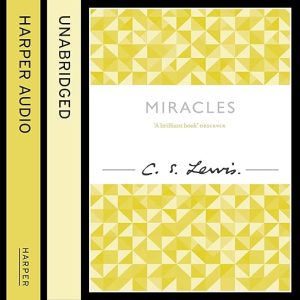
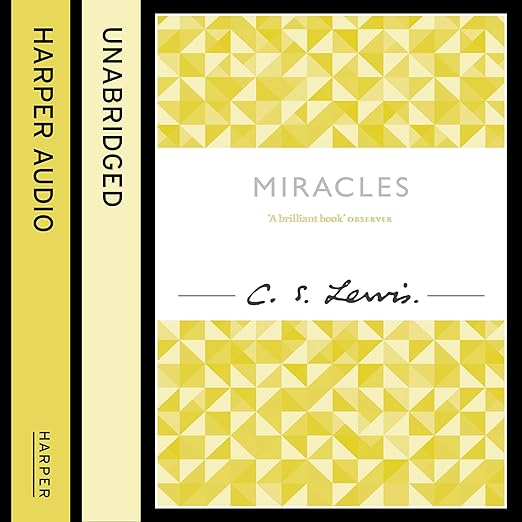
I first encountered Miracles in a theology reading group during my graduate years, when a professor assigned it alongside Hume's essay on miracles as a pair of opposed arguments to sit with. That pairing ruined me in a particular way, once you have read Lewis against Hume directly, it is hard to encounter either thinker in isolation without hearing the other's ghost. When this audiobook edition from William Collins appeared in my queue, narrated by Julian Rhind-Tutt, I decided it was time to return to the text without the scaffolding of a seminar.
Published in 2014 but drawing on Lewis's 1947 work (revised by Lewis himself in 1960 after a famous exchange with G.E.M. Anscombe), Miracles is among Lewis's most philosophically demanding texts. It is not a popular devotional. It is an argument, and it takes argument seriously.
Our Take on Miracles
Lewis's central claim is announced clearly: if you are a Naturalist, if you believe the universe is a closed system of cause and effect with no outside, then miracles are logically impossible before any examination of evidence, and the rational thing to do is dismiss every report of them on principle. But if Naturalism itself can be shown to be incoherent, then the door to miracles is at least open, and the specific question of whether they have occurred becomes an empirical rather than a philosophical one.
The argument against Naturalism that Lewis constructs, drawing on what he calls the self-refutation of the Naturalist position regarding Reason itself, is the most technical and contested section of the book. This is where Anscombe found her opening, and where Lewis revised. Whether the revision adequately answers the objection is a question that philosophers of religion still debate. Lewis acknowledges the difficulty without fully resolving it, which is honest but may frustrate readers expecting a watertight philosophical victory.
One reviewer called it "a hard read" and noted that their priest taught a class on the book specifically because it required guidance. Another reviewer, who identified as a Lewis admirer, gave it four stars and wished Lewis had organized the chapters differently for the general reader. Both responses are fair. This is Lewis at his most systematic, and the early philosophical sections require sustained attention that some readers find slow going before reaching the more accessible later chapters on specific miracles of the Christian tradition.
Why Listen to Lewis Rather Than Reading Him
Julian Rhind-Tutt's narration is an excellent match for Lewis's prose style. Rhind-Tutt is known for precision and intelligence in his delivery, he does not perform Lewis so much as think alongside him, which is the right approach for philosophical writing that asks you to follow an argument step by step. The wit that runs through Lewis's prose, the dry asides, the unexpected metaphors, the moments of poetic assertion that break through the logical scaffolding, comes alive in Rhind-Tutt's reading in a way that might flatten on a silent page.
At seven hours and twenty-three minutes, this is a substantial listen. It rewards pausing and returning rather than consuming in a single sitting. The audio format makes the density more manageable in some ways, you can listen to a chapter, sit with it, and return, though the absence of marginal annotations will frustrate readers who think by marking a text.
What to Watch For in Lewis's Argument
The book's organization is not immediately intuitive. Lewis spends considerable time on the philosophical case against Naturalism before arriving at specifically Christian claims, which can feel like the first third is a different book from the final third. Readers who push through to the sections on the Grand Miracle of the Incarnation, and on the nature of the resurrection and other specific New Testament miracles, often find those sections the most rewarding. One reviewer specifically wished the chapter order had been revised; Lewis's own 1960 revisions addressed the philosophical objections but not the structural ones.
Lewis is also writing in a particular mid-twentieth century philosophical idiom that shows its age in places. His framing of Naturalism versus Supernaturalism maps onto contemporary debates in philosophy of religion, but the vocabulary is dated enough that readers familiar with current analytic philosophy of religion will occasionally want to update the terminology.
Who Should Listen to Miracles
Readers who have enjoyed Lewis's more accessible apologetics, Mere Christianity, The Problem of Pain, and want to understand the philosophical foundations beneath them will find this essential. It is also strongly recommended for theology students who want a serious engagement with the rationalist case against miracles from a believing perspective. Those expecting Lewis's lighter, more anecdotal style will find this demanding in ways that could feel like a disappointment rather than a challenge. The Screwtape Letters this is not, but for readers who want Lewis thinking as hard as he can, this is the book.
Frequently Asked Questions
How does Miracles compare to Mere Christianity as an entry point to Lewis's apologetics?
Mere Christianity is the more accessible and widely recommended starting point. Miracles is more philosophically technical and assumes a reader willing to follow sustained logical argument. Many readers come to Miracles after Mere Christianity and find it deepens their understanding of the foundations Lewis was working from.
What was the Anscombe objection that led Lewis to revise the 1947 version?
G.E.M. Anscombe, one of the leading analytic philosophers of the twentieth century, argued at a 1948 Oxford meeting that Lewis's argument against Naturalism was logically flawed, specifically, that his claim about Reason self-refuting Naturalism did not hold in its original form. Lewis revised Chapter 3 for the 1960 edition to address this. Whether the revision satisfactorily answers Anscombe remains debated.
Is Julian Rhind-Tutt familiar with the philosophical material, or does his narration feel like a performance of content he does not fully grasp?
Rhind-Tutt brings the kind of intelligent engagement that suggests genuine comprehension rather than performance. His delivery respects the argumentative structure of each chapter and handles the moments of Lewisian wit without undermining the philosophical substance.
What sections of Miracles are most accessible for listeners who find the early philosophical chapters difficult?
The later chapters, particularly those on the Incarnation as the Grand Miracle, and on the nature of the resurrection and other specific New Testament miracles, are significantly more accessible and, for many readers, more rewarding than the opening philosophical sections. If the early argument feels too dense, moving ahead to these chapters and returning is a reasonable strategy.