Quick Take
- Narration: Lawrence Richardson delivers Cahn's layered, rhetorical style with conviction and authority, which is exactly what this material demands.
- Themes: End-times prophecy, spiritual warfare, the Israel-Hamas conflict as biblical fulfillment
- Mood: Urgent and revelatory, written for believers who want prophetic framework for current events
- Verdict: Cahn's most ambitious attempt to connect ancient biblical mystery to contemporary world events, compelling for his existing audience, likely unconvincing for skeptics.
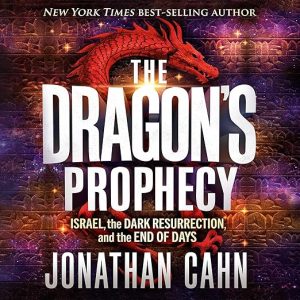
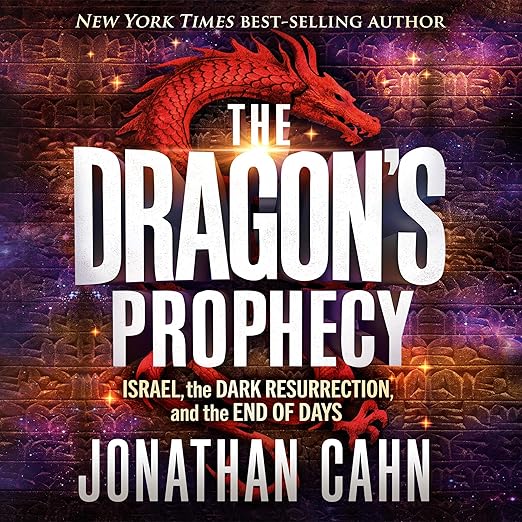
I approached this one knowing Jonathan Cahn's reputation well. He is the New York Times bestselling author of The Harbinger, a writer who has built an audience of millions by drawing connections between ancient biblical prophecy and modern American and global events. His readers are deeply committed, and they come to each book expecting the same quality of urgency and revelation. The Dragon's Prophecy arrived in September 2024, published by Frontline, and it is clearly intended as his most comprehensive statement yet on end-times theology.
Lawrence Richardson narrates the nine hours and thirty-nine minutes, and his delivery is well-suited to Cahn's particular register, a kind of controlled prophetic intensity that asks you to keep pace with a lot of interconnected ideas across a lot of historical and scriptural territory.
Our Take on The Dragon's Prophecy
Cahn's central argument in this book is that ancient biblical prophecy, specifically from the Book of Revelation and the Hebrew scriptures, is actively playing out in contemporary world events, and that the Hamas invasion of Israel on October 7, 2023 was foretold in a three-thousand-year-old mystery that specified not just the year but the exact date. He calls this the 18,263rd Day, and it is the kind of claim that will either strike you as profoundly significant or deeply problematic depending on the interpretive framework you bring to scripture.
The book covers an enormous amount of territory: the Dark Resurrection, the Sea Peoples, the Black Sabbath, the Inverted Angel, and a figure Cahn identifies as the Dragon operating through contemporary world events. One reviewer described it as having "some truly brilliant points and a lot of valuable insights" while also noting that the approach can feel like "a creative whirlwind, touching on various interesting ideas, which sometimes made it a bit challenging to track a single, clear line of thought." That is an honest account of Cahn's methodology. He does not build a linear argument. He spirals outward from one mystery to another, accumulating connections rather than proving a thesis in the conventional sense.
Why Listen for the Framework
Lawrence Richardson handles this material well. Cahn's prose has a rhythmic, sermonic quality that benefits from being heard rather than read, the rhetorical repetitions land differently when spoken, and Richardson maintains the intensity without losing the clarity. For listeners who engage primarily with Cahn through church or sermon context, this audiobook format will feel natural.
Reviewers who rated it highly consistently describe a sense of spiritual urgency and revelation. One wrote: "He explains the scripture so you can understand it and reminds you that there is a spiritual warfare going on for our souls." Another called it "spell-bounding" and read it in five days despite not normally reading this kind of book. Cahn has a genuine gift for making complex biblical and historical material feel personally urgent, and that gift is fully present here.
What to Watch For in Cahn's Method
Cahn's approach to biblical prophecy is interpretive and highly synthetic, he draws connections across millennia, cultures, and textual traditions with great confidence. Academic biblical scholars and historians would identify many of these connections as speculative or contested. That is not necessarily a disqualifying concern for readers who approach scripture through a prophetic rather than a critical-historical lens, but it is worth being aware of what kind of reading is on offer here. The confidence of the claims is not always matched by conventional evidential rigor, and a reviewer noted that while the book contained "truly brilliant points," the framework can be difficult to follow as a coherent argument.
There are also a large number of chapter-level topics, the book covers more than a dozen distinct prophetic themes, some of which get relatively brief treatment. Listeners who want extended analysis of any single thread will find that Cahn moves on before they feel satisfied with any individual mystery.
Who Should Listen to The Dragon's Prophecy
Existing fans of Cahn's work who found The Harbinger, The Return of the Gods, or The Paradigm compelling will find this a natural continuation. It is also appropriate for readers in evangelical or Charismatic Christian communities who want a prophetic framework for understanding events like October 7, 2023, and the broader geopolitical situation in the Middle East. Those approaching from a secular perspective, from mainline Protestant or Catholic traditions skeptical of end-times speculation, or from an academic interest in biblical scholarship will find the methodology difficult to engage with on its own terms. This is a book written for a specific kind of faith, and it rewards that faith generously.
Frequently Asked Questions
Do I need to have read Cahn's earlier books to follow The Dragon's Prophecy?
Not strictly, but familiarity with his earlier work, particularly The Harbinger and The Return of the Gods, will help. Cahn operates within a consistent interpretive framework across his books, and readers who have spent time in his world will recognize the methodology and pick up the thread more quickly.
What is the book's central claim about the Hamas attack of October 7, 2023?
Cahn argues that a three-thousand-year-old biblical mystery foretold the Hamas invasion of Israel with specificity down to the exact date, which he identifies as the 18,263rd Day of a prophetic cycle. This is the book's most striking and controversial specific claim.
Is Lawrence Richardson's narration a good fit for Cahn's writing style?
Yes. Richardson handles Cahn's rhetorical, sermonic prose with appropriate authority and intensity. The delivery suits the prophetic register of the material and maintains energy across the full nine-plus hours.
How does this book compare to Cahn's earlier titles in scope and ambition?
Reviewers and the author himself frame this as his most comprehensive prophetic statement to date. It covers more territory than earlier titles and attempts to synthesize several lines of biblical prophecy into a unified picture of end-times events. Some reviewers call it his best work; others find the breadth makes it harder to follow than the more focused Harbinger.