Quick Take
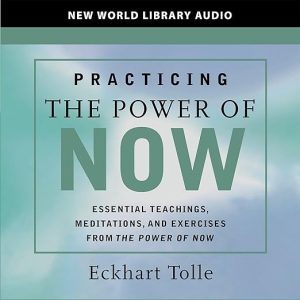
- Narration: Eckhart Tolle reading his own work is the definitive version, his unhurried, slightly accented delivery mirrors the stillness the book teaches.
- Themes: Present-moment awareness, releasing mental identification, inner stillness as daily practice
- Mood: Quiet and contemplative, best absorbed slowly rather than consumed
- Verdict: A more accessible entry point to Tolle's ideas than the original, and genuinely worth returning to during difficult periods.
I finished this one on a Sunday evening when I was deep in a stretch of anxious weeks, the kind where the mind keeps cataloguing future problems and refusing to leave well enough alone. I had listened to The Power of Now years earlier and found it alternately profound and bewildering, the way Tolle's work often goes. A colleague mentioned that the companion version distills the essential practices without the metaphysical tangents that can make the original feel like work. She was right.
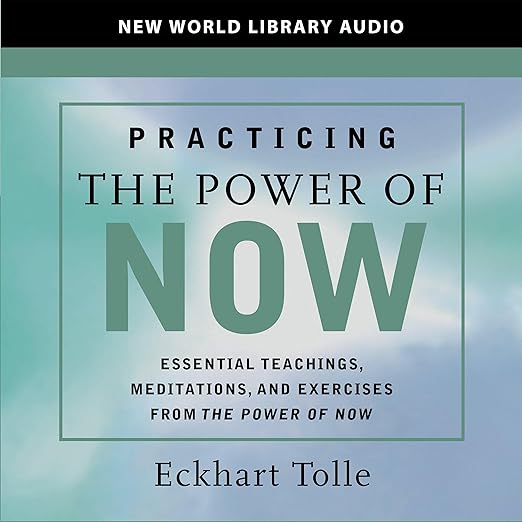
At just under three hours, Practicing the Power of Now is not so much a separate book as it is a curated extraction. Tolle describes it as a practical guide, and that framing is accurate. Where the original explores the philosophical and spiritual architecture of present-moment awareness in depth, this version moves toward the workable: what do you actually do with these ideas, moment to moment?
Our Take on Practicing the Power of Now
The governing idea here is deceptively simple: the present moment is the only place where life actually happens, and most human suffering comes from mental resistance to what is. Tolle builds this case in short, measured passages that read like contemplative prompts rather than arguments. There is no narrative arc to follow, no story structure to carry you forward. The text asks something different of you, a slower, more receptive kind of attention.
One reviewer put it exactly right: "This book seemed to just have the essential lessons of the original, which I liked and understood. It didn't have any of the more complicated and perhaps subjective stuff." That is an honest account of what Tolle has done here. The stranger metaphysical terrain of the original, the passages on pain-bodies, the more elaborate cosmological framing, is largely absent. What remains is the practical core: how to notice the thinking mind, how to step back from identification with thought, and how to return to a state of present-moment awareness that Tolle argues is our natural condition.
Why Listen Rather Than Read
The self-narration is everything here. Tolle's voice is one of the most distinctive in spiritual audio, calm to the point of seeming genuinely unconcerned with time, European-accented in a way that gives each sentence a slight foreignness, as if you are hearing ideas translated from somewhere quieter. There is a pause quality to his delivery that other narrators simply cannot replicate. I have heard versions of Tolle's work read by professional narrators, and they sound like competent readings of unusual ideas. Tolle reading Tolle sounds like the ideas themselves speaking.
One listener described it as "the right book at the right time" during a period of significant life change, noting that "many things were clarified for me." Another called it a better entry point than the full Power of Now for those new to Tolle's thinking. At under three hours, it is also forgiving to re-listen, something the length makes genuinely practical rather than aspirational.
What to Watch For in the Listening Experience
If you are expecting a how-to guide with numbered steps and concrete exercises, this is not that book. The practices Tolle describes are awareness-based, not behavioral, he is not asking you to schedule a meditation practice or keep a journal. He is asking you to notice something that is already happening. That can feel frustratingly abstract on a first listen, particularly if your mind is very busy and impatient with itself. The irony is not lost on Tolle, and he addresses it, but some listeners will still want more structure than this book provides.
It is also worth being clear: this is not a psychological self-help book in the conventional sense. Tolle draws from a range of contemplative and spiritual traditions and his framing is explicitly spiritual, not clinical. If that framing is uncomfortable for you, the ideas may still resonate but the packaging will occasionally grate.
Who Should Listen to Practicing the Power of Now
Those who found the original Power of Now difficult to get through but were drawn to its central ideas will benefit most from this version. It is also a strong recommendation for anyone going through a period of anxiety, transition, or overthinking who wants something short enough to return to regularly. Listeners who want a more structured mindfulness program, something with progressions, assessments, and measurable steps, will want to look at something like Jon Kabat-Zinn's work instead. Long-time Tolle readers who have absorbed the original will find little here that is genuinely new.
Frequently Asked Questions
Do I need to have read or listened to The Power of Now first?
No. In fact, several reviewers recommend starting here precisely because it is more accessible than the original. The core ideas are self-contained, and Tolle does not assume prior familiarity with his work.
Is Tolle's self-narration distracting if you are not familiar with his speaking style?
It can take a few minutes to settle into his cadence, which is slower and more deliberate than most audiobook narrators. Most listeners find that the pacing becomes an asset once they adjust, it models the quality of attention the book is actually trying to cultivate.
How is this different from the full Power of Now audiobook?
This version removes the more abstract metaphysical discussions and the extended question-and-answer dialogues that form much of the original. What remains is the practical guidance, how to work with the thinking mind, how to return to presence, how to use the body as an anchor to the present moment. It is shorter, more focused, and more immediately applicable.
Is this useful for people dealing with anxiety specifically, or is it more broadly pitched?
Multiple reviewers mention using it during periods of anxiety and fear, and one specifically credits it with helping with driving anxiety. The techniques Tolle describes, noticing thoughts without becoming them, returning attention to the present, have clear applications for anxious thinking, though Tolle does not frame the book in clinical or therapeutic terms.