Quick Take
- Narration: Mitch Horowitz is an adept narrator and New Thought scholar whose introductions add genuine context, though the lack of clear chapter markers was a significant structural problem that has since been partially corrected.
- Themes: Mind-power philosophy, prosperity consciousness, the New Thought tradition from 1910 to 1963
- Mood: Expansive and motivational, with a scholarly layer that distinguishes this compilation from standard self-help anthologies
- Verdict: An ambitious fifty-six-hour compilation of foundational New Thought texts, valuable for deep engagement with the tradition, though its structural navigation issues are worth knowing about before you commit.
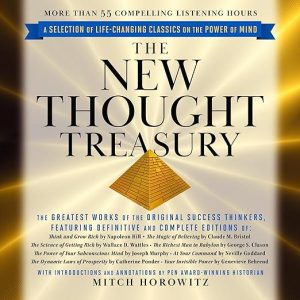
Fifty-six hours is not a short commitment, and I want to address that runtime directly before anything else. The New Thought Treasury collects eight foundational texts of the New Thought movement into a single compilation: Think and Grow Rich, The Magic of Believing, The Science of Getting Rich, The Power of Your Subconscious Mind, The Richest Man in Babylon, At Your Command, The Dynamic Laws of Prosperity, and Your Invisible Power. Each of these has been individually influential; some, like Napoleon Hill’s 1937 Think and Grow Rich and George Clason’s Richest Man in Babylon, are among the most widely circulated personal finance and self-help texts ever written. The question is what a compilation format adds to that already substantial legacy.
Our Take on The New Thought Treasury
Mitch Horowitz is the right person to curate and narrate this collection. He is not simply a voice actor reading texts; he is a recognized scholar of the New Thought movement who has written extensively on its history, its figures, and its continuing cultural relevance. His introductions to each text provide historical context, biographical information about each author, and assessment of why the work has endured. That framing material is one of the compilation’s most distinctive features, because it positions these texts not as interchangeable motivational content but as distinct artifacts of a coherent intellectual tradition. The definitive edition of Think and Grow Rich uses Hill’s complete 1937 text, the edition before subsequent revisions softened some of his more specific claims. Wallace Wattles’ Science of Getting Rich is presented in its full 1910 form with historical context. These editorial decisions suggest genuine curatorial care.
Why Listen to This Compilation Versus Individual Titles
The argument for this compilation over purchasing the texts separately is access to Horowitz’s scholarship alongside the texts themselves. His introductions and supplemental readings, particularly in the Murphy volume where he explicitly updates certain health claims for the twenty-first century, represent an intellectual engagement with the material that a standard audiobook edition of any individual title would not provide. Reviewer C. Grigsby described Horowitz as an adept commentator and master narrator, and that dual role, scholar and voice, is what makes the compilation more than a convenience bundle. For listeners interested in the New Thought tradition as a historical and philosophical phenomenon rather than as pure self-help prescription, the curatorial layer is valuable enough to justify the compilation format.
What to Watch For in the Navigation
The most significant structural problem this compilation faced at launch was the absence of clear markers between books. Reviewer Nick Myers found it nearly impossible to track which book he was listening to, since the 167 chapters were labeled generically without indicating which of the eight texts they belonged to. Reviewer Renee Tarmoom noted the same issue in a three-star review but updated to five stars when markings were added. As of available reviews, the navigation problem appears to have been addressed, but listeners starting a fresh copy should verify that their version includes clear book-title markers before committing to the full runtime. Fifty-six hours of undifferentiated content would be a genuine obstacle to engagement with any of the eight texts.
Who Should Listen to The New Thought Treasury
This compilation is best suited for listeners who want extended, immersive engagement with the New Thought tradition as a whole rather than familiarity with any single title. Someone who has already read Think and Grow Rich and wants to understand how it fits into a broader lineage, or who wants to encounter the Murphy and Goddard texts alongside Hill and Clason, will find the compilation format genuinely useful. Listeners approaching any of these texts for the first time as pure productivity or motivation resources may find the more academic framing slightly at odds with their goals. Those who need physical copies to annotate and act on the material, as reviewer Nick Myers noted, may find the audiobook format less practical for these highly actionable texts than they might hope.
Frequently Asked Questions
Has the navigation problem with unclear chapter markers been fixed in the current version?
Based on available reviews, the markers indicating where each of the eight books begins have been added since initial publication. Reviewer Renee Tarmoom updated her review to five stars after the fix. Listeners should verify their downloaded version includes clear book transitions before beginning.
What does Mitch Horowitz’s introductions add that you would not get from individual editions of these books?
Horowitz provides historical context for each author, situates their work within the broader New Thought movement, and in some cases, particularly with Murphy’s Power of Your Subconscious Mind, adds supplemental readings that update certain claims for contemporary listeners. His framing treats the texts as a coherent intellectual tradition rather than interchangeable self-help content.
Is Think and Grow Rich presented in its original 1937 text, or is it a later revised edition?
The compilation uses Hill’s complete 1937 text, which predates later revisions. Horowitz’s introductory material contextualizes the historical background of both Hill and his methods, so listeners get the original alongside scholarly framing.
At fifty-six hours, is this realistically listenable, or is it primarily a reference collection?
Both uses are valid. Listeners who engage with it as a reference, returning to specific texts or chapters rather than listening sequentially, will find the navigation markers essential. Sequential listeners who want to absorb the full tradition over an extended period will find it rewarding but should approach it as a months-long project rather than a conventional audiobook experience.