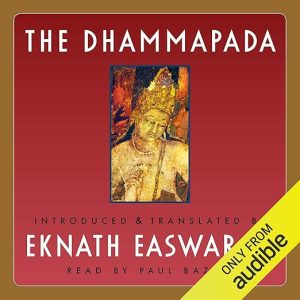
Key Details
- Read by: Paul Bazely reads Easwaran's translation and introduction with a measured contemplative quality that honors the text's meditative nature without making it feel remote or academic.
- At its heart: the path of dharma, the mind as source of suffering and liberation, practical ethics over metaphysical speculation
- Vibe: Still and illuminating, best heard in short sustained sessions
- Short version: Eknath Easwaran's best-selling translation of The Dhammapada is a landmark edition, and Paul Bazely's narration makes this four-hour audiobook one of the most accessible introductions to core Buddhist thought available.
Eknath Easwaran's translation of The Dhammapada has been the best-selling English translation in the United States for decades, and the question worth asking about this audiobook is why. There are other translations. Some are more scholarly. Some are more poetically ambitious. Easwaran's enduring readership, which the 4.8 rating from reviewers confirms but hardly encompasses, comes from something specific: he translates the text not as a document requiring specialist interpretation but as a living guide addressed directly to the reader. Paul Bazely's narration extends that directness into audio, and the result is four hours and twenty-two minutes of Buddhist scripture that functions, as the Buddha apparently intended, as a practical instruction rather than a philosophical puzzle.
The Dhammapada itself, meaning the path of dharma, is among the oldest and most widely circulated texts in the Buddhist canon. It is a collection of 423 verses gathered from the Buddha's direct disciples, who preserved what they had heard and wanted to transmit. The verses are vivid, aphoristic, and deliberately practical. They address how the mind works, how suffering arises, and what choices a human being can make to move toward liberation rather than away from it. The Buddha, as Easwaran's introduction establishes clearly, rejected both superstition and philosophical speculation. He was interested in what demonstrably reduces suffering and increases joy. The Dhammapada is his practical syllabus.
How The Dhammapada Holds Up
What distinguishes Easwaran's edition from others available in audio is the introduction, which the reviewer JAF calls excellent and not to be skipped. Easwaran brings the story of the young Prince Siddhartha and his spiritual quest to life with a narrative vividness that serves as both historical context and emotional preparation for the verses that follow. The Siddhartha who emerges in Easwaran's telling is not a mythological figure but a historically situated human being whose specific circumstances shaped specific insights, and understanding those circumstances makes the verses land differently than they do when read as floating aphorisms.
The practical orientation of Easwaran's commentary is also what makes this edition work as a recurring reference rather than a one-time listen. Reviewer Sly notes that few people comment on this text compared to contemporary bestsellers, and reads that relative silence as a kind of cultural embarrassment about serious spiritual study in favor of entertainment. Whether or not that analysis is right, the observation points to something real about The Dhammapada's intended function: it is not a book you consume and move past. It is a book you return to. The verses are short enough and dense enough with implication that repeated encounters with the same passage across months or years produce different resonances.
Paul Bazely brings the right qualities to this narration. His delivery is measured and unhurried, matching the contemplative register that Easwaran's prose establishes. He does not dramatize the scripture in ways that would feel inappropriate to the material, but neither does he deliver it as dry recitation. There is genuine care in how he paces the verse sections, allowing individual lines room before moving on, which is the appropriate approach for text designed to be meditated upon rather than absorbed at speed.
Why The Dhammapada Works as an Audiobook
This audiobook represents a complete narration of Easwaran's introduction and translation, with one noted absence: the short chapter introductions by other writers that appear in the print edition are omitted here. That omission is noted by the publisher and is worth knowing before you purchase, particularly if you are familiar with the print edition and value those supplementary introductions. The core text, Easwaran's introduction and his translation of the verses, is fully represented.
The four-hour-twenty-two-minute runtime positions this as a listen that can be completed in a single attentive session, though its subject matter suggests against it. The Dhammapada rewards the kind of listening that pauses, replays, and returns. An audiobook app that allows easy bookmarking and replay is the ideal environment for this text. Forcing it through in one sitting is possible but works against what the text is asking of its reader.
Weak Spots in The Dhammapada
Easwaran's interpretation comes from a specific lineage and perspective. He was an Indian professor and spiritual teacher who founded the Blue Mountain Center of Meditation, and his framing of Buddhist teaching is inflected by both his scholarly background and his own practice. Some readers with more sectarian Buddhist commitments, or those who prefer translations that maintain strict scholarly distance from interpretive commentary, will find his accessible framing too syncretic or too personalized.
For the general listener approaching Buddhist scripture without prior sectarian commitments, this is almost certainly a feature rather than a limitation. Easwaran is an expert guide whose introduction genuinely illuminates what follows. The single reviewer who found the introduction excellent and urged not skipping it is giving sound advice for listeners tempted to fast-forward to the verses. The framing Easwaran provides changes what the verses sound like, in the best possible way.
The Right Listener for The Dhammapada
Listeners approaching Buddhist philosophy for the first time will find no better audiobook introduction. Easwaran's prose is reliable, penetrating, and accessible, as the synopsis promises, and Bazely's narration makes those qualities audible rather than merely describable. Those already familiar with Buddhist practice who have not encountered this specific translation will likely find Easwaran's practical framing refreshing whether or not they share all of his interpretive positions.
The four-plus-hour runtime and the nature of the text make this a poor choice for background listening. This audiobook requires presence, the same presence the Buddha was teaching his disciples to cultivate when the original verses were gathered. For listeners prepared to bring that quality of attention, The Dhammapada in Easwaran's translation, as voiced by Paul Bazely, offers something genuinely rare: ancient wisdom rendered with contemporary clarity and without condescension.
A Few Questions About The Dhammapada
Does this audiobook include the complete text of The Dhammapada?
It includes the complete narration of Easwaran's introduction and his translation of all 423 verses. What is omitted are the short chapter introductions written by other contributors that appear in the print edition. The core text is fully represented.
Is this audiobook appropriate for someone with no background in Buddhism?
Yes, and it is arguably one of the best starting points available. Easwaran's introduction provides the historical and philosophical context needed to make the verses meaningful without requiring prior knowledge. The Buddha's practical, non-metaphysical approach, as Easwaran frames it, makes the text accessible to anyone interested in ethics and the nature of mind.
How should you structure listening sessions for this audiobook given the meditative nature of the text?
In short, intentional sessions rather than continuous playback. The verses are designed to be meditated upon, not absorbed at speed, and the four-hour runtime works best spread across multiple focused listens. An app that allows easy bookmarking and chapter replay will serve the material better than a one-time front-to-back session.