Quick Take
- Narration: Elsa Levytsky reads with quiet authority, matching the book’s contemplative, channeled-wisdom register without tipping into preachy or dramatic.
- Themes: Oneness and divine consciousness, manifestation and inner voice, metaphysical self-discovery
- Mood: Still, introspective, intentionally slowed down
- Verdict: A short but sincere entry in the metaphysical spirituality genre, best approached with genuine openness rather than skeptical curiosity.
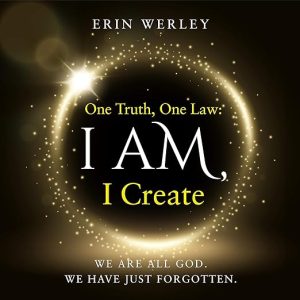
I listened to this one on a quiet Sunday morning, which turned out to be the right context for it. At two hours and twenty-three minutes, One Truth, One Law: I Am, I Create by Erin Werley is the kind of audiobook that does not demand much time but does demand a particular kind of attention. It is not background listening. Werley’s framework, built around what she describes as channeled deposits from an inner voice she calls I Am, requires the listener to slow down and sit with its ideas rather than process them as information to absorb and move past.
The book’s central claim is ambitious: that the universe operates according to a single governing truth, and that once you understand and internalize that truth, the experience of feeling lost dissolves. Werley frames this as something she received rather than constructed, which will either resonate or raise immediate skepticism depending on where you land on questions of channeled spiritual content. It is worth knowing upfront that this is not a philosophy text in the academic sense, and it is not trying to be one. The framework is metaphysical, the register is personal, and the intended audience is someone open to that territory.
Our Take on One Truth, One Law
What separates this from a lot of material in the metaphysical spirituality space is the genuine simplicity Werley commits to. Several readers who had already worked through a significant volume of books on oneness and universal consciousness found themselves unexpectedly moved by how uncluttered the presentation is. One reviewer who described themselves as well beyond beginner territory wrote that the book brought tears to their eyes precisely because of its clarity. That is not a reaction you see often in this genre, where complexity is frequently mistaken for depth. Werley’s willingness to strip things down to their simplest statement turns out to be a genuine editorial choice, not a limitation.
Why Listen to One Truth, One Law
Elsa Levytsky’s narration suits the material well. She reads with a measured, unhurried quality that reinforces the book’s contemplative intent rather than working against it. There is no performance here, which is the right call for a text that positions itself as transmission rather than argument. For listeners new to metaphysical spirituality content, the pacing gives ideas room to land. For those who already navigate this territory comfortably, the narration will feel appropriately restrained. The runtime is short enough that a second listen, which several reviewers described doing, is not a significant investment.
What to Watch For in One Truth, One Law
The brevity is both a strength and a limitation. At under two and a half hours, Werley establishes her framework and points toward practice without fully developing either. The book’s stated goal is to teach you to access your own inner voice rather than remain dependent on hers, which is genuinely different from how many spiritual titles position themselves. But the tools for actually cultivating that access are gestured at rather than systematically laid out. If you are looking for a structured practice guide with exercises and techniques, this is not that book. It is closer to a concentrated argument for a way of being than a manual for getting there.
Who Should Listen to One Truth, One Law
This audiobook works best for listeners already oriented toward metaphysical or New Thought spirituality who want a short, cleanly articulated statement of the oneness framework. It also functions well as a re-entry point for people who have drifted away from a spiritual practice and want something brief and focused to re-engage with the underlying ideas. Listeners who approach this genre with significant skepticism, or who need rigorous philosophical grounding before engaging with metaphysical claims, will likely find the book’s channeled framing a barrier rather than a bridge. The five-star review pattern is real but reflects a specific audience arriving at the text with aligned expectations. For what it sets out to do, the book delivers with unusual focus and without overpromising.
Frequently Asked Questions
What does Werley mean when she refers to the inner voice called I Am?
In the book, I Am refers to the universal divine consciousness or source that Werley describes as accessible to everyone, not uniquely through her. She frames it as the voice of one’s higher self or God-consciousness, positioned as something every listener can cultivate rather than a proprietary channel.
Is this audiobook appropriate for listeners with no background in spirituality or metaphysics?
Yes, and arguably that is one of its strengths. Several reviewers noted the book’s clarity and simplicity as assets for newcomers. The concepts are introduced without assuming prior familiarity with New Thought or Hermetic frameworks.
At under two and a half hours, does One Truth, One Law feel complete or like an excerpt?
It feels complete as a statement of core ideas but thin on extended practice guidance. Werley covers her framework thoroughly within that runtime but does not develop the practical applications in depth. Think of it as a concentrated introduction rather than a comprehensive system.
How does this compare to other books on manifestation and universal consciousness?
Reviewers who had read widely in the genre consistently described One Truth, One Law as among the clearest and most accessible. It shares conceptual territory with Neville Goddard and earlier New Thought writers but strips away the more elaborate mystical layering those traditions often carry.