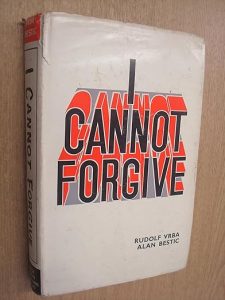
Seventeen hours and ten minutes is what this audiobook asks, and the subject earns the ask. Rudolf Vrba worked as a registrar inside Auschwitz, a position that placed him within the camp's own record-keeping, and he escaped. That is essentially all the listing's description tells you, in a single sentence of a hundred and thirty-seven characters that manages to misplace an apostrophe in the author's own name. The book behind that sentence is one of the primary documents of the twentieth century. The record wrapped around it on this page belongs to a different edition entirely.
Escaping Was Only Half the Point
Vrba's account is not a survival memoir in the shape the genre later settled into. It is an escape narrative followed by an act of testimony, and the second half is what makes it structurally unusual: the point of getting out was to be believed. A March 2018 response fits the two halves together in a single line, calling it an excellent, true, well written account of the horror of the concentration camps and the experience of capture, then adding, almost as an afterthought, his escape and what he bravely does afterwards. That afterthought is the book.
What seventeen hours buys is granularity. A short testimony can establish that something happened; a long one can show how it was organized, who administered it, what the paperwork looked like, and how a person working inside the machinery pieced together what the machinery was for. Length here is not padding, and it is not indulgence either. It is the difference between knowing a fact and understanding a system, and it is the reason the book still reads as evidence rather than as recollection.
Across Seventeen Hours, Restraint Beats Rhetorical Heightening
A five-star response from November 2015 makes a claim I would ordinarily hesitate to repeat, and I repeat it: of all the books written about the Holocaust, this is one of the best, if not the best. What follows in that response is more interesting than the superlative. It observes that English was not Vrba's first language, credits him with acquitting himself admirably through sharp perception and description of the unbelievable, and singles out his decision to quote Churchill verbatim instead of paraphrasing.
Language is worth pausing on, because it changes how the prose lands in audio. A writer working in an acquired language tends toward exactness over lyricism, and exactness is exactly the right register for this material. Sentences do not reach for effect. They report. Across seventeen hours that restraint accumulates into something much harder to shake off than rhetorical heightening would ever manage, and it also makes the book unexpectedly listenable, because you are never being asked to admire the writing while you absorb what it describes.
Even the Reviewer Doubts the Adventure Framing
That same November response registers a reservation worth carrying with you, saying it is unsure the title is the right way to approach a subject of this kind, and quoting Vrba's own line about armchair critics who write from a position they never occupied. Both remarks belong in any serious assessment. The title sells an adventure; the book delivers an indictment, and the distance between those two things explains why readers arrive expecting one and finish having read the other.
Wrong Name, Wrong Story, Real Feeling
Among the five responses gathered here, one functions as a caution all by itself. Awarding five stars in February 2015, it calls this the master of all books, then gives the author's name as Allen Verba, describes him and a friend as the first people to notify the authorities in the United States, and credits that act with the liberation that followed. The feeling behind it is real. The name on the cover is Rudolf Vrba, and the account of what happened afterward compresses a great deal into one sentence. Read this pool as a measure of impact and not as a source of facts.
Nineteen sixty-three sits in the release-date field, Sidgwick and Jackson sits in the publisher field, and the page count reads two hundred and seventy-eight, three values that together describe a hardback published more than sixty years ago, not a recording running seventeen hours. The narrator slot compounds it: what sits there reads Rudolf and Bestic, which is not a reader at all but the two writers, and it quietly confirms a collaborator the byline leaves off completely. This listing therefore credits nobody with the reading, files an author under narrator, and buries a co-author in the process.
Filed under history and, simultaneously, under religion and spirituality, with a single tag reading Religious. That classification is wrong, and not harmlessly so. Nothing in the description positions this as a devotional or theological work; it is a first-hand account of an extermination camp and of one escape from it. A listener browsing a spirituality shelf gets ambushed, and a listener searching history may never surface it. Genre fields are how people find books, and this one has been sorted in a way that serves no reader well.
Undivided Attention Across Several Long Sittings
Anyone who has read around the Holocaust and wants the administration rather than only the suffering should make time for this. A four-star response from February 2015 describes it as the painful reality of the author's personal experiences as a prisoner in a wartime concentration camp, and as a strong reminder to respect life and to appreciate freedom, which is a fair summary of what a general reader carries away from it. Students, teachers, and anyone assembling a serious reading list on the period will find it foundational, never supplementary.
Listeners who need a caution deserve a plain one: the material is unrelenting, the runtime is long, and with no reader credited anywhere on the page you cannot audition a voice before committing to it. Nobody should treat this as background listening, and nobody should hand it to a young reader without preparation first. Those willing to give it undivided attention across several sittings will find that seventeen hours stops feeling like an imposition somewhere in the first one.
At a Glance
- Themes: testimony as resistance, the bureaucracy of an extermination camp, escape and what follows it
- Mood: Unrelenting, exact, quietly furious
- Verdict: A foundational Holocaust document that repays undivided attention, on a listing that credits nobody with reading it.
Questions Listeners Ask
Who reads the I Escaped from Auschwitz audiobook?
Nobody is credited. What sits in the narrator slot names the book's two writers in place of a performer, so the page identifies no reader for a seventeen hour recording. Anyone who chooses audio by voice will have to sample first, because the page offers nothing at all to go on.
How young was Vrba when he made the escape?
A five-star response from June 2015 puts him at nineteen, and describes him keeping his wits about him through the ordeal before setting out to tell the world what he believed was being kept from it. The listing's own description gives no age, so that figure belongs to a reader, not to the publisher.
Is this a sensible first audiobook on the Holocaust, or should other reading come first?
It works either way, though it lands harder with context. Vrba writes from inside the camp's administration and assumes you can follow names, dates, and procedures without hand-holding. A general history first will make the seventeen hours more legible, but the account is clear enough to stand alone if you are patient.