Quick Take
- Narration: Michael Loblein delivers a crisp, controlled performance suited to special operations content, authoritative without the excessive intensity that undermines some military narration.
- Themes: Special operations culture and training, the ROK-US alliance, the Korean Peninsula’s ongoing security posture
- Mood: Compressed and factual, structured as a briefing rather than a narrative
- Verdict: A tight two-hour introduction to one of the world’s lesser-known elite military units, informative for listeners curious about South Korean special forces, honest about what its series format can achieve.
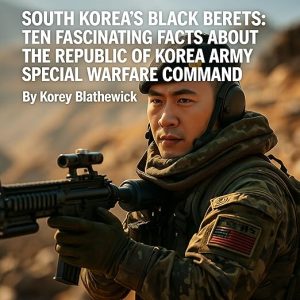
There is a genre of military writing that operates like a well-produced briefing: compact, specific, organized around revealing what a general audience does not know about a unit that specialists take for granted. South Korea’s Black Berets belongs to this genre. At under two hours, it is not attempting the kind of immersive narrative that works for longer military histories; it is offering ten focused facts about the Republic of Korea Army Special Warfare Command, organized to correct the most common gaps in Western understanding of South Korean military capability.
I have listened to enough Pacific War and Korean War history to recognize how thoroughly the ROK military is underrepresented in English-language audio. The Korean War itself tends to be covered as an American story with Korean geography; South Korean military development post-armistice rarely surfaces in books aimed at general Western audiences. The Black Berets is a direct response to that absence, and the ten-fact structure serves the goal well within its constraints.
The Security Context That Shaped the Force
The framing that opens this book is its most useful contribution. The Korean War never formally ended; the 1953 Armistice is a ceasefire, not a peace treaty, and the ROK military has been developing in explicit response to an enemy across the DMZ that maintains one of the world’s largest active militaries with genuinely different operational doctrines and capabilities. This context is often missing from Western assessments of South Korean military capability, which tend to emphasize the US-ROK alliance rather than the specific pressures that have shaped South Korean special operations development over seven decades.
The Black Berets’ training philosophy, the shirtless drills in sub-zero temperatures, the HALO parachute and SCUBA qualification requirements, the endurance standards that explicitly define themselves against North Korean unconventional warfare capability, makes considerably more sense when understood as a response to a specific threat environment rather than as generic elite military culture. Blathewick puts this context first, which is the right structural choice for an audience that may not have the background to supply it themselves.
The 707th Special Mission Group
The treatment of the 707th Special Mission Group, the White Tigers, South Korea’s counterterrorism and hostage rescue unit, is the book’s most substantive section and the one most likely to give listeners something they could not have easily found elsewhere in English-language sources. The 707th is typically compared to Delta Force or the SAS in accounts that reach English-language audiences, but the comparison flattens what makes it specifically South Korean: the threat environment, the operational constraints imposed by geography and the armistice framework, and the integration with combined US-ROK structures that shapes bilateral military relations in ways other partnerships do not replicate.
The unit’s lineage from Korean War guerrilla operations is traced efficiently, and the connection between Cold War unconventional warfare on the peninsula and the modern special operations capability is made legible for listeners without prior exposure to ROK military history. The motto Make the Impossible Possible is examined as an operational philosophy rather than a slogan, with specific training requirements shown to embody it rather than merely claim it.
Michael Loblein and the Briefing Register
Michael Loblein’s narration is a good match for this format. The briefing register, clear, specific, controlled, suits a narrator who brings authority without theatrics. Over a two-hour runtime, the consistency is more asset than limitation, and Loblein handles the Korean proper names with appropriate care. The 5.0 rating from forty-one reviews is worth noting: this is a series format with a genuinely engaged audience that comes to it knowing what it offers, and the consistent ratings across that base suggest that Blathewick’s research and Loblein’s delivery are meeting those expectations reliably. It is a better production than the slim runtime might suggest.
What This Book Cannot Do
A two-hour introduction structured around ten facts cannot provide operational narrative, personal memoir, or the institutional analysis that a full-length military history would offer. Listeners looking for the ROK-SWC equivalent of a detailed unit history will need to look beyond this series. What this book does do is establish the conceptual architecture, the training philosophy, the operational mission set, the institutional lineage, the alliance dynamics, that would allow a more detailed source to be understood in context. As a starting point for listeners genuinely curious about South Korean military capability and the specific pressures that have shaped one of Asia’s most capable special operations forces, it earns its runtime efficiently. The books that belong to this series are not trying to compete with unit histories or campaign narratives; they are establishing a baseline for listeners who have none and correcting the specific Western blind spot that treats Pacific security as synonymous with American Pacific security. On that specific task, South Korea’s Black Berets delivers, and Loblein’s narration makes the delivery clean and efficient.
Frequently Asked Questions
Is this book part of a series, and do I need to read the other entries first?
Yes, this is part of the Silent Warriors: Inside the World’s Elite Special Forces series. Each entry covers a different special operations unit and functions as a standalone briefing. There is no dependency between volumes, you can start with the Black Berets without having read other entries in the series.
Does the book cover recent South Korean special forces operations, or only training and structure?
The book focuses primarily on history, training culture, and organizational structure rather than specific recent operations, most of which remain classified. The operational mission set, counterterrorism, hostage rescue, and behind-lines reconnaissance, is described in general terms consistent with what is publicly known.
How does the ROK-SWC compare to other special forces units covered in this series?
The series is designed for comparison across entries, so listeners who read multiple volumes will develop a sense of how the Black Berets’ training standards and mission set relate to units like the SAS or Delta Force. Each entry emphasizes what is distinctive about its force rather than ranking them against one another.
Is there substantial coverage of the Korean War itself, or does the book focus on the post-armistice period?
The Korean War is covered as the origin point of the ROK-SWC’s lineage, the guerrilla warfare lessons of 1950-53 that shaped the unit’s early development. The bulk of the content covers the Cold War and contemporary period, particularly the development of special operations capability in response to North Korean unconventional warfare doctrine.