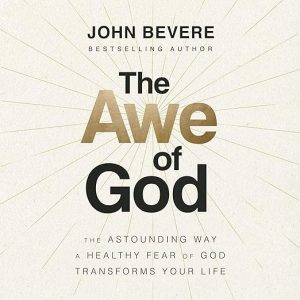
- Read by: John Bevere reading his own audiobook gives it an authority that third-party narration rarely matches, his conviction in the material is not performed, it is present.
- At its heart: Holy fear as foundation rather than obstacle, spiritual maturity through intentional devotion, the gap between cultural Christianity and genuine transformation
- Vibe: Convicting and steady, with real pastoral warmth underneath
- Short version: Bevere's self-narrated audiobook makes a serious and unfashionable argument for recovering a forgotten virtue, and it earns its 7-plus hours through specificity and sincerity.
John Bevere begins from a distinction that most contemporary Christian publishing has largely abandoned: the difference between being afraid of God and fearing God. The Awe of God audiobook is his attempt to recover that distinction and show why it matters for anyone who wants a faith that actually functions, not just intellectually but practically, through the ordinary pressures of daily life and the harder pressures of crisis. This is not a comfortable book in the sense of affirming what the reader already believes. It is an uncomfortable book in the sense of identifying something missing and refusing to pretend that the absence is acceptable. Bevere's argument is that the fear of the Lord is not a relic of Old Testament severity, but the foundation on which genuine spiritual life is built, and that its absence from contemporary Christian culture explains a great deal about why so many believers find their faith insufficient when it is most needed.
Bevere narrates his own work, and the effect is significant. His voice carries the particular quality of a person speaking from experience rather than theory, not smooth or professionally distant, but present in the material in a way that sustained reading aloud requires something genuine to sustain. At 7 hours and 28 minutes, the audiobook is long enough that performance alone could not carry it. Conviction does.
Why The Awe of God Works as an Audiobook
The book's structural argument is that holy fear, the fear of the Lord described throughout Scripture, functions as the foundation for wisdom, direction, spiritual maturity, and freedom from lesser fears. This is not a novel theological claim; it has a long tradition in Christian writing, from Proverbs through the Desert Fathers to Jonathan Edwards. What Bevere contributes is a contemporary application and a pastoral honesty about why the concept has been systematically avoided. He is writing for Christians who have grown up in churches where this concept has been de-emphasized in favor of an emphasis on God's love and accessibility, and his argument is that this emphasis, while not wrong in itself, produces a truncated faith that cannot sustain the weight of difficult times.
The book is designed to be engaged with slowly. Each of its 42 chapters ends with five tools: reflection questions, scriptural references, and practical exercises meant to anchor what the chapter has presented. As an audiobook, this structure creates natural pause points, moments where the listener can stop, reflect, and apply before continuing. Bevere acknowledges this explicitly. The devotional format works with the audio medium rather than against it, and one reviewer described using it for daily devotion over an extended period, which is almost certainly the most effective way to engage with the material. The reviewer who described it as required reading for anyone in leadership was responding to the book's argument that leaders without healthy fear of accountability cannot function with genuine integrity.
The sincerity that multiple reviewers noted is not incidental. Bevere shares personal experiences alongside biblical argument, and the combination produces a credibility that purely theoretical treatments of the subject do not have. He has lived with these ideas and teaches from inside them, and self-narration makes that quality immediately audible.
It is also worth noting that the book's 4.8 rating across all five available reviews is consistent, every reviewer who engaged with the material found it valuable, even those who came to it as a gift recipient rather than a personal choice. The reviewer whose husband received it as a birthday gift and found it genuinely eye-opening and encouraging is a useful data point: the book reaches people who are not already searching for this particular argument. That accessibility, despite the subject matter's unfashionability, speaks to Bevere's skill as a communicator and to the fact that self-narration here is not vanity but craft, he knows how to deliver these ideas from a position of invitation rather than accusation.
Weak Spots in The Awe of God
This audiobook assumes a Christian framework. Bevere is not making the case that the fear of the Lord is relevant to non-Christians, he is speaking directly to people who already identify as followers of Jesus and asking whether their practice reflects the full biblical portrait of God. Listeners outside that framework will find the book's language and assumptions require significant translation to engage with productively. It is not written for the curious outsider; it is written for the inside believer who suspects something is missing.
The 42-chapter structure means the book builds cumulatively rather than presenting its full argument upfront. Some listeners will find the early chapters establish a foundation that pays off in the later material. Others may find the pacing deliberate. Bevere is not in a hurry, and the audiobook benefits from that patience. This is not a book to consume in a single long session and put aside, it is one to return to, and the chapter-by-chapter reflection tools are designed precisely for that incremental engagement.
The Right Listener for The Awe of God
The Awe of God audiobook is for Christians who feel that something is missing in their spiritual life and are willing to consider that the missing thing might be something their church tradition has actively moved away from. It is for people who want a faith that holds up under sustained pressure rather than one that functions only in favorable conditions. The self-narration by Bevere is a genuine asset, this is not a book that benefits from third-party performance. Those who are not Christian or who have no existing theological framework will find the material requires considerable translation. The audiobook is most effective listened to incrementally over weeks, pausing at each chapter's end to engage with the reflection tools Bevere provides.
Common Questions
Is The Awe of God audiobook suitable for someone new to Christianity?
Bevere writes for people who already identify as Christians and are looking to deepen their practice. He assumes familiarity with biblical texts and Christian vocabulary. Someone new to Christianity would likely find the book's devotional chapters more accessible after establishing some foundational context through other resources first.
How does John Bevere's self-narration affect the audiobook experience?
Significantly, and positively for listeners in the target audience. Bevere's narration carries the material with personal conviction that a third-party narrator could not replicate. The result is closer to hearing a pastor teach than to hearing a book performed. For devotional content specifically, this kind of directness works very well.
How long is The Awe of God audiobook and how should listeners pace themselves through it?
The audiobook runs 7 hours and 28 minutes across 42 chapters. Bevere himself suggests the material is designed to be engaged with slowly and intentionally. One chapter per day or per session, with time to engage with the five tools at each chapter's end, is likely the most productive approach rather than listening straight through.