
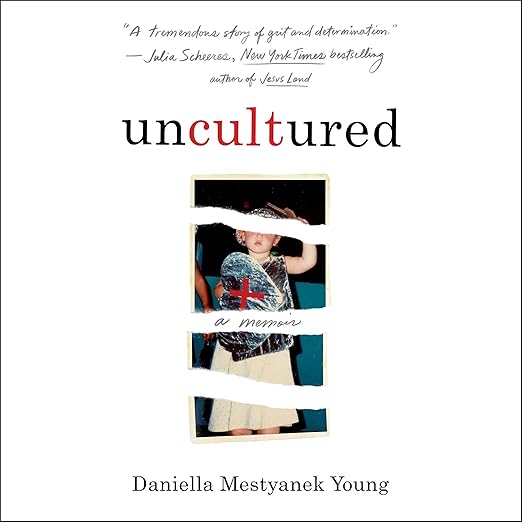
Daniella Mestyanek Young grew up behind the gates of a religious commune in Brazil, the daughter of high-ranking members of The Children of God, also known as The Family, a cult whose first American commune her own great-grandmother donated the land for. This audiobook runs just under fourteen hours and is narrated by Young herself, her first time ever narrating an audiobook.
Her mother was forced to marry the cult's leader at thirteen and served for years as his secretary. Daniella suffered physical, emotional, and sexual abuse inside the commune, disguised as godly discipline, and was denied any traditional education, until she escaped to Texas at fifteen, enrolled herself in high school, and graduated valedictorian of her college class before joining the military as an intelligence officer.
Military Culture Rhymes With the Cult Itself
What makes Uncultured land as hard as it does is the second half of the structure, not just the escape from the cult but what came after. Young discovers in Afghanistan, surrounded by men on a deployment meant to be her fresh start, that military culture shares uncomfortable structural similarities with the group mentality she spent her adolescence clawing free of. That parallel is the book's real argument, not a twist ending but a sustained, uncomfortable observation about how institutions built around hierarchy and loyalty can rhyme with each other in ways their members rarely want to admit.
Library Journal's quote, embedded directly in the synopsis, makes a specific case for the audio edition: listeners will appreciate hearing this deeply personal story told by the author herself, explicitly noting this is Young's first time narrating anything. The New York Times' Ernesto Londono calls it a dark story that forced him to think more expansively about what constitutes a cult, and a second Times review describes it as painful and propulsive, delivered, in their words, in the honest tones of a woman who didn't always think she'd live to tell her story.
It's worth naming the production pedigree too: this is a Macmillan Audio production from St. Martin's Press, a major publisher's full backing rather than a self-published or independently produced memoir, which matters practically for a first-time narrator specifically. That level of production support suggests real editorial and technical guidance went into helping Young's inexperience as a narrator not become a liability across the audiobook's full runtime.
First-Time Narrators Are a Genuine Gamble
First-time narrators reading their own memoirs are a genuine gamble in general, since professional narration is a distinct skill from having lived the story being told, but trauma memoir specifically is where that gamble pays off most often. Reviewer Rachel Rueckert describes the book cracking her heart open in one of the most beautiful and healing ways, and calls Young a survivor in every sense of that word, language that suggests the audiobook's authenticity, not its polish, is what actually lands.
Reviewer ohiocat's response captures something similar from a different angle: they came specifically to flag, without fully reviewing yet, that anyone with any personal connection to cult experience or interest in the subject should seek this book out directly, a recommendation strong enough that they promised a fuller writeup elsewhere later. That kind of immediate, almost urgent endorsement is a meaningful signal in itself.
A Second Insular Institution, After the First
The book invites direct comparison to Tara Westover's Educated and Deborah Feldman's Unorthodox, both cited explicitly in the synopsis, and the comparison holds up: all three trace a woman's escape from an insular, controlling community into an entirely unfamiliar mainstream world, then reckon honestly with what that transition costs even after the escape succeeds. Uncultured's specific addition to that lineage is the military chapter, a second insular institution encountered almost immediately after the first.
At just under fourteen hours, the book has real room to develop both halves of its structure fully, the childhood inside the commune and the adult reckoning with military culture, without either section feeling compressed to make space for the other. That balance matters, since a shorter treatment might have leaned entirely into the more sensational cult material and shortchanged the arguably more original argument about institutional parallels that follows it.
The synopsis situates the book explicitly 'in the vein of' Educated and The Glass Castle, and that framing is doing real marketing work, but it holds up on the substance too: like Jeannette Walls before her, Young writes about extreme circumstances without asking for pity, favoring clear-eyed documentation over melodrama even when the material would easily support a more sensationalized treatment.
The Title Itself Is a Reclaimed Insult
Reviewer Beverly Diehl offers the most direct content warning among the three reviews: this book is, in her words, a lot, and recommends listeners with their own personal history of escaping a cult be in a good emotional place, ideally with support available, before starting. That is sound advice for anyone approaching nearly fourteen hours of detailed abuse, control, and institutional betrayal, regardless of personal history.
Diehl's review also adds an important piece of context: both Daniella and her mother were born into The Children of God, meaning the abuse documented here spans at least two generations within the same family before Daniella herself finally broke the cycle. That generational depth is part of what separates this from a single-person escape narrative into something closer to a family history of institutional harm.
It's worth noting the book's title itself, Uncultured, functions as a double meaning worth sitting with: both a description of the isolation The Family imposed on her, cut off from mainstream culture entirely, and a wry reclamation of an insult once used against her for not fitting the group's own rigid internal culture.
Veterans May Find This Parallel Uncomfortable
This lands hardest for fans of Educated and Unorthodox specifically, and more broadly for anyone drawn to memoir about high-control groups, institutional power, and the long process of rebuilding an identity from scratch after leaving one. Military listeners and veterans may find the second half's parallel between cult dynamics and service culture particularly striking, even uncomfortable, in ways civilian listeners might not immediately register.
Skip it, or at least wait for a steadier moment, if you are currently processing your own experience with a controlling group or relationship and are not yet ready to sit with someone else's parallel story. For everyone else, especially listeners who have found Westover's or Feldman's memoirs genuinely important, Young's own voice telling her own story, unpolished by design, is the strongest possible version of this book available.
Key Details
- Narration: Daniella Mestyanek Young narrates her own memoir for the first time, and the authenticity of hearing her own voice outweighs any rough edges her inexperience might carry.
- Themes: cult survival, institutional parallels, rebuilding identity
- Mood: Raw, urgent, and unflinching
- Verdict: A powerful, self-narrated memoir that belongs alongside Educated and Unorthodox for anyone drawn to high-control-group survival stories.







