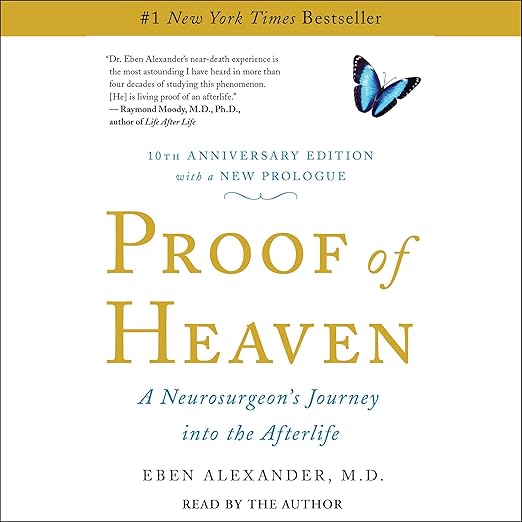
Few audiobooks create the kind of cognitive dissonance that Proof of Heaven does. I started listening on a gray November afternoon, half-skeptical, fully aware of the controversies surrounding Eben Alexander's account, and found myself caught in something genuinely unsettling: not the supernatural elements, which are as extraordinary as advertised, but the quality of the writing itself. Alexander narrates his own story, which is the correct choice for material this intimate, and the audiobook format forces you to sit inside his account in a way that reading the page version does not.
The setup is by now well-known. Alexander was a neurosurgeon and Harvard Medical School faculty member who considered near-death experiences to be neurological artifacts, the brain's last-ditch response to crisis. Then his own brain was attacked by E. coli meningitis so severe that the cortex, the seat of thought, emotion, and language, shut down entirely. He spent seven days in a coma. His doctors were preparing to stop treatment when he returned.
Precision From a Physician Who Doesn't Perform Wonder
What Alexander experienced during those seven days is the center of this audiobook, and he describes it with unexpected specificity: an angelic being who guided him through layered realms of light, a divine intelligence at the core of existence, sensations of unconditional love that he insists cannot be reduced to brain chemistry because the part of his brain producing such experiences was, by clinical measurement, not functioning.
The self-narration works here in ways it wouldn't for most books. Alexander's voice carries the gravity of someone who spent years as a scientist before his cosmology was upended, and that credibility gap, the distance between who he was and who he became, is the book's real subject. He doesn't perform wonder; he reports it with a physician's precision, which makes the material land differently than it would from a professional narrator trying to convey spiritual experience from the outside.
Astounding If True, and Alexander Knows It
The book succeeds most completely as a study in epistemic crisis. Alexander isn't asking readers to take his account on faith alone; he's presenting it as evidence, and he's acutely aware of how that claim sounds to his former neuroscience colleagues. The audiobook has an unusual intimacy precisely because you can hear him working through this tension in real time. His pauses, his careful qualifications, his moments of near-wonder, all land differently in audio than on the page.
For listeners interested in consciousness studies, the questions this book raises are genuinely interesting regardless of where you land on its conclusions. The relationship between brain activity and subjective experience is among the hardest problems in philosophy and neuroscience, and Alexander's account is unusual in that it comes from inside the discipline. Whether you read it as testimony, as neurological artifact, or as something in between, it's worth sitting with.
Reviewers have consistently noted that the book opens questions rather than closing them. One reader described it as 'the most astounding, enlightening and uplifting story ever told if true,' while another appreciated it as a well-reasoned account from a former Harvard faculty member. The conditional 'if true' is doing a lot of work in that first quote, but it reflects the honest position most thoughtful readers occupy.
Audiobook Format Delivers an Audible Reckoning
The book has been disputed. Skeptics have challenged the medical timeline, the claims about cortical shutdown, and specific elements of the account itself. Alexander's response to those critiques is available elsewhere, and serious listeners will want to read both sides. This audiobook doesn't engage with the controversy directly, which is both a strength (it's a personal account, not a debate) and a limitation (it presents conclusions without acknowledging the pushback).
The theological framing in the latter portion of the book will alienate listeners who want the neuroscience without the cosmology. Alexander moves from clinical reporting to spiritual conclusion fairly quickly, and the leap between those registers may feel under-supported if you arrive from a strictly empiricist position.
At just over six hours, the audiobook is concise for its subject matter. Alexander covers ground quickly, which means some episodes from the NDE itself feel skimmed. Listeners who want more granular description of the experience may find the book moves past its most interesting material too efficiently.
It's worth noting what the audiobook format specifically contributes to Alexander's account beyond what the print version delivers. Reading a description of divine light and unconditional love is one thing. Hearing a neurosurgeon, whose voice carries the weight of clinical precision, describe those same experiences in the first person is something the page genuinely cannot replicate. The tension between the vocabulary of neuroscience and the vocabulary of mystical experience is audible in Alexander's narration in a way that makes the intellectual collision more vivid. He sounds like what he is: a man who built his professional identity on one set of explanations and found them insufficient. That audible reckoning is the audiobook's primary gift beyond the text itself.
Rewards Curiosity About the Limits of Science
This audiobook rewards listeners who are curious about consciousness, near-death experience, and the limits of scientific materialism, regardless of their prior conclusions. The self-narration is ideal: Alexander's voice carries the weight of his former skepticism and his current conviction simultaneously, and that tension is the most interesting thing the audiobook offers.
Skip it if you want a peer-reviewed survey of NDE research. This is one man's account, not a meta-analysis, and its value lies in the specificity of that personal testimony rather than any claim to scientific consensus. Listeners who need epistemic resolution rather than productive uncertainty will find the ending unsatisfying.