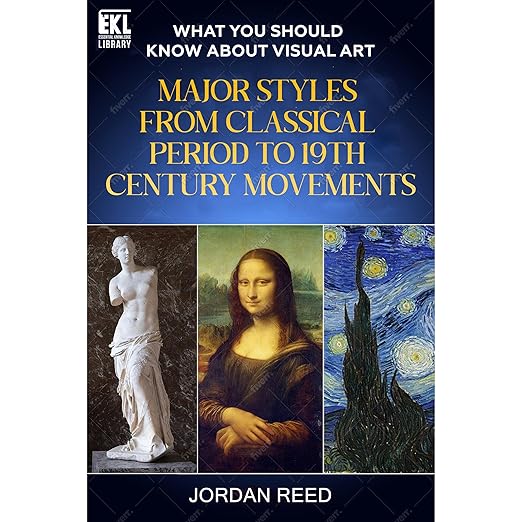
Jordan Reed's What You Should Know About Visual Art positions itself exactly as its title promises, and this audiobook delivers that clearly stated ambition. This is a survey of Western art history from Ancient Greece in the fifth century BCE through the Post-Impressionist and Art Nouveau movements of the late nineteenth and early twentieth centuries, organized chronologically, written accessibly, and designed for listeners who want orientation rather than specialist depth. Running 4 hours and 16 minutes, it is efficient by deliberate design, part of the Essential Knowledge Library series, and its scope reflects that series' commitment to accessible breadth over exhaustive detail.
The inherent challenge of any art history audiobook is one that Reed addresses honestly by focusing on historical and cultural context rather than visual description alone. Where a more ambitious audio production might attempt extended ekphrasis, detailed verbal painting of individual works, Reed instead builds scaffolding: here is the period, here is the cultural moment, here are the major figures, here is what changed. Reviewer Janet M., writing as an art student from the 1980s with experience of formal coursework, called this 'the complete package for Art History 101 and beyond,' noting that it covers major styles with examples, time periods, and notable artists. That framing as an orientation rather than a definitive resource is the right way to approach it.
An Unmapped Territory, Finally Sequenced
The book's organization reflects its educational framing. Movements are arranged chronologically from Classical through Medieval, Renaissance, Baroque, Rococo, Neoclassicism, Romanticism, Realism, and Impressionism, continuing through Post-Impressionism, Symbolism, and Art Nouveau. For listeners who have felt the geography of art history to be an unmapped territory, this sequencing is genuinely useful. You understand not just what each movement was but how it was reacting against, absorbing, or transforming what came before it. The thread of historical cause and response is more instructive than any list of isolated facts would be.
Reviewer Magda praised the 'comprehensive yet well organized overview' and specifically noted that illustrations add value in the print version. That observation points to a real limitation of the audio format here: Reed's text, by the reviewer's account, was designed with visual materials as a complement. When those are absent, some of the specific discussions of individual works lose grounding. A description of Caravaggio's use of chiaroscuro or Monet's brushwork technique is necessarily more abstract when you cannot see the paintings being discussed. Listeners who follow along with a companion search for the works mentioned will get considerably more from this audiobook than those who listen without any reference images.
The Virtual Voice's Clear, Consistent Narration
Reviewer bookprincess described this as 'wonderfully insightful' and valued how it 'showcases how art exemplifies different cultures and reflects upon the nuances of various peoples and societies.' That cultural-context framing is where the audiobook earns its strongest marks. Reed does not treat art history as a parade of masterpieces to be catalogued but as a record of how human communities have understood and represented their worlds across time. That interpretive thread, connecting the Classical to the Medieval to the Renaissance to early Modernism, gives the survey coherence beyond its chronology.
At just over four hours, the audiobook is well-suited to listeners who want a single committed session rather than a multi-week project. The Virtual Voice narration is clear and consistent, maintaining pace without the occasional warmth or interpretive inflection a human narrator might bring to descriptions of specific artworks. For a content-first survey, this trade-off is acceptable. The clarity serves the educational purpose, even if it does not add emotional color to the Renaissance or gravity to the Baroque tragedies it describes.
Stopping Short of Cubism and Modernism
The book's title says 'What You Should Know,' and it means it. This is a selective and condensed survey, not a comprehensive history. Movements and artists who fall outside the Western European canon are largely absent, which reflects a deliberate framing choice that listeners with broader art historical interests should factor in. The survey does not extend into twentieth-century Modernism, leaving Cubism, Abstract Expressionism, and subsequent movements outside its scope. Listeners expecting coverage through the present will need to supplement elsewhere to complete the picture.
Some of the writing, particularly in the more technical sections about compositional principles or the mechanics of individual painting techniques, translates less effectively to audio than to the printed page. These sections are brief but require more attentive listening than the historical and biographical passages that surround them. Having an image search open while listening helps substantially during those descriptive stretches where the visual reference is really the point.
An Honest Limitation, Not a Stretched-Thin Survey
This audiobook is best suited to listeners who are new to art history and want a structured foundation before moving to more specialized reading. It works well as preparation for visiting a museum collection, as a companion to a humanities course, or as a refresher for someone who encountered this material years ago and wants a chronological reset. Listeners already comfortable with comprehensive art history texts will find the survey level insufficient for their needs. Those who want a focused, efficient introduction to the Western art tradition in audio form will find what they are looking for here, so long as they keep a screen nearby to look up the works being discussed. The guide's honest scope limitation, stopping before twentieth-century Modernism rather than stretching thin to cover everything, is actually one of its more useful qualities.
Is the Virtual Voice narration clear enough to follow the art history content in this audiobook without distraction?
The narration is consistently clear and well-paced for educational content. It does not bring interpretive warmth to descriptions of specific artworks, but for a survey focused on historical chronology and cultural context, the clarity serves the purpose adequately.
Does this audiobook cover non-Western art traditions alongside the Western canon?
No. The book is explicitly a survey of the Western art tradition, tracing a path from Ancient Greece through the late nineteenth century. Listeners interested in non-Western art histories will need to look to other resources for that coverage.