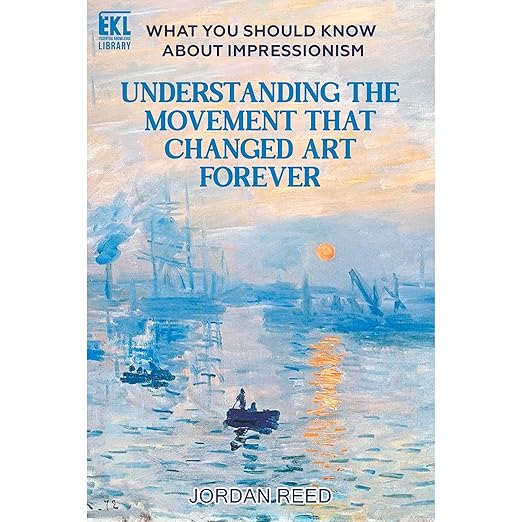
At a Glance
- At its heart: Impressionism's pre-history, the Academy and its rules, broken color, the road out to Fauvism and Cubism
- Vibe: Orderly and explanatory, built for understanding rather than for looking
- Short version: A clear, well-sequenced introduction whose largest limitation is the one format it happens to be published in.
A well-built art history primer, delivered by synthetic voice, about paintings you cannot see. That combination is the whole story of this audiobook, and it deserves saying before anything else does. Five hours and fifty-seven minutes of Impressionism without a single image is a genuinely strange proposition, and whether it works for you depends almost entirely on what you already carry around in your head.
Jordan Reed has written something the reviewers plainly rate. Seventeen ratings sit behind five visible notices, four of them at five stars and one at four, and those five average exactly the 4.8 the listing displays. The praise is consistent in an unusually specific way. Not that the book is enjoyable, but that it accounts for why Impressionism mattered rather than cataloging what it looked like. That distinction is what rescues the audio edition.
Reviewers Push the Timeline Back to the 1850s
The best thing about this book, according to the people who have read it, is not the thing the description sells. The product copy dates the origins to 1870s France and leads with Monet's water lilies and Renoir's intimate portraits. The reviewers keep pointing somewhere else entirely, back before 1874. Peter Jackson writes that the book "goes back to the 1850s and 1860s and explains what was happening before Impressionism officially started." Courbet, Corot, Manet, and Bazille get named as the figures showing "how the strict rules of the Academy were already being questioned before the first independent exhibition in 1874."
C.R. reaches the same conclusion from another direction, praising a guide that is "thorough and well-researched" while noting that the author "doesn't just jump straigh tinto the paintings" and instead works through the period before the movement began. The typing errors in that phrase are the reviewer's own, left as filed. What matters is the pattern underneath: two reviewers out of the five single out that pre-history explicitly, and a third credits the book for showing how the movement challenged academic tradition. Nobody praises it for the water lilies. The description sells the famous canvases; the readers came away talking about the argument that produced them.
Significance Survives the Transfer, Brushwork Does Not
JohnH makes the case for a recording without meaning to. Writing as an artist shaped by the Impressionists, JohnH describes being unable to see any real paintings from the period "in the flesh" until "the Renoir to Rembrandt exhibition came to NZ in the mid 90s," and then reports the outcome in six words: "I must admit I was shocked." What produced the shock is never stated. The gap it points at is the honest ceiling on every book about painting, in any format whatsoever. Print offers postcard-sized approximations of enormous canvases. Audio offers none. The distance between those two shortfalls is smaller than it first sounds.
What this book does, on its reviewers' evidence, is cross that gap by explaining rather than displaying. Marie Anna writes that it "explains not just what Impressionism looks like, but why it mattered," and credits it with "helpful context about how the movement challenged academic traditions" before praising anything else. Magda, a five-star reviewer who came in already loving the paintings and wanting to understand their significance, came away grasping how Monet and Renoir "transformed the use of light" and changed everything downstream of themselves. Significance survives the transfer into sound. Brushwork does not survive it.
The sequencing gets specific praise too, which matters more in audio than in print because you cannot flip back. That same reviewer calls the progression of ideas logical and easy to follow, and credits the ordering with keeping the material engaging rather than academic-heavy. For a listener with no ability to skim back, a book arriving in the right order is doing something genuinely useful, and it is the single structural quality that matters most in this format.
Virtual Voice Must Pronounce Courbet, Corot, and Manet
Virtual Voice is the credited narration, and on this particular title that disclosure carries more weight than it usually would. This is a text packed with surnames that nobody spells the way they sound: Courbet, Corot, Manet, Bazille, Monet, Renoir, and, from the description, Cassatt and Morisot. It also moves through movement names a reader has to land cleanly for the sentences to work, Fauvism and Cubism among them, plus the broken color technique the copy names as a founding principle. Pronunciation is the one variable a written preview cannot show you, and on this book it is the variable that matters most. Play the sample.
Watch the dates as well. This edition was published on February 25, 2026, and all five visible notices were filed between February 28 and March 3 of that year, three of them on that last day. Nothing improper attaches to any of that, and tight review windows are ordinary for small independent releases. It does mean the whole visible pool comes from the opening week, before anyone had lived with the material long enough to test whether the framework survives a second pass or a gallery. Six days is not much of a proving ground for a book whose stated ambition is to change how you look at things permanently.
One metadata oddity deserves noting: the publisher and the series carry the same name, Essential Knowledge Library, so the imprint and the branding are one entity. That is common enough in independent nonfiction. It does mean the essential-knowledge framing running through the copy is the publisher's claim about its own product rather than any outside judgment, and the description's insistence that this is "essential reading for anyone" should be read with that in mind.
Commuters and Museum-Goers Building Context Before a Visit
Two audiences get real value here. The first already knows the paintings, has stood in front of a few, and wants the intellectual scaffolding: why the Academy mattered, what broken color was reacting against, how a movement that announced itself with an independent exhibition in 1874 became the hinge between traditional and contemporary art. The second is a commuter or a walker building context ahead of a museum visit, using the explanation as preparation for looking rather than as a replacement for it.
The wrong listener is anyone who wants to learn to recognize the work. If you cannot presently tell a Monet from a Morisot and want that to change, this format will not get you there, and no quantity of clear writing substitutes for looking at a canvas. Give it a miss, too, if you want scholarly apparatus, because the description promises no footnotes, no bibliography and no citation machinery of any kind, and nobody who has read it reports finding any. This is a synthesis written for people who want the argument, not the evidence trail behind it. What Jordan Reed has produced is a confident, orderly, well-sequenced introduction, and it knows exactly that is what it is.
Before You Listen
Does this audiobook work if you cannot picture the paintings it discusses?
It substitutes chronology and argument for imagery. The material is organized as a sequence of reactions: what the Academy demanded, what the precursors broke, what came after. That sequence holds without visuals. Recognizing individual canvases does not. Decide which of the two you actually came here for before you buy.
Is this audiobook part of a series, and does listening order matter?
The listing places it in an Essential Knowledge Library series, which shares its name with the publisher. No dependency on other volumes appears in either the description or the reviews, and the series number field sits empty. Treat it as a standalone title with no implied order.