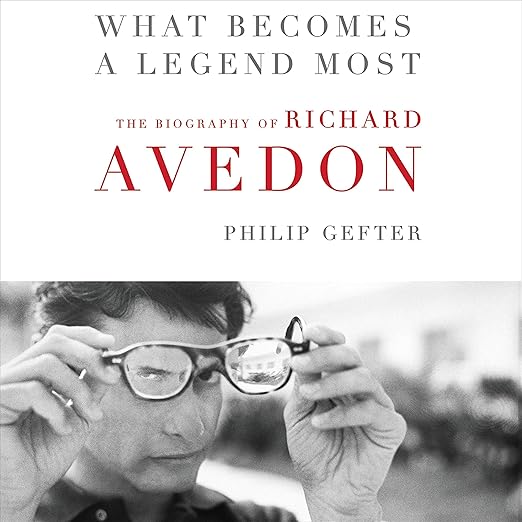
Richard Avedon’s photographs are among the most recognizable images produced in twentieth-century America, and yet for most of his career he remained, in the eyes of the fine-art world, something less than a serious artist. He was a fashion photographer, which in the decades from the 1950s through the 1970s was a category considered to exclude its practitioners from genuine artistic consideration regardless of the quality of their work. Philip Gefter’s audiobook What Becomes a Legend Most, running nearly twenty-three hours, is a sustained engagement with that contradiction, and it is the first full-scale biography to take Avedon’s life and ambition as its central subject with the seriousness they deserve. A supplemental PDF accompanies the recording and contains images that significantly enrich the visual analysis sections.
A Photography Critic Explains Technical Choices
Gefter is an award-winning photography critic, and his deep familiarity with the medium gives the biography a quality that separates it from standard celebrity life-writing. He understands not just what Avedon photographed but why specific technical and compositional choices produced specific effects, and he can explain those effects in terms that make sense to a listener who has never held a camera professionally. The book begins with Avedon’s childhood in New York between the wars, in an environment where cultural prejudice and family expectations would shape his sense of self for decades to come.
His Jewishness, his sexuality, his driving ambition, and his profound insecurity are treated with equal weight throughout and without sentimentality. Gefter builds the biography on archival research and exclusive interviews with those closest to Avedon, which gives the book an intimacy that distinguishes it from any account assembled at a distance. One reviewer who worked through the print edition described it as comprehensive to the point of being a slog in places, but worth every page, and that assessment translates accurately to the audio experience. This is not a light biography. It is thorough, and its thoroughness is the point: Avedon was a figure of genuine complexity, and reducing his story to its most dramatic highlights would betray the argument Gefter is making about what made him significant.
Close Friendship With Capote, Baldwin, and Bernstein
The biography’s cultural richness is one of its greatest strengths as an audiobook. Avedon moved through his professional world in close friendship with Leonard Bernstein, Truman Capote, James Baldwin, Harold Brodkey, Renata Adler, Sidney Lumet, and Mike Nichols, and Gefter renders those relationships with enough detail that the book doubles as a portrait of the creative community that defined American cultural life in the postwar decades. For anyone interested in that milieu, the biography offers access to its inner workings that is hard to find in more narrowly focused cultural histories.
Jane Oppenheimer’s narration is consistently intelligent across the recording’s considerable length. She captures the biographical voice Gefter establishes without imposing a separate interpretive layer, and she handles the transitions between Avedon’s professional chronology and his personal life without losing the listener’s sense of where they are in the larger arc of the story. At nearly twenty-three hours, the audiobook requires real commitment, but listeners who invest in it tend to find the length justified by the scope of the life and the richness of the world it inhabited. The supplemental PDF contains the Avedon photographs that Gefter analyzes in detail, and using it alongside the audio during the visual-analysis passages significantly enriches those sections of the biography.
Exhibited at the Met, Finally a Household Name
The audiobook’s central tension is Avedon’s lifelong struggle to be taken seriously as an artist rather than as a craftsman in the service of commercial clients. Gefter traces this fight across decades, from Avedon’s early work at Harper’s Bazaar and Vogue through his increasingly assertive push into portraiture and social documentary. The 1950s and 1960s chapters are among the most historically rich in the recording, capturing a period when photography itself was fighting for institutional recognition within the art world while individual photographers were simultaneously trying to stake their own claims against the medium’s commercial associations.
The moment when Avedon’s fashion work was exhibited at the Metropolitan Museum of Art in the late 1970s, which finally made him a household name, arrives with genuine emotional weight after everything the listener has witnessed. Gefter is also unflinching about Avedon’s personal failures, including the cost his ambition extracted from relationships and the complexity of his family dynamics. He does not write hagiography; he writes biography in the tradition that takes the full person as its subject, including the parts that are harder to admire. Listeners should prepare themselves for a portrait that earns its subject’s significance rather than simply asserting it from the opening pages.
Worth Twenty-Three Hours for the Right Listener
Listeners who come to this audiobook with an existing interest in photography, fashion history, or mid-century American cultural life will find the richest experience. The biography does not require specialist knowledge, but it rewards it: listeners who know Avedon’s images will hear Gefter’s analysis differently than those encountering the work for the first time. Given the supplemental PDF, those images are available alongside the recording, and using them while listening makes the analysis significantly more immediate. Anyone interested in the sociology of artistic legitimacy, in how medium, class, and commercial success interact to determine which artists the art world takes seriously, will find this biography a case study of exceptional depth. Those who want a quicker or more celebratory portrait of a famous name will find the scope and the density demanding, but for listeners willing to give nearly twenty-three hours to one life, Gefter has written a biography that genuinely justifies the investment.
Common Questions
Does the What Becomes a Legend Most audiobook require seeing Avedon’s photographs to be worth listening to?
No, though the supplemental PDF that accompanies the audiobook adds considerable value. Gefter describes the photographs in enough detail that listeners unfamiliar with Avedon’s work can follow the analysis. Having the images available during the visual-analysis sections makes those passages significantly more immediate and rewarding.
At nearly 23 hours, is this audiobook structured to sustain attention or does it feel exhaustive?
Gefter structures the biography chronologically with strong thematic threads, particularly the recurring question of Avedon’s artistic legitimacy, which gives the long runtime a clear shape. Several reviewers noted it is comprehensive rather than breezy, which is an honest description of a serious biography of a genuinely complex life.
How does this audiobook treat Avedon’s personal life alongside his professional career?
Gefter integrates both throughout. Avedon’s sexuality, family relationships, and emotional insecurities are treated as formative forces on his work rather than as separate from it. The biography is frank about his personal failures as well as his professional achievements and does not offer a sanitized portrait.
Is this audiobook appropriate for someone who knows nothing about photography as a discipline?
Yes. Gefter explains the visual and technical choices in Avedon’s work in terms accessible to any engaged listener. The book is equally a cultural history of the postwar period and a biography of an individual, and both dimensions work without requiring specialist knowledge.