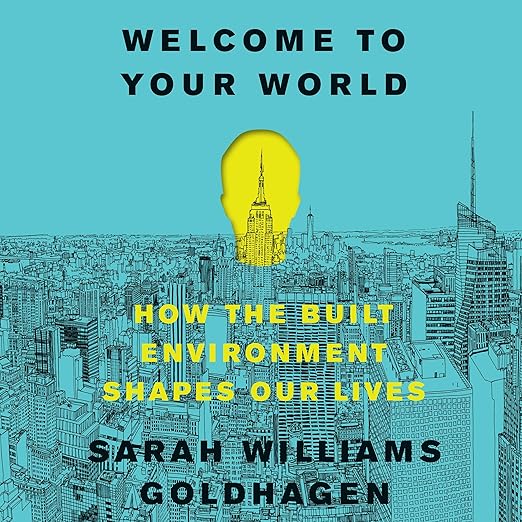
Badly designed rooms make people measurably more anxious, and well-designed ones measurably calmer; that's the core, testable claim Sarah Williams Goldhagen spends this audiobook backing up with cognitive neuroscience rather than just aesthetic opinion. My verdict going in: architecture critics make this kind of claim often, but Goldhagen is one of the few who actually show their scientific work rather than just asserting good taste as self-evident truth. That distinction, argument backed by research versus argument backed by pedigree, is what separates this audiobook from a typical architecture-criticism collection, and it's the reason the book's claims feel earned rather than assumed.
A Guided Tour of Excellent and Damaging Spaces
Goldhagen structures the argument as a guided tour through both ends of the spectrum, genuinely excellent spaces and genuinely damaging ones, using specific real buildings and landscapes rather than staying at the level of abstract theory. That grounds the neuroscience in something a listener can actually picture. The closest comp in the field is Juhani Pallasmaa's work on the sensory experience of architecture, and listeners who appreciated that book's attention to how buildings affect the body, not just the eye, will recognize familiar territory here, though Goldhagen leans harder into hard research citations than Pallasmaa's more phenomenological approach.
Exhausting Versus Enervating, Not Ugly Versus Beautiful
Reviewer David Swanson frames the book's premise sharply: of all the factors shaping our lives, the built environment gets comparatively little attention next to more familiar wellness topics like sleep or diet. Reviewer Dan Lyons adds useful context on Goldhagen's authority to make that case, noting she's 'a former professor at Harvard Graduate School of Design,' which tracks with how methodically the book handles its research citations rather than leaning purely on critical opinion. That combination, an underdiscussed topic paired with a credentialed, research-grounded messenger, is a big part of why the book lands as more than just another design-appreciation title.
Goldhagen's framework for bad design is more precise than a simple ugly-versus-beautiful binary, and it's worth naming that precision directly: she distinguishes between environments that are exhausting and overstimulating, too much visual noise, poor acoustics, chaotic wayfinding, and environments that are enervating and understimulating, blank facades, monotonous repetition, nothing for the mind to engage with. That two-sided framework matters because it explains why some spaces widely praised for minimalist restraint can still register as psychologically draining; understimulation is presented here as its own distinct design failure, not simply the safer alternative to visual excess.
Gallo Must Shift Registers Within a Paragraph
Andrea Gallo has no prior track record to draw on here, so the fairest assessment is genre fit: this material needs a narrator who can move fluidly between hard scientific explanation, neuroscience findings, psychology research, and genuinely evocative description of physical spaces, sometimes within the same paragraph. That's a real range requirement, since the book keeps shifting registers between citing a study and painting a picture of an actual plaza or building. Based on how the material is structured, a narrator with a controlled, clear delivery that doesn't rush past the research citations while still finding warmth for the descriptive passages is what this book calls for, and that appears to be the register Gallo brings to it.
Reviewer Taylor Ellwood highlights what might be the book's most distinctive contribution: how thoroughly Goldhagen integrates 'cognitive and bodily experiences' into the analysis, so listeners aren't just looking at buildings from the outside but considering how a body actually moves through and registers a space. That embodied angle gives the book real stakes beyond aesthetic preference, especially given how directly Goldhagen ties her argument to the sheer scale of construction ahead: a growing population means new construction is coming regardless, and her case is that getting the human-experience side right now, rather than retrofitting later, is the actual opportunity.
Real Buildings You Can Only Imagine Here
As with any book making an extended case for how physical space affects the mind, an inherent visual gap runs through the audio format: Goldhagen describes specific real buildings, plazas, and landscapes in detail, but listeners who don't already have a mental picture of a specific cited plaza or building facade are working from description alone rather than an accompanying image. That's a real limitation for anyone who processes architectural argument best by seeing the actual space being discussed, though Goldhagen's descriptive writing is specific enough that most listeners should be able to follow the argument without needing a photo reference constantly at hand.
This Isn't a Light Travelogue of Buildings
The neuroscience and psychology citations, genuinely central to the book's whole argument rather than decorative, do mean the pacing occasionally slows for listeners expecting a more purely narrative architecture-criticism book. This isn't a light travelogue through beautiful buildings; it's an argument built on evidence, which means research findings get real explanatory space rather than a passing mention. Listeners who want Goldhagen's conclusions without the underlying scientific case for them may find some chapters denser than expected, though that density is exactly what separates this from a coffee-table-style architecture appreciation book.
Most listeners aren't in a position to personally redesign a city block or commission a building, which raises a fair question about how actionable the book's argument is for an individual audience rather than policymakers and design professionals. Goldhagen does address this at the level of everyday choices, what to look for in a home, a neighborhood, a workplace, but readers hoping for a pure how-to guide to personally healthier environments should know the book's center of gravity sits closer to policy-level argument than individual lifestyle advice.
Drained by a Building Without Knowing Why
Anyone who has ever felt inexplicably drained by a specific building or oddly at peace in another without being able to explain why is the intuitive audience, and Goldhagen gives that vague feeling real vocabulary and research backing. Urban planners, architects, and design students are the obvious professional audience, but this reaches further: reviewer David Swanson's framing, built environment as an underdiscussed wellness factor alongside sleep and diet, suggests real appeal for general wellness-minded listeners who've simply never considered their physical surroundings through that lens before.
A quick, breezy overview of pretty buildings is not what this delivers, and listeners hoping for that lighter architectural-appreciation experience should look toward a more visually driven coffee-table title instead. Readers who prefer their arguments purely anecdotal, without research citations slowing things down, may also find the neuroscience-heavy chapters ask for more patience than a casual listen typically allows.