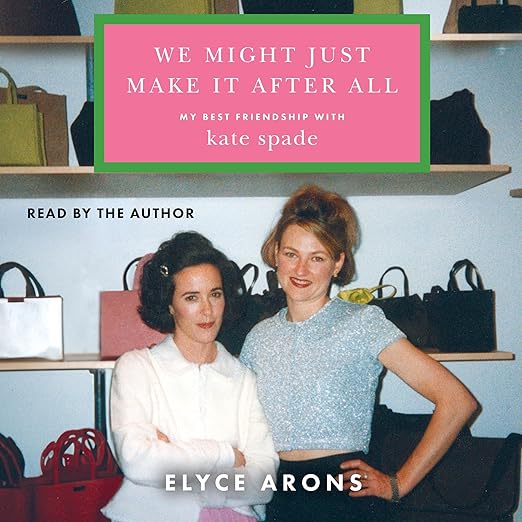
- Performance: Elyce Arons's self-narration is restrained rather than performed in the memoir's hardest passages, which makes the loss land harder.
- What it covers: Decades-long friendship, women in entrepreneurship, grief and legacy.
- Feel: Warm and specific, turning quietly devastating near the end.
- Our call: A genuinely moving memoir, recommended with a clear content warning around its handling of suicide.
Elyce Arons writes from inside a friendship rather than about one from a respectful distance, and that choice shapes every page of this audiobook. We Might Just Make It After All traces the nearly forty-year relationship between Arons and Katy Brosnahan, better known to the world as Kate Spade, from a University of Kansas dorm room through scraping-by years in 1990s New York City to the handbag line that would eventually become a billion-dollar fashion company. Arons narrates her own book, which matters enormously here, since the memoir's emotional center is not really the business success story but the friendship itself, one that ended with Kate Spade's death by suicide in 2018 after nearly four decades. One reviewer flagged that content directly as a warning for sensitive listeners, and it is a warning worth repeating.
A Mary Tyler Moore Lyric Reworked as We
Reviewer Christine, writing from her own Midwestern background, described feeling like she personally knew Arons and Spade by the book's end, crediting how relatable their 'kind, fun, genuine' personalities and evident work ethic come across. That sense of personal familiarity is a real achievement for a memoir about people who, by the story's end, had become genuine cultural icons; Arons never lets the eventual fame flatten either woman into a symbol, keeping both grounded as the specific, flawed, funny people she actually knew from a dorm room forward. That groundedness is likely the single biggest reason this book connects as strongly as reviewers describe.
Reviewer Tad raised an important framing point worth carrying into the listen: depression and anxiety can be genuinely hidden from even close friends, and a person's suicide should not be allowed to define their entire life and legacy afterward. Arons seems to share that instinct in how she structures the book, dedicating the overwhelming majority of the runtime to the friendship's life and success rather than centering the tragedy itself, which arrives late and is handled with evident care rather than sensationalism. That structural choice, celebration first, loss acknowledged honestly but not dwelt upon disproportionately, feels like a deliberate act of honoring how Arons actually wants her friend remembered.
The book's title itself rewards a moment of attention: it borrows from the theme song of The Mary Tyler Moore Show, the very program the synopsis mentions Arons and a young Katy Brosnahan watching together in their dorm room, a line about making it after all reworked here into a shared 'we.' That small lyrical borrowing does real work as a framing device, casting their decades of ambition and partnership as an extension of a very specific, very 1990s cultural touchstone about a woman making her own way in a new city. It is a detail easy to miss on a first listen but worth catching, since it threads the whole memoir back to that single dorm-room afternoon.
Restraint That Turns Into the Performance Itself
This is, according to the available narrator history for Arons, a genuinely rare kind of self-narrated memoir performance: she does not perform the sadness in the book's most difficult passages, and that controlled restraint turns out to be the performance itself, more affecting than a more theatrical reading would likely have been. The warmth and directness she brings to the earlier, pre-tragedy chapters, the dorm-room meeting, the frat parties, the roach-infested Hell's Kitchen apartments, establishes a baseline intimacy that makes the later loss land with real weight precisely because nothing about the narration oversells it in advance. Self-narrated memoirs live or die on whether the author-narrator can sustain that kind of control across genuinely difficult material, and Arons manages it consistently.
The 1990s New York backdrop gets rendered with specific, lived-in texture rather than generalized nostalgia: transferring colleges on a whim, falling in and out of love with various suitors, cramming into cheap Hell's Kitchen apartments while building a handbag line at night after day jobs. That specificity matters for the entrepreneurship half of the story too, since Arons and Spade were navigating the particular challenges facing women starting a business in that decade, before the current wave of startup culture and its accompanying infrastructure existed to support them. The book captures both the glitz of eventual global fame and the genuine grit of the years before it arrived.
A Rollercoaster Before the Business Narrative Settles
Reviewer Jean Katherine's warning deserves direct repetition here: if you are triggered by discussion of suicide, even handled with the evident care Arons brings to it, approach this book cautiously or wait for a moment when you are better equipped to engage with that content. The mentions are described as brief relative to the book's full runtime, but they arrive as the emotional culmination of a nearly forty-year relationship the listener has spent hours getting invested in by that point, which can hit harder than a more clinical or distant treatment of the same subject matter might. Know that going in and plan your listening accordingly.
Structurally, the book moves through what Arons herself frames as a rollercoaster of adventures and misadventures, which means the narrative is more episodic than strictly chronological in places, whim-driven college transfers, romantic detours, apartment hunting disasters, before settling into the more linear business-building narrative of the company's actual founding and growth. Listeners expecting a tightly structured entrepreneurship memoir, quarter by quarter, decision by decision, may find the earlier chapters looser and more anecdotal than that format usually delivers. That looseness is intentional and matches how memory and friendship actually work, but it is a real structural choice worth knowing about going in.
A Hired Narrator Could Not Have Replicated This
Fans of the Kate Spade brand curious about its origin story, readers of friendship memoirs generally, and anyone interested in the specific challenges facing women entrepreneurs in 1990s New York will all find substantial value here. The book works as well for readers who never owned a single Kate Spade product and simply want a well-told story about a decades-long friendship as it does for brand loyalists wanting the company's founding mythology. Arons's own narration, warm and direct through the earlier chapters, restrained and controlled through the difficult final stretch, makes this one of the stronger self-narrated memoir performances in this particular genre, worth the nine-and-a-half-hour investment on narration quality alone.
Skip this one, or at least delay it, if suicide as subject matter is currently a difficult trigger for you, regardless of how carefully the book ultimately handles it. Readers wanting a strictly structured business memoir, chronological milestones, hard numbers, strategic pivots explained in sequence, may also find the more episodic early chapters slower than expected before the entrepreneurship narrative fully takes shape. For anyone approaching it as what it actually is, a memoir of friendship first and a business story second, though, this is a genuinely moving listen, and Arons's own voice telling her closest friend's story is not something a hired narrator could have replicated.
Does this audiobook go into detail about Kate Spade's death?
It addresses it directly but briefly relative to the full runtime, arriving late and handled with evident care rather than sensationalism.
Is this audiobook narrated by Elyce Arons herself?
Yes, and her self-narration is a significant strength, particularly her restrained delivery through the book's most difficult passages.