In Brief
- Narrator: One reader carrying seventy-eight years of a single life, where steady pacing matters far more than characterization; Aaron Killian is credited
- Subjects: the life of Duke Kahanamoku, surfing exported worldwide, racism in early American sport, Hawaii from kingdom to statehood
- Tone: Steady, admiring and quietly political
- Bottom line: A definitive account of a figure most listeners cannot name, sold under a one-word title that hides him completely.
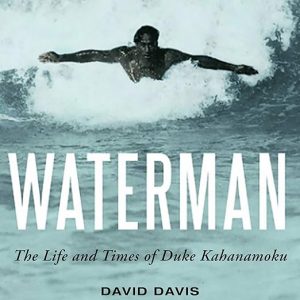
Surfing reached New Jersey because one Hawaiian swimmer carried a wooden longboard there, and this audiobook gives its whole length to the man who did it. Duke Kahanamoku, born in 1890 when Hawaii was still an independent kingdom, set world swimming records, won Olympic gold, demonstrated surf-riding in Australia and California and on the Atlantic coast, then served as sheriff of Honolulu through Pearl Harbor and the war. David Davis calls this the first comprehensive biography of him, and the claim holds.
What We Made of It
Olympic gold is the smaller half of this life. The description's framing is that no American athlete has shaped two sports as profoundly, and the book earns that by refusing to treat surfing as an appendix to the swimming career. Kahanamoku turned the medals into a platform, and what he did with the platform is the actual story: a sport practiced nowhere outside the Hawaiian Islands became a global one because a single person kept demonstrating it wherever he was invited to travel.
Aaron Killian is credited as reader, and not one of the five written responses says anything about the recording. That is the plainest silence on this record, with 207 ratings sitting above those five and every written verdict treating the book strictly as a book. What the material asks for is specific: a university-press biography carrying decades of dates, period sportswriting and quoted sources, all of which arrive on a page with footnotes underneath and arrive in a listener's ear with nothing underneath at all.
Hidden history is the phrase May 2025 offers, in a five-star verdict singling out the racism Kahanamoku met because of his skin color. That is where the book is strongest and least comfortable. The description places him chronologically ahead of Joe Louis, Jesse Owens and Jackie Robinson, a dark-skinned Pacific Islander competing and winning in a country with no category ready for him, and Davis neither softens the treatment he received nor converts the biography into a thesis about it.
The Best Parts of Waterman
Swimming records came first, and they were not modest. The book tracks dozens of world records and more than a decade at the top of the rankings, and the rivalry with Johnny Weissmuller is treated as the thing that turned competitive swimming from a sideshow into an event people bought tickets to watch. For anybody who knows Kahanamoku only as a surfing figure, this half of the biography is the surprise, and it is where the sports writing is most concrete.
Honolulu is where the second act happens. Kahanamoku served as sheriff of the city through Pearl Harbor and the war, spent the years afterward as a traveling Ambassador of Aloha, and died not long after Hawaii became a state. That arc, from a subject of a kingdom to a citizen of the fiftieth state, hands the biography a political dimension most sports books never reach for, and Davis lets it sit underneath the narrative rather than announcing it from the front.
One January 2019 five-star response comes from somebody describing themselves as a waterman, born and raised on the Big Island, learning to surf on balsa boards in the 1950s and paddling canoe before that, back when three hotels stood on the whole of Waikiki Beach. The verdict from that quarter is accuracy. When a biography of a Hawaiian figure passes inspection by a reader carrying that much first-hand context, it counts for more than any quantity of general recommendation.
What Might Not Land
Discovery is how the September 2025 five-star found this book at all, arriving by way of a documentary series about surfing in which a subject used the word waterman, then following the name Kahanamoku down a research trail. That account is honest about something the book cannot repair on its own: most buyers will not know who he was before they start. The description does the work eventually. The product itself offers almost nothing until you press play.
University of Nebraska Press is named in the closing line of the description, and that is the print publisher rather than the house that produced this recording, which carries a different imprint entirely. Neither statement is false. A buyer reading straight through the copy nonetheless finishes with the wrong publisher in mind, and on a scholarly biography the imprint is precisely the detail a careful buyer uses to work out what kind of book is being sold.
Eleven hours and thirteen minutes is a long stay with one athlete, and the pacing is not uniformly kind. The early swimming years accumulate records at a rate that flattens into a list if your attention drifts, and the mid-century sections carry a great deal of Hawaiian context that some listeners will want badly and others will experience as a detour. This is a book that rewards attention rather than one that keeps you company while you do something else.
The Right Listener for Waterman
Paddlers, swimmers and anybody raised near water will find the technical detail satisfying, and surfers get an origin story far better documented than the version handed around in surf shops. Sports-history readers who prefer the biography of a figure to the chronicle of a season are well served here. So is anybody interested in racial politics in early twentieth-century American sport, since this career runs earlier than the names usually cited in that conversation.
None of it works for readers who want surfing technique or coaching, because this is a life rather than a manual. Anybody hoping for a broad history of the sport itself should also pass, since surfing enters through one person and stays with him. October 2019 brought the four-star, and it names the real gap, wanting some of the many letters Kahanamoku wrote while traveling, and noticing along the way that he needed a permit to surf in Atlantic City, which implies somebody had already surfed there. Duke Kahanamoku earns the length; the listing title never once says he is in it.
Questions Listeners Ask
Is the audiobook built on new research or on existing accounts?
The description calls it the first comprehensive biography of Kahanamoku, which implies primary work rather than synthesis of earlier books. What the record does not offer is any list of sources, so a listener wanting to weigh the research has to take that claim on trust or consult the print edition to check it.
What does the word waterman actually mean?
It describes somebody at home in the ocean across several disciplines at once: swimming, paddling, surfing and lifesaving rather than any one of them. The description applies it to Kahanamoku as a summary of all four, alongside two other names he collected, the human fish and the Ambassador of Aloha.
Is this audiobook suitable for younger sports fans?
Mostly, yes. The sporting content is clean and the racial history is handled directly without graphic detail. The real obstacle is scale rather than subject matter, since a long single-subject biography asks for more patience than most teenage listeners bring to a sports book they picked up for the surfing.
Do the written responses agree about the book?
Broadly. Four of the five are fives and one is a four, with the July 2024 five-star stating the consensus as a fascinating look at an iconic Hawaiian and American figure. Five written accounts under 207 ratings make a thin basis for any consensus, but the direction they point in is consistent.