Before You Press Play
- Read by: Gary Roelofs brings a measured, unhurried delivery well suited to Sedlak's historical throughline, though the driest engineering passages could use more urgency.
- At its heart: infrastructure history, water scarcity and policy, invisible civic engineering
- Vibe: Steady and informative, occasionally textbook-dense
- Short version: A clear, well-researched pick for civic-minded nonfiction fans, though the middle stretch runs slower than the Roman opening promises.
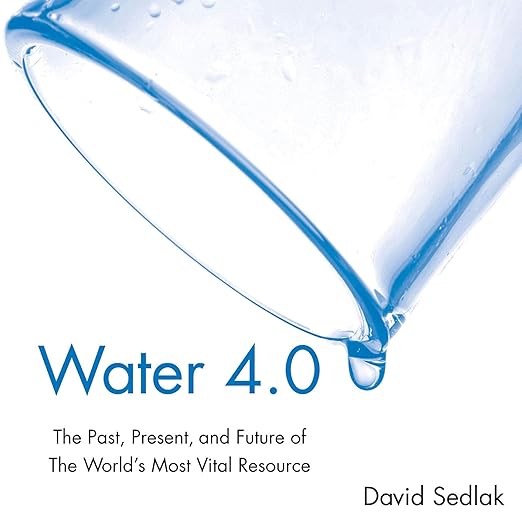
Roman aqueducts, fountains, and sewers open David Sedlak's Water 4.0, an audiobook that treats plumbing as one of civilization's quietest revolutions. I came to it after a week of reading drought headlines out west, curious whether a book about pipes and treatment plants could hold my attention for eleven hours. It did, mostly because Sedlak organizes 2,500 years of water engineering into three distinct revolutions rather than one sprawling technical survey, and narrator Gary Roelofs treats that structure with the patience it needs.
Three Revolutions in 2,500 Years of Plumbing
Sedlak's case is that almost nobody thinks about the systems that deliver clean water and carry waste away until something breaks, and the book's real achievement is making that invisibility itself the subject. He starts with Rome's aqueducts and public fountains, the engineering that first made dense urban living survivable, then walks through the nineteenth and twentieth century arrival of treatment plants and sewage systems as the second and third revolutions. One listener, RabiysRhyme, put it plainly: "If you are looking for a dry, academic treatise on why humans have corrupted the earth, keep looking." That listener called the result instead "a delightful, fascinating and ultimately very balanced treatment of humans and water: past, present, and future."
Another reviewer, Mike K., called it "the clearest articulation of the multiple facets of urban water supply and water quality" they had come across, and that clarity is the book's strongest quality in audio. Sedlak doesn't assume an engineering background, building each new system on the last so that reservoirs, underground pipe networks, and storm sewers make sense by the time he gets to them. Roelofs reads the historical sections with an unhurried, storytelling cadence that suits Camillus-era Rome and Victorian-era sanitation reform alike, treating both as chapters in the same long argument rather than disconnected trivia.
A Berkeley Engineer Plans for a Drier Future
Sedlak devotes real attention to the endgame too, not just the history: what he frames as the systems' eventual reinvention, decentralized treatment, wastewater recycling, and stormwater capture designed for a hotter, drier future. That forward-looking material gives the back third of the audiobook a different energy than the historical chapters, closer to a briefing on emerging technology than a chronicle of what already happened, and it's arguably the most useful material for listeners motivated by contemporary drought coverage in the first place.
Sedlak's own background is worth naming directly: he's a professor of civil and environmental engineering at UC Berkeley, and that research vantage point shows in how carefully he sources his claims rather than relying on anecdote alone. The book reads like the work of someone who has spent a career inside the systems he's describing, not a journalist parachuting in for a single feature.
An Erudite Romp Through Two Millennia
The reason to spend eleven hours here rather than skimming a magazine piece on water scarcity is the argument Sedlak builds toward: that the fourth revolution (decentralized, recycled, drought-resilient water systems) requires the public to actually understand what the first three cost to build. Nature's review, quoted in the synopsis, called the book "an erudite romp through two millennia of water and sanitation practice and technology." That romp is what carries a listener through material that could otherwise read as a policy white paper.
What Actually Happens Between Faucet and Sewer
It also works as a corrective to how invisible this infrastructure has become. Sedlak's insider descriptions of current systems (the reservoirs, pipe networks, and treatment plants most listeners have never toured) land with more weight in audio than they might on the page, since Roelofs gives the technical passages the same measured confidence as the historical ones. For anyone who has ever wondered what actually happens between a faucet and a sewer main, this fills that gap without condescension.
The book also earns points for specificity rather than abstraction. Sedlak doesn't just gesture at aging infrastructure in vague terms; he walks through exactly what a reservoir, an underground pipe network, and a modern treatment plant each contribute to the system, and why replacing any one piece is harder and more expensive than most public debates acknowledge. That granularity is what separates Water 4.0 from a general-interest environmental book skimming the same territory from a distance.
Too Text-Bookish, One Reviewer Warns Fairly
The trade-off is pace. A reviewer identified as canoeman found the book "well written" and "engaging" but flagged it as "possibly a bit too text-bookish for the general public," depending on a listener's own background, and that caveat holds up in audio too. The middle stretch covering treatment technology and regulatory history drags more than the historical chapters do, and Roelofs's steady, declarative delivery, while appropriate to the material, doesn't inject much urgency into the driest policy passages.
Worth flagging as well: this is nonfiction built around systems and eras, not characters, so listeners expecting a narrative throughline with recurring figures will find Sedlak's approach more thematic than dramatic. The three-revolutions framework does most of the organizational work, and once you have that scaffolding in mind, the individual chapters on specific technologies read more like case studies than a continuous story. That's by design, but it changes what kind of listening experience to expect going in.
No Glossary for Eleven Hours of Jargon
Listeners should also know this audiobook assumes a fair amount of patience with policy and regulatory detail, not just engineering vocabulary. Sedlak spends real time on the political and economic obstacles to modernizing water systems, funding gaps, regulatory inertia, public resistance to rate increases, and that material, while genuinely important, moves at a more deliberate pace than the historical narrative that opens the book.
A glossary or reference sheet would have helped listeners keep the recurring engineering terms straight across eleven hours, something print readers can flip back to more easily than audio listeners can. It's a minor structural gap rather than a serious flaw, but worth knowing if technical vocabulary retention is a concern.
Civic-Minded Listeners Who Followed the Restrictions
This is a strong pick for civic-minded nonfiction listeners, urban planning students, and anyone who followed recent water restrictions in California or the Southwest and wanted the historical context behind them. It also rewards listeners who enjoy infrastructure-as-storytelling, the same impulse that makes a good history of the power grid or the highway system compelling, applied here to something even more fundamental.
Graduate students in public policy or environmental engineering, journalists covering infrastructure, and book clubs looking for nonfiction with real civic stakes will all find plenty to discuss here. It's also a natural next listen for anyone who enjoyed a documentary or podcast about American infrastructure and wanted the fuller historical picture behind the headlines.
Statistics-Heavy Chapters Test Your Patience Here
Anyone allergic to statistics-heavy chapters on treatment technology might find the middle stretch slower going than the Roman opening promises.
Does the Water 4.0 audiobook explain current water crises like the ones out west?
Not by name, but David Sedlak's framework, especially his account of the third and looming fourth revolutions in water systems, gives listeners the historical and technical background behind why droughts and aging infrastructure create the crises they do.
How technical is the Water 4.0 audiobook for someone without an engineering background?
Sedlak builds each new system on the last, so reservoirs, treatment plants, and pipe networks make sense by the time he introduces them, but a few chapters on treatment technology and regulation run denser than the historical sections.
Is the Water 4.0 audiobook more history or more science?
Both, organized as three historical revolutions in water engineering followed by a discussion of the technologies likely to define a fourth, so listeners get roughly equal parts historical narrative and technical explanation.