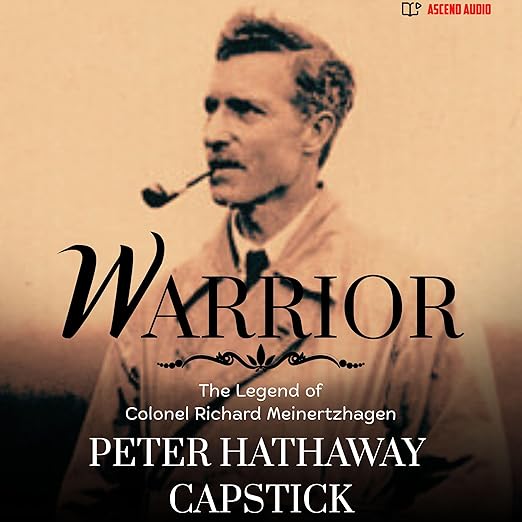
Capstick's final audiobook, Warrior, arrived posthumously, finished in the months before his 1996 death and prepared for publication by his widow Fiona. Knowing that fact changes how you hear Paul Maitrejean's narration of these nine hours and forty-one minutes: every page is Capstick at his most deliberate, returning to a figure he felt a personal kinship with, and the result carries an unusual weight that his earlier adventure books, vivid as they are, rarely matched. Colonel Richard Meinertzhagen was one of those men whose life spans so many consequential events that a conventional biography would risk feeling like a digest of the twentieth century. Capstick, wisely, never lets it become that.
The subject is extraordinary almost beyond credibility. Meinertzhagen served across colonial Africa and India during the glory days of the British Empire, earned a reputation as one of the most feared soldiers in East Africa during the brutal colonial wars at the turn of the century, then went on to run intelligence operations against German forces in both Africa and the Middle East during the First World War, conduct covert missions to the Soviet Union and Nazi Germany between the wars, work as an OSS agent in World War II, and spend the remainder of his long life as a passionate ornithologist and a committed advocate for Israeli nationhood. That is not a life. That is several lives braided together, and Capstick has the storytelling instincts to know which threads to pull and when.
Capstick Loves This Like a Hunter's Landscape
Capstick writes with what can only be described as enthusiastic precision. He loves this material the way a hunter loves a landscape: he knows its moods, its dangers, its beauty, and he navigates it with the confidence of someone who has been paying attention for a long time. Reviewer Akitalady noted that "Capstick had my interest and held it throughout the book" and described it as "extremely well written with a great deal of insight," which captures the experience accurately. This is not a scholarly biography in the academic tradition. It is narrative history told at full speed, with Capstick's own personality woven into the account.
That personality is worth acknowledging clearly. Capstick was a professional hunter and adventure writer whose books celebrate a version of colonial African life that contemporary readers will find complicated at best. He brings the same framing to Meinertzhagen's early career, presenting the colonial wars of East Africa as adventures rather than as campaigns of violent dispossession. Listeners who want a critical reckoning with that history will not find it here. What they will find is a vividly rendered portrait of a man who was genuinely extraordinary by any measure, described by someone who found him profoundly admirable.
Maitrejean's Cadence, Borrowed From Capstick's Prose
Meinertzhagen's most famous intelligence operation, the Haversack Ruse in Palestine in 1917, in which he staged his own wounding to plant false maps on the Ottomans and redirect German-backed forces ahead of the Battle of Beersheba, would be dismissed as too convenient in a novel. Capstick narrates it with the relish it deserves. Similarly, the accounts of Meinertzhagen's years in Africa, developing the tracking and survival skills that would later serve him in his intelligence work, are rendered with the specific sensory authority that Capstick's background in the same landscapes produces.
Paul Maitrejean's narration serves the material well. He does not attempt to impersonate Capstick's voice, but he captures the cadence of Capstick's prose, the controlled energy of a writer who knows when to slow down and when to accelerate. The nine-hour-and-forty-one-minute runtime passes without the kind of pacing problems that can stall adventure biography audiobooks. Maitrejean handles both the action sequences and the quieter, more reflective passages about Meinertzhagen's ornithological work and his feelings about Africa with equal competence.
A Legend Now Significantly More Contested
It should be said that Meinertzhagen's historical reputation has become significantly more contested since Capstick completed this book. Questions about the accuracy of his diaries, the authenticity of some of his claimed intelligence exploits, and the provenance of some of his ornithological specimens have been raised by subsequent researchers. Capstick was not working with that later scholarship, and this book treats the Meinertzhagen legend largely at face value. Listeners who have encountered the revisionist accounts will need to hold that context alongside Capstick's narrative, which presents a more uniformly heroic portrait than the documentary record fully supports.
That caveat does not diminish the audiobook's value as a piece of narrative history. Capstick is writing a portrait of a legend, and legends are historical objects in their own right. The question of what Meinertzhagen actually did versus what he claimed is genuinely complex, and Capstick, who provides what one reviewer describes as "a detailed index" to support his sourcing, was aware that some claims were disputed even at the time of writing.
His Voice at Its Most Considered
Listeners who enjoy British imperial history told as adventure narrative, who appreciate the kind of biography that privileges storytelling over academic caution, and who can engage critically with the colonial framing while still appreciating the craft of the prose will find this audiobook deeply satisfying. Capstick fans who have not yet encountered this final work will want to hear it: it represents his voice at its most considered, shaped by awareness that he was writing a farewell.
Listeners who want a rigorously critical examination of Meinertzhagen's disputed legacy, or who find the celebration of colonial military figures without historical contextualization uncomfortable, should approach with that expectation calibrated. This audiobook is magnificent as portraiture and adventure writing. It is not a balanced historical reassessment.
Is this audiobook appropriate for listeners new to Capstick's writing, or does it assume familiarity with his earlier work?
It works as a first Capstick listen. The biographical context about Capstick's own background as a professional hunter and adventure writer enriches the experience, but the book is self-contained as a biography of Meinertzhagen.
For a listener interested in WWI intelligence history, does this audiobook provide enough detail on the Haversack Ruse and other operations?
Capstick covers the Haversack Ruse and related intelligence operations in Palestine with considerable narrative detail and evident enthusiasm. The coverage is more vivid than technical, but it is substantive enough to satisfy readers interested in the operational history of WWI intelligence.