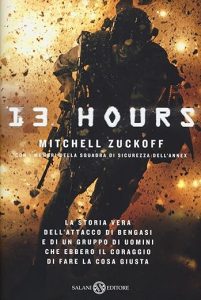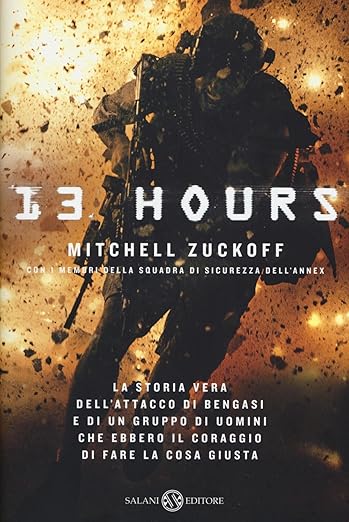
Can six people hold a perimeter while the support structures around them fail? That is the operational question at the heart of 13 Hours, Mitchell Zuckoff's account of the September 11, 2012 attack on the American diplomatic compound in Benghazi, Libya. This audiobook, narrated by Jason Reynolds, runs just under eight hours, which gives it something close to a real-time relationship to the events it describes. Listening in a single extended session produces a particular kind of compression, the sense of a clock running that the six Global Response Staff operators at the center of the story could not stop and the relief that was not coming could not outpace.
A Closer Look at 13 Hours
Zuckoff built this account from direct interviews with the surviving members of the security team who fought through those hours. This is not reconstructed from documents or third-party sources. The men who were there told him what happened, in their own words, and Zuckoff's achievement is making that testimony readable without smoothing away its contradictions and confusions. War reporting at this level requires the writer to resist the temptation to impose a cleaner narrative than the events actually had, and Zuckoff largely succeeds at that restraint.
The night of September 11, 2012, began with an assault on the diplomatic compound and ended at a CIA annex after hours of sustained combat, rocket fire, and repeated requests for backup that did not arrive in time. Zuckoff does not use 13 Hours to adjudicate the political controversy over who was responsible for the institutional failures. That decision has frustrated some readers who came to the book wanting accountability assigned. But it is also what makes the book durable. By staying close to the ground-level experience of the operators themselves, Zuckoff produced a document that will outlast the political arguments that briefly surrounded it.
The chronological structure is one of the book's formal achievements. Zuckoff moves through the thirteen hours almost in real time, with the compressed urgency of events unfolding faster than anyone can fully process. Reviewers have noted that the account is equally compelling whether or not you have seen the Michael Bay film adaptation, and that the audiobook includes political and international backstory that the film could not accommodate. The texture of the operators' experience, the waiting, the improvisation, the mechanical decisions made under fire, translates particularly well to the listening format.
Reynolds narrates with a steadiness that matches Zuckoff's prose: controlled, exact, without ornament. The chronological structure becomes almost cinematic in audio, hour by hour, and Zuckoff's account earns the comparison to a thriller while remaining fully grounded in testimony and documentation. One reviewer praised the book for its depth beyond the film, noting the international and political backstory that enriches the chronicle of those days. Another called it essential for those fascinated by real, true stories. The nearly-eight-hour runtime is exactly the right length for material that unfolds in real time.
The narrative's restraint in handling the political dimensions of Benghazi means the audiobook works as a military account regardless of where a listener stands on the policy failures. The operators were professionals doing a specific job under catastrophic conditions. Zuckoff honors that specificity without inflating it. The result is a crisis narrative with the density of lived experience rather than the tidiness of retrospective judgment.
Things to Know Before Starting 13 Hours
The account of the hours immediately before the attack, establishing the diplomatic and security context in Benghazi, can feel slow after the momentum of the opening. Zuckoff needs to lay the groundwork, but listeners impatient for the action may find the first act longer than they expected. The investment pays off once the assault begins, when the pre-established geography and personnel become essential to following what happens.
The book also makes demands on listeners unfamiliar with military terminology and the specific organizational structures of State Department security arrangements. Zuckoff introduces these clearly enough, but the acronyms and unit designations accumulate. A second listen, or occasional pausing to look up a term, will reward listeners who want to follow every operational detail. Those willing to accept some fog of war will still get the human story clearly. The political absence some readers wanted is a real limitation if your primary interest is in the failure of institutional response rather than the operators' experience. Zuckoff is explicit that he is telling the story of the men on the ground, and he holds that scope throughout. For readers who want the institutional accountability that this book deliberately withholds, other accounts of the Benghazi attacks serve that need. For the specific experience of six men in an impossible situation, 13 Hours remains the essential account, built from the testimony of the people who were actually there. Reynolds sustains that intimacy with the material throughout, and the result is a listening experience that honors the events without aestheticizing them.
Who Mitchell Zuckoff Is Writing For
This audiobook rewards listeners drawn to military nonfiction, crisis narratives, and accounts of small-unit cohesion under impossible conditions. It sits comfortably alongside books like No Easy Day and Lone Survivor in the library of modern American military memoir, though it is journalistic rather than first-person. Listeners who want a clear political verdict on Benghazi will be frustrated by Zuckoff's deliberate restraint. Those who want to understand what six trained operators experienced across thirteen hours of sustained attack will find this account the definitive one, delivered with the pace and control the material deserves.
- Narration: Jason Reynolds delivers a taut, controlled performance that keeps the urgency intact across nearly eight hours without tipping into melodrama.
- Themes: Military duty, political failure, civilian courage, the fog of real combat
- Mood: Tense and relentless, with the compression of real-time crisis embedded in every chapter
- Verdict: A precise, unflinching account of six operators and one catastrophic night in Benghazi, narrated with the discipline the men themselves would recognize.
A Few Questions About 13 Hours
Is the 13 Hours audiobook the same story as the film adaptation?
The same events, but Zuckoff's book includes significantly more political and international context that the film omitted, as well as more detailed accounts of the operators' interior experiences and decision-making. Listeners who have seen the film will still find substantial new material in the audiobook, particularly in the diplomatic and backstory sections.
Does the 13 Hours audiobook take a political position on the Benghazi controversy?
No. Zuckoff made a deliberate choice to stay close to the ground-level experience of the security operators rather than adjudicating political responsibility. The book reports what the men on the ground saw and did. The larger institutional failures are present as context but are not the book's primary argument.
How long is the 13 Hours audiobook and is it paced for a single sitting?
The audiobook runs 7 hours and 43 minutes. The chronological, hour-by-hour structure makes it well-suited to an extended listening session. The compression of the timeline works particularly well in audio. A long drive or a full afternoon sitting will give you something close to the real-time experience the title promises.
Do I need prior knowledge of the Benghazi attack to follow this audiobook?
No prior knowledge required. Zuckoff establishes the diplomatic and security context in the early chapters and builds from there. Listeners who do know the political background will have a richer reading of the institutional failures, but the human story is fully accessible without it.