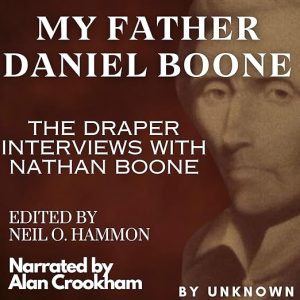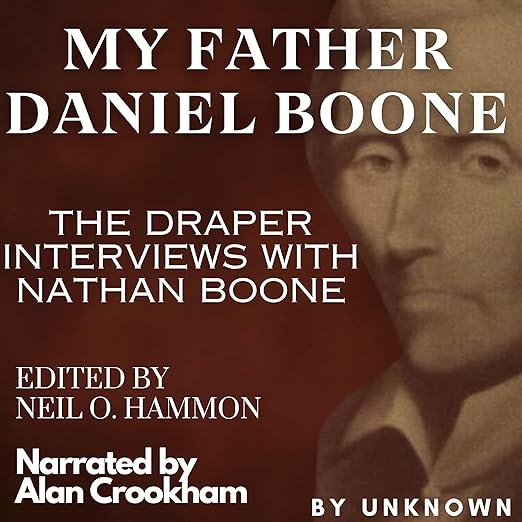
Lyman Draper walked hundreds of miles through the South during the Civil War to save historical manuscripts from destruction. That fact alone establishes the stakes of My Father, Daniel Boone as an audiobook: what you hear is not a retelling or a synthesis but the result of a nineteenth-century archivist's obsessive dedication to preservation, specifically the over three hundred pages of notes from an 1851 visit with Nathan Boone, Daniel's youngest son, and Nathan's wife Olive. Alan Crookham narrates with the careful respect the source material deserves, keeping the historical distance between the events and the listener present without making the text feel embalmed.
Daniel Boone is one of the most over-mythologized figures in American history, his actual life buried under a succession of commercial representations that began with John Filson's Adventures of Col. Daniel Boone in Boone's own lifetime and continued through the Fess Parker television series and beyond. Nathan Boone was conscious of that mythology and made a point of separating fact from fiction in his conversations with Draper. The portrait that emerges from his testimony is more complex and more credible than the legend, a man who was an extraordinary tracker and hunter, a capable military leader at Fort Boonesboro, and a financially disastrous land speculator whose title claims repeatedly failed and who eventually moved to Missouri specifically to escape the legal consequences. The heroic portrait survives, but it does so alongside evidence of human-scale failure.
A Transcription Slip That Makes It More Authentic
The book's structure reflects its archival origins. Draper's method was to let Nathan speak and to transcribe what he heard, with editor Neil Hammon providing notes that give context to specific statements and correct identifiable errors. One listener noted a potential slip in the transcription, a moment where a detail about a specific historical figure did not match the timeline, which is precisely the kind of micro-evidence that makes this text valuable as a primary source document rather than a finished narrative. Those moments of inconsistency, when Nathan's memory or Draper's transcription may have introduced an error, are part of what makes the record authentic.
What Nathan preserves is exceptional in its specificity. The methods Daniel used to track game, described by a son who observed them firsthand. The dynamics of his capture by the Shawnee and his years among them, a period of his life that later accounts have treated with varying degrees of romanticism. His defense of Fort Boonesboro, with the practical details of provisioning and military decision-making that do not appear in the legend. His lengthy hunting expeditions and the economic context that drove them. His final years in Missouri, where he went to find land without legal complications and where Nathan was able to observe his father as an old man. Each of these sections offers detail that no secondary source could provide.
Crookham Restores the Original Speech-Act Quality
The audiobook format suits this material particularly well because of the oral testimony at its core. Nathan Boone did not write his memories down. He spoke them to Lyman Draper over the course of an 1851 visit, and Draper transcribed what he heard. Listening to Alan Crookham read that transcription restores something of the original speech-act quality of the account. You hear someone describing what it was like to be the son of a famous man, to watch him navigate political and legal complications, to know that the stories circulating about his father's exploits were a mixture of truth and embellishment. Crookham's narration does not dramatize or perform, which is the right choice for a document that has its own authority as a primary source.
At five hours and four minutes, the book is short for a historical biography, which reflects the nature of the source material: Draper's notes and Hammon's editorial additions rather than a full narrative synthesis. The concision is an asset. Listeners do not need to sit through extensive speculation or narrative reconstruction; they get the testimony and the context, clearly organized and efficiently presented.
Author Credit Reads Unknown, and It's Deliberate
Listeners expecting a conventional narrative biography will find the format unusual. The interview-based structure means the material covers the events of Boone's life non-chronologically, following Nathan's conversational associations rather than a biographical arc. Hammon's editorial notes provide orientation, but the experience is more like reading primary sources than reading history in the familiar sense.
The author credit of Unknown reflects the book's collaborative, archival nature, which may also require adjustment for listeners accustomed to a single authorial voice. Nathan Boone, Lyman Draper, and Neil Hammon all contribute to what you hear, and the layered nature of that provenance is part of what makes the book valuable. Readers seeking the mythology of Boone rather than the evidence about him will find this frustrating, because Nathan corrects the legend at multiple points rather than endorsing it.
Historians and Genealogists Will Call This Indispensable
Historians, genealogists, and readers with a serious interest in the American frontier era will find this an indispensable document. Listeners who appreciate oral history methodology and the specific texture of testimony preserved at one remove from the original events will find the archival structure rewarding rather than awkward. Fans of historical biography who want material that revises rather than repeats the established legend should find plenty here.
Readers who want a fast-moving biographical narrative, listeners who need chronological organization to follow a subject's life, and anyone primarily interested in the Daniel Boone of television and popular mythology should look elsewhere. This is a primary source document with editorial apparatus, and its pleasures are the pleasures of that form.
Before You Listen
Is this audiobook suitable for listeners who already know Daniel Boone's legend fairly well?
Especially suitable. Nathan Boone explicitly works to separate fact from the mythology that had already formed around his father during Boone's lifetime, which makes the book most rewarding for listeners who know the legend and are curious about what the son who actually observed his father's life remembered.
How does the oral history format affect the audiobook experience?
Crookham's narration of Draper's transcription has a quality of testified speech rather than composed prose, which suits the material. The audiobook format restores something of the original speech-act, since Nathan spoke these memories rather than writing them. Listeners who appreciate oral history will find the format adds to the book's authority.
Is this audiobook useful for academic research on Daniel Boone or frontier history?
Yes. The book is based on Lyman Draper's 1851 interview notes, one of the most important primary source collections on Boone's life, with editorial notes from historian Neil Hammon. The review noting potential transcription slips reflects the kind of scrutiny this material rewards in an academic context.