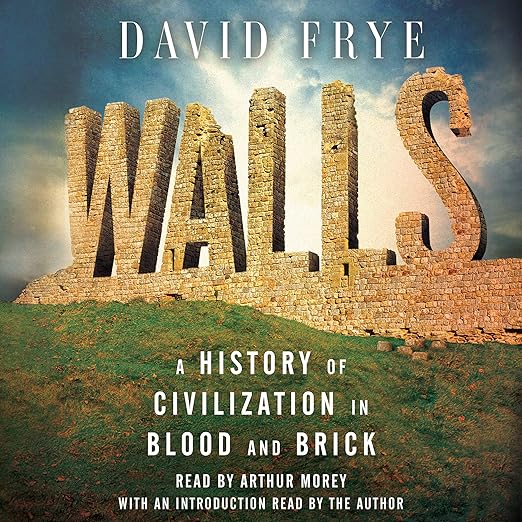
David Frye's history of walls begins, appropriately, before walls existed. The audiobook of Walls, narrated by Arthur Morey across nine hours, opens in the nomadic era, before any human community had stacked mud or stone into a barrier, and then traces the ten-thousand-year arc from that pre-wall condition to the wall-obsessed present. It is, as Kirkus Reviews noted, a timely book, walls have rarely been more politically charged as a subject, but Frye resists the temptation to write a contemporary polemic. The result is something more durable: a genuinely curious popular history that earns its political relevance through historical weight rather than topical argument.
Barriers Produced Civilization Rather Than Reflecting It
Frye's central argument is that walls did not merely reflect civilization, they produced it. The division they created between those protected by walls and those excluded by them reorganized human society at a fundamental level. On one side were people who could farm, accumulate, and specialize. On the other were the nomadic communities that walls had been built against, who remained hunters and raiders because the alternatives had been structurally foreclosed. This is not a neutral architectural history. It's an argument about how barriers shape the people on both sides of them, and that argument carries through from Mesopotamia to the Maginot Line to Cold War Berlin without straining.
A Wry Sense of Humor in Sparta
The breadth of the historical canvas is the book's most striking quality. Frye moves from ancient Mesopotamia and Babylon through Sparta's bizarre anti-wall customs, China's Great Wall and its actual military logic, Rome's frontier barriers, the thousand-mile wall hidden in Asia's steppes that almost no one knows about, the epic siege of Constantinople, and eventually to Hollywood gated communities and contemporary border politics. Each location and period gets enough specific detail to feel visited rather than summarized, and Frye's prose carries what one reviewer accurately called a "wry sense of humor", the Spartan material, in particular, is presented with a deadpan comedy that makes it stick.
The Maginot Line chapters are among the most satisfying in the book because Frye refuses the standard interpretation of the Line as simple strategic folly. He contextualizes it within the psychological logic of walls, why civilized populations build them, what they cost, and what happens when the thing that protects you also becomes the thing that imprisons your strategic imagination. That reframing of a well-known historical episode is the kind of intellectual move that makes popular history worth reading.
Morey's Deadpan Conviction Makes the Comedy Land
Morey's narration is a significant reason to choose the audio version. He has a quality that is rarer than it sounds in historical nonfiction narration: he can sustain a wry register without letting it tip into sarcasm. Frye's prose has a dry wit that depends on timing, and Morey delivers it with enough deadpan conviction to make the comedy land. The Spartan ritual sections and the Hollywood gated community passages, two of the book's more absurdist episodes, work particularly well in audio because Morey's restraint amplifies rather than undercuts the humor.
From Mongolia to Berlin Without Losing Pace
The nine-hour runtime moves faster than the subject matter might suggest. Frye structures the book as a journey across time and place rather than a systematic argument, which means each new location brings a change of scene. The chapters on Mongolia and the steppe wall, the siege of Constantinople, and the Cold War Berlin segments each carry their own narrative momentum, and Morey's pacing adjusts to each context. Reviewers have noted that the book doesn't read as a dry academic history, and Morey's performance reinforces that characterization at every turn.
The contemporary political relevance is present but not belabored. Frye raises the questions the history generates, Did walls make civilization possible? Can we live without them?, without pretending the book answers them definitively. That restraint is appropriate. The history is too rich and too morally complicated to support a simple verdict, and both Frye and Morey seem to understand that the value of the book is in the asking rather than the conclusion.
Psychological Dimensions Matter More Than Tactics
Listeners looking for a comprehensive military history of specific walls, detailed tactical analysis of the Great Wall, say, or a granular account of Hadrian's Wall as a fortification system, will find Frye's treatment more interested in the cultural and psychological dimensions than the engineering ones. This is a history of what walls mean and what they do to the people they contain and exclude, not primarily a history of how they were built. That's a deliberate choice, and it's the right one for the book Frye wanted to write, but it shapes expectations about depth at specific locations.
The later chapters on contemporary walls are necessarily more speculative than the ancient and medieval sections, where the historical record is established. Frye's analysis of gated communities and border walls involves interpretive claims rather than documented events, and listeners who found the ancient history most engaging may find the contemporary material less grounded. But the connective argument, that the human relationship with barriers has remained structurally consistent across ten millennia, holds, and Frye earns the contemporary application through the weight of the preceding historical record.
Read This if You Like Simon Winchester
This audiobook is well suited to listeners who enjoy popular history with a clear argument and a specific strange subject: readers of Simon Winchester, Charles Mann, or John Fabian Witt will recognize the genre and appreciate the execution. It also works well for anyone who finds themselves thinking seriously about contemporary border and immigration politics and wants a historical frame that predates and transcends any single moment.
Skip this one if you need deep-dive treatment of specific walls or civilizations rather than a comparative sweep. The breadth is the point, and listeners who want the granular detail of, say, a dedicated history of the Great Wall will find this too brief at each stop. But as a nine-hour argument for taking walls seriously as a civilizational force, it does exactly what it sets out to do.