Key Details
- Voice: Jeff Speck self-narrates his own urban planning guide, and his delivery has the confident clarity of someone who has argued these ideas at city council meetings - practical, direct, and occasionally impassioned when the evidence is particularly strong.
- Big ideas: urban walkability, city planning reform, transportation and public health
- Atmosphere: Engaged and persuasive, with strong data backing every argument
- Worth it?: One of the most practically useful urban planning audiobooks available - Speck gives listeners the conceptual vocabulary and the specific tools to advocate for change in their own communities.
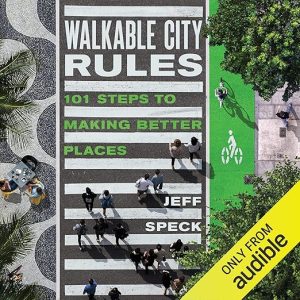
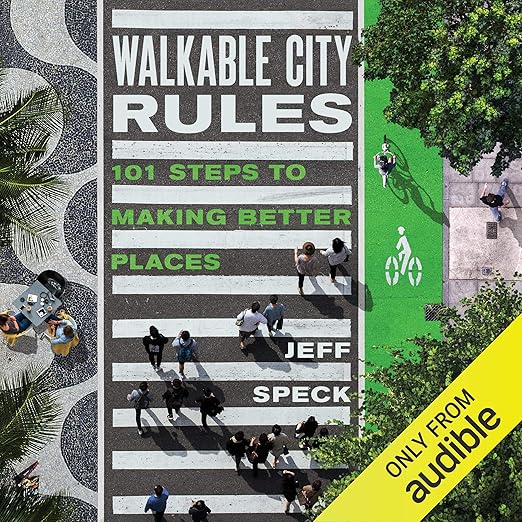
Jeff Speck has spent his career arguing that American cities are failing their residents not through grand ideological failures but through accumulated small decisions about parking minimums, lane widths, and sidewalk continuity. Walkable City and its companion volume Walkable City Rules form his most complete case for why walkability is not a luxury but a precondition for urban health, economic vitality, and genuine livability. Speck self-narrates the audiobook, and his delivery has the assured cadence of someone who has made these arguments in front of planning commissions and city councils often enough to know exactly which points require emphasis and which can move quickly. This is a craft of self-narration that actually improves on what a professional narrator would deliver, because the authority behind the arguments is present in the speaker's voice, not performed for it.
Speck's central argument is both simple and counterintuitive: nearly every American city would like to be more walkable, very few are taking the right steps to get there, and the gap between aspiration and action is primarily a knowledge problem. The original Walkable City was written to inspire - to make the case for why walkability matters and to orient readers toward the evidence that supports it. The companion Walkable City Rules is a doer's guide: 101 specific, numbered rules grouped into 19 chapters covering everything from parking policy to the spatial dynamics of comfortable pedestrian environments. Together they function both as intellectual grounding and as a practical manual for anyone who wants to change how their city works.
The audiobook's companion PDF is worth flagging early. The rules format - visual, illustrated, designed to be cited in arguments at planning commissions - is genuinely enhanced by having the written document alongside the audio. Speck's narration of each rule works as explanation and orientation, but the specificity of some rules around lane widths, setback ratios, and parking count formulas is easier to apply if you can refer back to the written text. The PDF is available in your Audible library with your purchase, and using both formats together gives you the full toolkit Speck intended when he structured the companion volume as he did.
Why Listen to Walkable City
The audiobook earns its strong ratings through a combination of intellectual rigor and genuine accessibility. Speck is not writing for urban planning professionals, though professionals in transportation and city design will find the material technically credible. He is writing for the city councilor who wants to make a better case for pedestrian infrastructure, for the transportation commissioner who needs to explain the health benefits of cycling lanes to skeptical colleagues, and for the citizen who knows their city is failing pedestrians but cannot articulate why in a way that will move bureaucracies. One reviewer who presents this material to fellow transportation commissioners described it as indispensable for exactly that purpose, which captures the specific practical register Speck achieves.
The chapters on escaping automobilism - Speck's term for the car-centric planning orthodoxy that has shaped American cities for decades - are the audiobook's most ambitious and most successful. He traces how specific policy decisions accumulated into the car-dependent built environment that now makes walkability so difficult to retrofit, and does it with enough historical specificity that the argument feels grounded rather than ideological. The sections on parking are particularly well-argued, addressing the counterintuitive ways that parking supply actually undermines the economic vitality it is supposed to support - a point that lands differently on listeners who have watched their own downtown cores hollow out around surface lots and parking structures.
What to Watch For in Walkable City
The audiobook is unambiguously an argument for a specific set of urban planning values. Speck is not neutral on these questions, and the book does not pretend to be a balanced survey of competing city-planning philosophies. Listeners who are already skeptical of density and walkability as planning priorities will find themselves in conversation with a committed advocate rather than a dispassionate analyst. That is not necessarily a flaw - Speck's arguments are well-evidenced and his specific recommendations are detailed enough to evaluate on their merits - but it means the audiobook functions as persuasion as much as information, and listeners should bring their own critical engagement rather than passive reception.
The rules format in the companion volume can feel somewhat catalogic in audio, particularly in chapters that cover multiple specific measurements and ratios. Speck's narration does what it can to animate these sections, but listeners following along purely by ear will absorb the conceptual principles more readily than the specific numerical guidelines. The practical application of the 101 rules benefits significantly from having the PDF in hand, particularly for anyone who intends to use the material in actual advocacy contexts where citations and specific figures are expected.
Who Should Listen to Walkable City
City planners, transportation commissioners, urban design advocates, and engaged citizens who want to understand why their city works or does not work the way it does will find this audiobook directly useful. The structural clarity and Speck's confident self-narration make the material accessible to anyone who cares about where they live, regardless of prior planning knowledge. Listeners planning to use the content in actual advocacy - at city council, in community presentations, in conversations with local officials - should download the companion PDF alongside the audio to have the specific rules and data points available for citation in real contexts. People looking for a more academic treatment of urban planning theory will find Speck's practical focus slightly limited in that direction, but for anyone who wants to understand what makes a city good to walk in and what it actually takes to change a city that is not, this audiobook is among the most actionable resources available in its category.
Is this audiobook more useful for urban planning professionals or general readers?
Speck pitches the material to an engaged general audience rather than specialists, and it works for both. Reviewers include transportation commissioners who have presented the content to colleagues and general readers who wanted to understand why their city is hard to walk in. The conceptual arguments are accessible without prior planning knowledge; the specific rules are detailed enough to be credible to professionals.
Does the audiobook cover both the original Walkable City and Walkable City Rules content?
The audiobook edition incorporates content from both volumes - the original Walkable City, which makes the inspirational case for walkability, and Walkable City Rules, which translates those principles into 101 specific, actionable guidelines. Together they give you both the intellectual foundation and the practical toolkit Speck developed across the two books.