- Performance: Jeff Speck self-narrates with the pacing of someone who has made these exact arguments to real planning commissions for years.
- What it covers: Urban walkability, parking reform, practical civic advocacy
- Feel: Practical, reference-driven, quietly persuasive
- Our call: An actionable, expert-narrated toolkit for anyone actually trying to change how their city works, best used with the companion PDF.
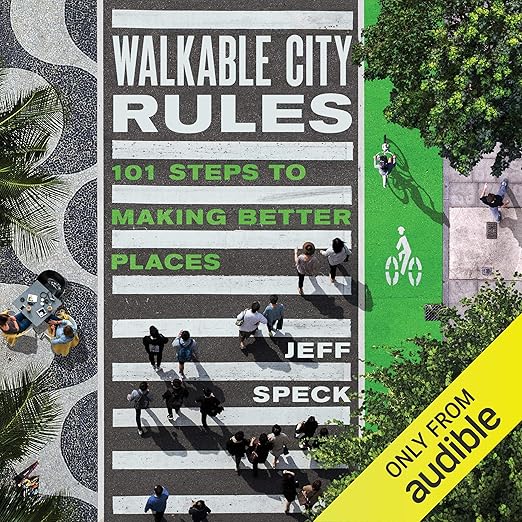
One hundred and one rules across nineteen chapters make up the audiobook Walkable City Rules, and Jeff Speck, the urban planner who wrote it, narrates every one of them himself. This is a direct follow-up to Speck's bestselling Walkable City, and the shift in mission is right there in the two titles: the first book existed to inspire, this one exists to enable, functioning as what the author calls a doer's guide for anyone actually trying to change how a city works. At eight hours and six minutes, it moves through selling walkability, fixing parking, escaping automobile dependency, and building genuinely comfortable public space.
David Owen of The New Yorker is quoted calling Speck someone who 'knows how to make them work' when it comes to cities, and that practical, mechanism-focused reputation is exactly what carries over into the audiobook. A PDF companion ships alongside the audio, since the 101 rules are, per the publisher, illustrated for clarity and packed with specifications and data that benefit from a visual reference.
The book's organizing structure, 101 discrete rules grouped into 19 chapters, is built for reference use as much as linear listening, and that's a meaningfully different design goal than Speck's first book. Walkable City made an argument; Walkable City Rules assumes you're already convinced and hands you the actual talking points, worded specifically, as the synopsis notes, for arguments at the planning commission. That's an unusually candid statement of purpose for a nonfiction audiobook to make about itself.
What holds the whole structure together across nineteen chapters covering everything from parking reform to street design is Speck's consistent voice as both author and narrator, someone speaking from decades of actual consulting work rather than academic distance. The rules move from big-picture arguments, selling walkability to a skeptical city council, down to granular specifics, exact parking ratios, comfortable sidewalk widths, and the tone stays consistent across that entire range.
Speck's authority on this subject is not incidental. He has spent his career as a city planner and urban designer, including a stint directing design programs at the National Endowment for the Arts, and he co-authored the influential Suburban Nation before writing Walkable City and this follow-up. That professional throughline, decades spent specifically on how the built environment shapes daily behavior, is part of why the 101 rules here read as tested field knowledge rather than academic theory assembled secondhand.
What Jeff Speck Gets Right
Self-narration by a working urban planning consultant is a genuine asset here, not just a nice authenticity touch. Speck has spent his career making exactly these arguments in front of skeptical planning commissions and city councils, and that lived experience is audible in how he paces persuasive material, he knows which objections are coming and clearly built the rules to preempt them, which a professional narrator reading someone else's talking points could never quite replicate.
Listener AyJayATL bought the book specifically to bring insights back to their own city's mayor and commission in Athens, Georgia, and reports learning 'so much more about urban planning than I ever hoped', a strong, specific endorsement from exactly the kind of engaged-citizen audience this book is built for. That's the book functioning exactly as designed: turning a motivated local resident into someone who can speak the technical language of planning commission meetings.
Reviewer Idena Suzanne goes further, describing having actually presented material from the book to fellow commissioners in an official capacity as a Transportation Commissioner and Active Transportation Advisory Commission chair. That's about as direct a real-world application of a nonfiction audiobook's content as this genre gets, and it speaks to how genuinely actionable the material is rather than merely inspirational.
The chapter groupings themselves tell you how practically minded the book is: selling walkability to skeptical audiences, getting the parking right, escaping automobile dependency, making comfortable spaces and interesting places, and doing it now, each phrased as an action a reader is meant to actually take rather than a concept to simply understand. Parking specifically gets sustained attention, a subject that sounds mundane until you realize how much of American urban space and municipal policy actually revolves around where cars sit when they're not moving.
Things to Know Before Starting Walkable City Rules
Passive listening will only get you so far here, and that's worth acknowledging directly. A rules-based reference book organized into 101 discrete entries doesn't build the same narrative momentum as a book with a single sustained argument, and listeners expecting Walkable City's more essayistic pull should recalibrate: this is denser, more specification-heavy, and rewards active, engaged listening, ideally with the companion PDF open, more than passive background play.
The PDF companion isn't optional for anyone who actually wants to use this as a working reference rather than a one-time listen. Data tables, illustrated specifications, and exact figures don't translate fully into narration no matter how clearly and patiently Speck reads them aloud, and a listener planning to cite this material at an actual planning commission meeting should have the visual document in hand, not just the memory of an audio chapter.
Numbered-rules nonfiction is its own small genre, promising the reader a scannable, arguable, presentation-ready structure rather than a single sustained argument they have to accept or reject wholesale. Speck's version earns that format by keeping each rule genuinely specific and actionable rather than padding the count with restated generalities, a real risk whenever a nonfiction book commits to an arbitrary round number like 101.
Who Jeff Speck Is Writing For
City planners, transportation commissioners, and local advocates actively working to change their own community's infrastructure are the clearest audience, and reviewer Carly Creating's blunt verdict, titled simply 'A MUST READ,' reflects how directly useful practitioners have found the material.
It's also a strong pick for engaged residents without a planning background who want to walk into a city council meeting speaking the same technical language as the professionals in the room, following the same path AyJayATL and Idena Suzanne describe taking.
Architecture and urban studies students preparing for a career that will eventually involve real planning commission meetings will get practical value that purely academic texts on walkability rarely offer, since Speck's rules translate theory into the exact vocabulary and format those meetings actually use, right down to specific parking ratios and sidewalk-width recommendations a classroom syllabus rarely covers in that much granular, arguable detail.
Passive, background listeners should adjust expectations: this rewards active engagement, best paired with the companion PDF and a specific local project in mind, far more than it rewards a single casual pass with no follow-up action, since the entire design of the book assumes the rules are going to actually get used somewhere.