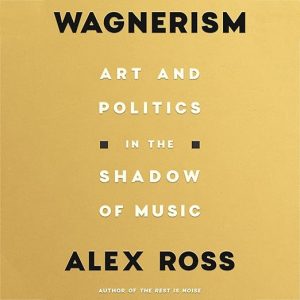
Virginia Woolf, Thomas Mann, and Paul Cezanne all fell under the same spell, and so, catastrophically, did Adolf Hitler. Alex Ross's Wagnerism spends nearly twenty-eight and a half hours tracing how one composer became, in the author's own words, the proving ground for modern art and politics, an aesthetic war zone where anarchists, occultists, feminists, and gay-rights pioneers once saw a kindred spirit in the same figure the Nazis would later weaponize into their soundtrack. This audiobook is narrated by Ross himself and threaded throughout with actual excerpts from Wagner's compositions, a production choice the print edition simply cannot offer.
Ross's Reach From Architecture to Civil Rights
Ross, a New Yorker music critic and the author of the Pulitzer Prize finalist The Rest Is Noise, is working at the scale that book made his reputation on, except here the entire structure orbits a single figure rather than a century of music broadly. Reviewer Manny M calls him the greatest living music critic writing in English, and the claim is at least borne out by range: this book moves confidently between the architecture of Louis Sullivan, the science fiction of Philip K. Dick, the Zionist writing of Theodor Herzl, and the civil-rights essays of W.E.B. Du Bois, all treated as legitimate Wagnerian inheritance rather than tenuous namedrops.
Reviewer John W makes a point worth foregrounding for anyone hesitant about a twenty-eight-hour commitment to a single composer: loving, or even particularly liking, Wagner's music is not a prerequisite for getting real value out of this book. The subject, per that same reviewer, is best understood as intellectual and cultural history, using Wagner's outsized influence as a lens onto a much broader argument about how art gets absorbed, distorted, and weaponized across a century of very different movements.
Of all the cross-disciplinary connections Ross draws, the line from Wagner's mythmaking to Philip K. Dick's science fiction is among the least obvious on paper and among the most rewarding once explained, both builders of total, self-contained mythological systems meant to be entered rather than simply read, a lineage that helps explain why Wagnerian leitmotif structure still echoes through modern franchise storytelling and superhero-film scoring decades later. Tracing that specific thread is the kind of connection a lesser cultural history would gesture at; Ross actually builds the case.
Hearing Wagner's Own Music at the Right Moment
The inclusion of actual Wagner excerpts throughout the narration is a genuine audio-format advantage worth taking seriously; a reader can look up a reference to Tristan und Isolde in print, but hearing the music itself, at the exact moment Ross is discussing its influence on a particular writer or movement, does real interpretive work no footnote can replicate. Combined with Ross's own narration, a critic reading his own prose rather than a hired voice interpreting it secondhand, this production leans into exactly what audio can do that the page cannot.
An Aesthetic War Zone of Beauty and Violence
The book's tragic frame, an artist who Ross suggests might have rivaled Shakespeare's reach undone by an ideology of hate, gives even its most academic passages real narrative propulsion. Reviewer Manny M's description of loving and hating Wagner simultaneously captures the tension the whole book sits inside, and Ross never resolves that tension into a simple verdict, refusing, as the synopsis puts it, either apologia or condemnation in favor of a more honest reckoning with how art actually moves through the world.
Ross's own phrase for Wagner's legacy, an aesthetic war zone where the Western world wrestled with its capacity for beauty and violence, sets the book's actual thesis apart from a simple hagiography or takedown. The argument is not that Wagner's admirers were wrong to be moved, or that his later Nazi appropriation retroactively poisons the music itself; it is that both responses, worship and horror, were reasonable reactions to the same body of work, and untangling why requires exactly the kind of patient, wide-lens history this book provides.
Momentum Resets Every Time Ross Changes Fields
At just over twenty-eight hours, this is one of the longer titles in any nonfiction catalog, and listeners should budget for a real commitment rather than a quick cultural-history primer. The cross-disciplinary structure, hopping from opera to architecture to civil-rights writing, means momentum occasionally resets as Ross pivots fields, which rewards a listener comfortable with that kind of associative structure over one expecting a strict chronological throughline.
Not every response to this book has been uncomplicated enthusiasm. One reviewer who ultimately awarded five stars for the sheer scale of the research nonetheless voiced real reservations partway through, suggesting the payoff did not fully match the effort invested by that point in the listen. That reaction is worth flagging as a genuine counterweight to the otherwise strong consensus, since a book built on this much cross-referenced material can occasionally strain even a sympathetic reader's patience.
Placing Theodor Herzl's Zionist writing and W.E.B. Du Bois's civil-rights essays inside the same Wagnerian lineage as European occultists and American architects is a genuinely bold structural choice, and it mostly earns its ambition, but it also means individual chapters can shift subject and register quickly. Listeners who prefer a single sustained argument developed slowly, rather than a wide net of case studies each making a related but distinct point, should know this book's structure leans toward the latter.
Skip It for Pure Musicological Analysis
Cultural and intellectual history listeners are the clearest audience, especially anyone who already made their way through The Rest Is Noise and wants Ross's same combination of erudition and narrative drive applied to a tighter, single-subject frame. Classical music enthusiasts will get an extra layer of reward from actually hearing the referenced excerpts, but as John W's review confirms, deep prior knowledge of Wagner's catalog is not a prerequisite.
Skip this one if a strictly musicological or technical analysis of Wagner's compositions is the goal; this is cultural and political history built around a composer, not a music-theory deep dive. Skip it too if a shorter, single-sitting listen is needed, since nearly twenty-eight and a half hours demands real patience. For listeners genuinely curious how one nineteenth-century composer's shadow reached superhero films and fantasy fiction, though, this is a rare, ambitious work of cultural synthesis.
A Few Questions About Wagnerism
Do I need to know Wagner's music to follow this audiobook?
No. One reviewer explicitly notes that loving or even liking Wagner's music is not necessary to appreciate this book, since it functions primarily as intellectual and cultural history rather than musicology.
Does this audiobook actually include musical excerpts from Wagner's compositions?
Yes. The production includes excerpts from Wagner's music throughout the narration, a feature specific to the audiobook edition that the printed book cannot replicate.
How does Wagnerism address Wagner's antisemitism and Nazi appropriation?
Directly and without minimizing it. The book traces how Hitler incorporated Wagner into Nazi Germany's cultural identity, and Ross frames the composer's legacy as neither apologia nor condemnation but an honest reckoning with both his influence and his ideology.
Is Wagnerism a sequel to The Rest Is Noise?
Not a direct sequel, but it comes from the same author and shares its ambitious, cross-disciplinary approach to music history, this time focused entirely on Wagner's influence rather than the twentieth century broadly.