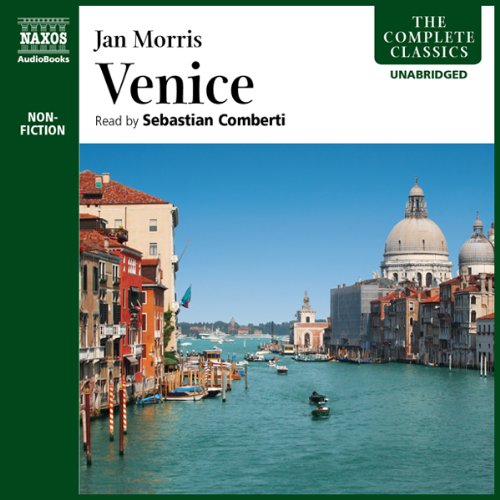
Dennis Romano is credited as the author of this audiobook, but the actual content on this specific listing, confirmed by the synopsis text, the attached reviews, and narrator Sebastian Comberti's own track record, is Jan Morris's Venice, the celebrated 1960 portrait of the city that helped establish Morris as one of the twentieth century's great travel writers. That mismatch is worth naming upfront: Romano is a real, separate historian with his own more recent academic history of Venice, but nothing in this particular recording's synopsis or reviews points toward his book. One reviewer's own review title says it plainly: 'Venice by Jan Morris.'
Written Before Conundrum, Already Alert to Liminal Identity
Morris opens with Venice standing, in her words, on the frontier between east and west, quoting Goethe's description of the city as 'the market-place of the Morning and the Evening lands.' That opening sets the register for everything that follows: less a conventional history with dates and rulers marching in sequence, more an impressionistic, deeply personal portrait built from decades of the author's own observation and research.
Reviewers consistently describe the prose as elevated and allusive. One calls Morris 'a formidable scholar' who 'drifts from topic to topic with an impressive array of facts, anecdotes and observations,' adding that some references required independent research to fully catch. That's a fair characterization of Morris's style broadly: dense, literary, assuming a reader willing to follow tangents rather than a straight linear narrative.
Morris wrote Venice in 1960, more than a decade before Conundrum, her landmark 1974 memoir about her own gender transition, and knowing that later book exists adds a certain resonance reading backward into this earlier one. Long before she wrote directly about her own transformation, Morris had already built a career noticing how places hold contradiction, how a city can stand, as she puts it, on a genuine frontier between two worlds without fully belonging to either. That attentiveness to liminal identity, whether a city's or, later, her own, runs through her body of work more consistently than most travel writers ever manage.
A City Manufactured by Its Place on a Map
The reviewer who called Morris 'a formidable scholar' also noted the prose 'drifts from topic to topic,' and that structural looseness is a genuine feature of the book rather than a flaw to excuse. Morris organizes by association and observation more than strict chronology, moving from architecture to local custom to historical anecdote as the city itself seems to suggest them, which mirrors how an attentive visitor's own attention actually moves through Venice rather than imposing a textbook's rigid structure onto the experience.
That opening framing about standing between East and West does more work than a decorative flourish; Morris returns to the idea in concrete form throughout, Byzantine and Islamic architectural influences, trade goods and artistic styles moving in both directions across centuries, a cultural identity built specifically on exchange rather than isolation. The book's real argument, carried inside richly descriptive prose, is that Venice's entire character was manufactured by its position on a map, not simply inherited.
The synopsis closes on its own strong claim, that no city on earth gives 'a more immediate impression of symmetry and unity, or seems more patently born to greatness' than Venice, and Morris spends her whole book earning that assertion rather than simply stating it upfront and moving on. The rating on this specific listing, 4.5 from 540 ratings, reflects a book that has held up as a genuine reference point for literary Venice writing across more than six decades since its original publication.
Comberti Paces Long Passages Without Going Soporific
Sebastian Comberti's narration is well matched to Morris's specific register. His reading carries a lyrical intelligence through elevated, musical prose without losing its natural rhythm, and he paces the long descriptive passages, exactly the kind of extended set-piece writing Morris specializes in, without letting them go soporific, a real risk with this much unbroken descriptive prose read aloud.
Weeks of Pre-Trip Listening, Before Trieste Existed
At thirteen hours and one minute, the audiobook gives Morris's discursive style the room it needs; this isn't a book built for efficient plot summary, it's built for immersion, and a shorter treatment would have to cut the very digressions reviewers praise most. Multiple reviewers mention using the book specifically to prepare for a trip to Venice, and the long runtime supports that use case, giving a traveler weeks of pre-trip listening material rather than a single afternoon's overview.
Venice predates Morris's later, equally admired city portraits, including Trieste and the Meaning of Nowhere, her final book, and listeners who come to this one first are hearing her earlier voice: still confident and richly allusive, but writing before decades more travel and research had further deepened her range. Read in either order, the two books make an interesting bookend pair around one writer's lifelong preoccupation with cities that sit at the edge of larger empires and identities.
Some Allusions Will Send You Off to Research
The prose asks something of its listener. One reviewer admits some of Morris's allusions 'bypassed me,' requiring quick outside research to fully land. That's worth knowing going in: this isn't breezy travel writing built for passive listening, it rewards focused attention and, occasionally, a pause to look something up.
Because the credited author field is wrong, searching for this specific audiobook by Dennis Romano's name won't reliably surface it again, and anyone specifically seeking Romano's own academic history of Venice should look for that title separately rather than assuming this recording is his work under a different framing.
Context and Mood Ahead of a Visit, Not Logistics
This is not a guidebook, and listeners expecting practical trip-planning information, hours, addresses, transit routes, should look elsewhere entirely. What it offers instead is atmosphere and historical grounding: a sense of the city's centuries of trade, art, and self-mythology that a guidebook has no room for. Reviewers who used it as trip preparation specifically valued this: context and mood ahead of a visit, not logistics during one.
Listeners who prefer travel writing organized strictly by neighborhood or itinerary, the structure many modern travel audiobooks favor, should adjust expectations; Morris organizes by theme and historical association rather than by a walkable route through the city. That's a deliberate choice suited to armchair immersion and pre-trip context rather than in-the-moment navigation, and it's worth knowing before expecting a book you could follow step by step while actually walking Venice's streets.
More Work Than Pleasure for a Distracted Commute
Anyone planning a trip to Venice, or anyone who simply loves literary travel writing in the register of a well-read, deeply informed friend rather than a guidebook, is the clear audience. Fans of Morris's other acclaimed work, including her Pax Britannica trilogy, already know what to expect and will find the same voice here.
Skip it if you want a conventional chronological history with clear dates and rulers, or if elevated, allusive prose asking for active attention rather than passive listening sounds more like work than pleasure; Morris rewards patience more than she accommodates a distracted commute.
- Narrator: Sebastian Comberti's lyrical delivery matches Jan Morris's elevated, musical prose precisely.
- Subjects: Literary travel writing, cultural history, a single city's identity
- Tone: Immersive, allusive, best suited to focused listening
- Bottom line: A genuine literary-travel classic misfiled under the wrong author's name, worth seeking out regardless.
Good to Know
Is this Venice audiobook actually written by Dennis Romano, the credited author?
No. The synopsis, reviews, and narrator history all point to Jan Morris's 1960 book Venice rather than Romano's separate, more recent academic history, despite what the listing's author field states.
Does this audiobook work well for listeners planning an actual trip to Venice?
Yes, several reviewers specifically describe using it to prepare for a visit, and the long runtime gives a traveler enough material for weeks of pre-trip listening.
How demanding is Jan Morris's writing style for casual audiobook listening?
Fairly demanding by design. The prose is elevated and allusive, and at least one reviewer notes some references required outside research, so this rewards focused attention more than background listening.