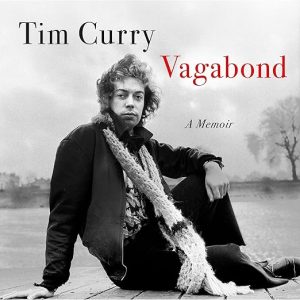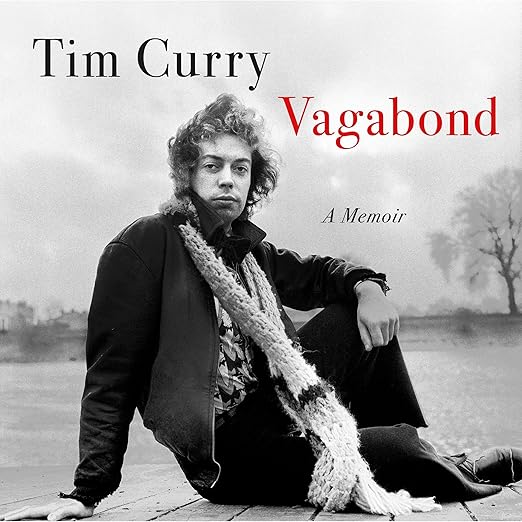
Tim Curry narrating his own audiobook memoir is one of those casting decisions that feels almost cosmically correct. Vagabond, written and read by Curry himself, covers roughly five decades of one of the most eclectic careers in 20th-century entertainment, and the format - at 10 hours and 40 minutes - turns out to be the ideal vessel for it. Curry's distinctive English baritone, the one millions first heard in the basement of the Frankenstein place, gives even the quietest passages an air of theatrical occasion. This is not a tabloid confessional or a string of Hollywood name-drops. It is something rarer: a genuinely self-aware account of what it costs to build a life entirely on transformation.
Curry moves through his life roughly chronologically, beginning with his upbringing as a military brat and moving through the boarding schools and university years that shaped his voice and his understanding of performance. The early chapters carry a kind of quiet English melancholy that the later ones, full of Broadway footlights and film sets, never quite lose. What distinguishes this memoir from the standard celebrity retrospective is Curry's refusal to sentimentalize his own ambition. He does not present himself as a man who always knew he was destined for greatness. He presents himself as someone who kept showing up, kept transforming, kept taking roles that other actors considered beneath them or too weird to touch, and found that weirdness was his most durable asset. The account of landing Dr. Frank-N-Furter and understanding, even then, that the role would define him in ways he could not control is handled with a clarity that only hindsight provides.
One reviewer called this memoir the story of a man who is 'so much more than Frank,' and the book bears that out across its runtime. Curry gives substantial time to his stage work, including his Tony-nominated turn in the original Broadway and West End productions of Spamalot, and to the voicework that became a second career after his 2012 stroke. The stroke passages are handled without self-pity, which makes them land harder. He describes the experience of surviving it and the slower process of re-learning what his voice could still do with the same matter-of-fact precision he brings to everything else in this book. It is not a trauma narrative; it is an accounting. Curry is also clear-eyed about the particular position he occupied in Hollywood: someone whose reputation for commitment and genuine craft opened doors, but whose unconventional persona meant those doors were never the most obvious ones. The sections describing how he chose roles - the Clue ensemble, the voiceover years, the stage work he clearly loved most - reveal a man with a coherent artistic philosophy that the surface catalog of horror icons and comic villains tends to obscure.
From Childhood to Chair, Unhurried and Comprehensive
The narration is the central argument for choosing the audio format. Curry's delivery is not a polished read-through but a performance in the truest sense. He modulates between anecdote and reflection with the ease of a man who has spent fifty years reading an audience. There are moments of sly humor - the kind that arrives without telegraphing itself - that land specifically because of his timing. Reviewers have noted his charm and sly wit, and those are the right words, but they undersell the emotional range he brings to the heavier passages. When he discusses the colleagues he lost and the roles he declined, the voice slows, and that slowing is itself informative. No printed page can do that. Audiobook listeners who have spent years hearing Curry in animated roles and film dubbing will find something genuinely new here: the man behind all those voices, speaking in his own register. One reviewer described the listening experience as being taken 'through his life, from childhood to chair' - a capsule of the book's full span that captures how unhurried and comprehensive this memoir is.
Voicework Deserves More Attention Than It Usually Gets
Listeners coming specifically for behind-the-scenes stories from It or Clue should temper their expectations slightly. Curry is more interested in the arc of a career than in the mechanics of individual productions. The Rocky Horror material is rich, particularly his reflections on the cult following that grew around the film after its theatrical release, but the book is structured around a life, not a filmography. The discussion of his voicework - including his prolific career in animation and video games through the late 1990s and 2000s - is one of the sections that deserves more attention than it typically receives in reviews. Curry treats it as artistically serious work, not a fallback, and that reframing is one of the more interesting arguments the book makes. With the 50th anniversary of The Rocky Horror Picture Show approaching, this memoir arrives at a moment when new audiences are encountering Curry's work for the first time, which makes his own account of what all of it meant to him feel especially timely.
Meeting Curry on His Own Terms
This audiobook is the right choice for anyone who grew up with Curry's performances and wants to understand what held them together across five decades and wildly different mediums. It will also appeal to listeners interested in character acting as a discipline and in the specific pressures of building a career on transformation rather than stardom. Those who prefer reading celebrity memoirs in print may find this one of the cases where the audio format is genuinely superior: the authorial voice is present in a way that page typography cannot replicate. Listeners looking for a gossipy Hollywood memoir or extensive plot recaps of his films will find this quieter and more literary than they expect. Those who come to it ready to meet Curry on his own terms will find one of the more honest and graceful memoirs the entertainment world has produced in some time.
Before You Listen
Does Tim Curry actually narrate the Vagabond audiobook himself?
Yes. Curry reads the entire memoir himself, and at 10 hours and 40 minutes, his narration is a central part of the experience. His voice and comic timing are inseparable from the material.
Is the Vagabond audiobook focused mainly on Rocky Horror or does it cover Curry's full career?
It covers his full career, from childhood through his stage work, film roles, and voiceover career. Rocky Horror receives significant attention, but the book is explicitly structured as a life story, not a single-film retrospective.