Before You Press Play
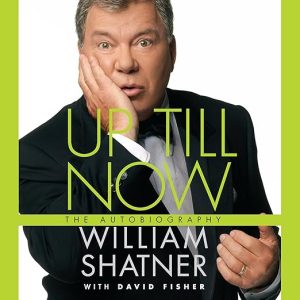
- Performance: William Shatner narrating his own autobiography is the only casting that could work - his voice carries the same theatrical self-awareness that defines the book's tone, equal parts self-deprecating and grandiose.
- What it covers: Career reinvention, Hollywood mythology, persona versus person
- Feel: Funny, nostalgic, and occasionally tender
- Our call: Shatner's autobiography covers sixty years of television and film with restless energy, and self-narration makes it feel like a long conversation with someone who cannot resist the punchline even when the subject is grief.
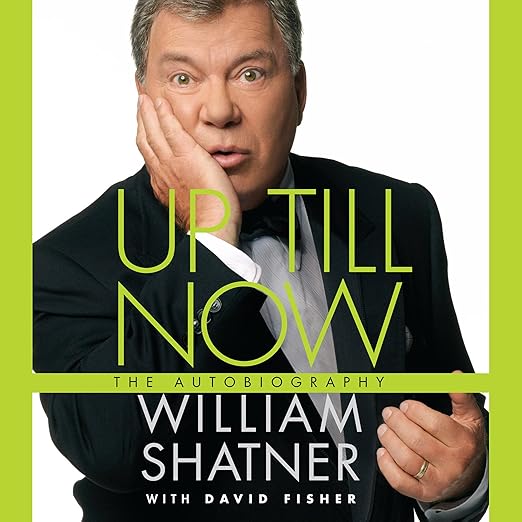
William Shatner has been narrating his own life story since at least 1966, so the decision to have him read Up Till Now himself is less a casting choice than a logical inevitability. This audiobook covers nearly six decades in entertainment with the same combustible mixture of charm, absurdism, and genuine reflection that has defined Shatner's public persona since the original Star Trek series made him Captain Kirk to the entire planet. At ten hours and forty-five minutes, it is a generous and frequently surprising account of a career that refuses to be reduced to a single role or a single era.
What We Made of It
Shatner's autobiography works best when it resists the gravitational pull of the Enterprise. He is, of course, aware that Star Trek dominates any room he enters, and he addresses it directly and generously - the sections on the show's cultural impact and his complicated relationship with the role that defined him are honest and occasionally raw. But the book's real pleasure lies in the stretches before and between those cultural landmarks. His early theater work, stepping in for Christopher Plummer in Shakespeare's Henry V, his Twilight Zone episode staring at something on the wing, his time making a racially incendiary film in the Deep South during the height of the civil rights movement - these sections have the texture of genuine surprise because they belong to a version of Shatner that the Kirk mythology tends to obscure.
One reviewer described the book as complete while also creating the ache of wanting more, which is an accurate account of how it operates. At its peak, Up Till Now makes the case that Shatner is far more interesting as an actor than his most famous role allowed him to be - someone who straddled the classic world of the theater and the new world of television when those were still genuinely different cultural spaces, who starred in history's first all-Esperanto-language film with the same commitment he brought to Shakespeare, who paramotored into a field of paintball-armed fans with what appears to be genuine delight. The irreverence about his own career is not false modesty. When Shatner describes the album called Has Been, he sounds like someone who genuinely found the project interesting rather than someone working through regret. That refusal to rank his own output is either admirable or telling, and the book never fully resolves the ambiguity. One reviewer noted that his interruptions occasionally derail a good story's flow, which is fair - Shatner cannot resist a digression or a self-correction - but those interruptions are also exactly where the personality lives.
Why Up Till Now Works as an Audiobook
The self-narration is the central argument for choosing audio over print. Shatner's voice is not a neutral instrument and he knows it. When he describes the Esperanto film, the delivery carries a particular flavor of delighted disbelief that no hired narrator could replicate. When he describes his second wife's death, the shift in register is immediate and real. The book moves between comedy and genuine loss with the ease of someone who has spent a lifetime calibrating audience response, and on audio that calibration is audible in the breath before a punchline and in the slower pacing of the harder passages.
Fans of his later work on Boston Legal will recognize the same quality that made Denny Crane compelling: the sense of a performer absolutely aware of what he is doing and doing it anyway, enthusiastically, with the performer's knowledge that the performance and the person are no longer meaningfully distinguishable. What a reader loses in print - the timing, the emphasis, the particular note Shatner hits on words like well and universe and everywhere - is material. The New York Daily News quote that closes the book, that it is now Bill Shatner's universe and we just live in it, lands completely differently when Shatner reads it himself: deadpan, proud, possibly ironic, certainly aware of all three possibilities simultaneously. That is the Shatner experience distilled.
What Might Not Land
The book's structure is broadly chronological but Shatner frequently interrupts the timeline to reflect from a present-day vantage, and listeners accustomed to tight memoir architecture may find this disorienting at first. The digressions are where the personality lives, and the structure rewards patience. Watch also for the sections covering T.J. Hooker and Rescue 911, which Shatner treats with the same seriousness as his Shakespeare work. His even-handedness across the career spectrum - refusing to signal which work mattered and which was merely work - is either a performance of philosophical equanimity or genuine evidence of it, and Up Till Now never quite reveals which. The lengthy passages on the Star Trek phenomenon, covering both its original cancellation and its subsequent cultural rehabilitation, are handled with more historical self-awareness than most star memoirs manage. Shatner knows he is a sociological event as much as a career, and he writes about that condition with more honesty than expected.
Who Should Listen to Up Till Now
This audiobook rewards Star Trek fans who want a fuller picture of the actor behind Kirk, but it is at least as entertaining for listeners with no particular attachment to that franchise. Shatner's sense of comedy and his genuine engagement with the stranger corners of his career make this accessible beyond genre fandom. The ten-plus hours pass quickly for listeners who enjoy memoirs built around strong personality rather than strict chronological documentation. Those looking for a conventional celebrity memoir with a clear arc, measured reflection, and consistent tonal register will find Shatner's interrupting, digressing, self-interrupting style frustrating. If you go in expecting a conversation rather than a document, the format makes sense immediately.
Common Questions
Does William Shatner narrating his own audiobook add genuine value or is it primarily a novelty?
It is genuinely valuable rather than a gimmick. Shatner's timing and vocal self-awareness are inseparable from the material - the humor in the writing only fully lands when delivered in his particular register. Several passages around grief and career failure shift in tone in ways that a professional narrator would not replicate authentically. Reviewers consistently describe the performance as the book's primary asset.
Does the audiobook spend most of its time on Star Trek or cover Shatner's broader career?
Star Trek is present throughout but is not the whole story. The book gives significant time to his theater background, pre-Trek television work including The Twilight Zone, later series like Boston Legal, personal experiences, and a range of genuinely strange professional choices. Reviewers consistently note they wanted more, specifically because the non-Trek sections proved so unexpectedly rich.