Quick Take
- Narration: L.J. Ganser delivers Zoroya’s combat sequences with the controlled pace of a war journalist, propulsive without tipping into thriller territory.
- Themes: The birth of modern insurgent warfare, military loyalty under fire, the long tail of combat trauma
- Mood: Visceral and mournful, the feeling of being at the front of something catastrophic without knowing it yet
- Verdict: A meticulously researched account of a battle that changed the Iraq War’s trajectory, with veteran testimony that makes the history immediate and painful.
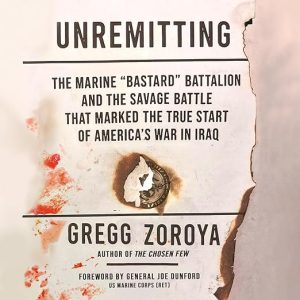
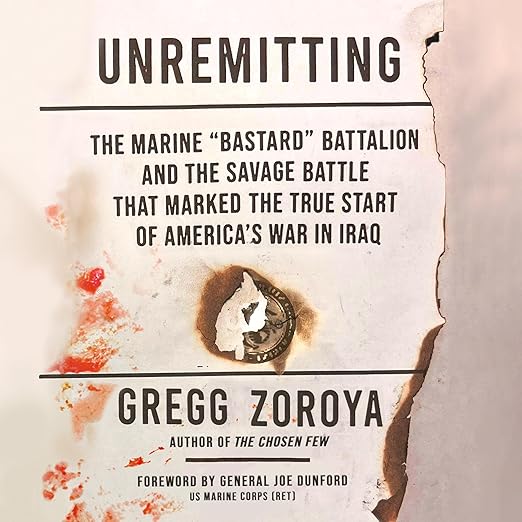
I came to Unremitting knowing only the broad outlines of the Iraq War, the invasion, the insurgency, the IED campaigns that defined the middle years. Gregg Zoroya’s account of the Battle of Ramadi in 2004 gave me something I hadn’t expected: a specific origin point for the catastrophe that followed. By the time L.J. Ganser finished narrating the three-day insurgent offensive against the Magnificent Bastards of the 2nd Battalion, 4th Infantry Regiment, I understood the Iraq War differently than I had before. That’s what the best military history does.
Zoroya is a former USA Today journalist who also wrote The Chosen Few, another account of American forces in the Middle East. His method is recognizable: meticulous research combined with on-the-ground reporting, anchored by the voices of the people who were actually there. In Ramadi’s case, he reconstructs a battle that most American civilians never knew was happening, fought in February 2004, when the public narrative was still about post-invasion stabilization, not insurgent uprising.
The Battalion That Wasn’t Supposed to Be There
The narrative setup is quietly devastating. The Magnificent Bastards were kept stateside after 9/11, sidelined during the initial invasion of Iraq in 2003. They were, in the language of the book, bench-warmers, warriors without a war, floating in the Pacific as others went into combat. Then war came for them in the worst possible way. Thrust into Ramadi with minimal preparation for what they’d find, they faced hundreds of organized insurgents in a coordinated three-day assault on a city of 400,000 people.
Zoroya is careful to situate this battle in both the military and political contexts. The Ramadi offensive of 2004 wasn’t random violence, it was an organized attempt to demonstrate that Coalition forces could be driven out. Understanding that organizational dimension makes the Marines’ response both more impressive and more heartbreaking, because you can see in retrospect that winning this battle didn’t win the underlying argument. The insurgency adapted, and the war that Zoroya’s subtitle calls seven years long was just beginning.
The Veterans Who Knew They Were There
One of the most striking features of the reviews is the comment from someone who identifies themselves as having been in Ramadi during the battle: the author gets the details right, I should know because I was there. This is the reviewer Donovan Campbell, himself the author of Joker One, a memoir of leading a Marine platoon in Ramadi. That kind of validation from a participant is rare and meaningful. It tells you Zoroya did the interviews, checked the facts, and didn’t flinch from the uncomfortable details that make memoir-style military history credible.
Another reviewer, the spouse of a Marine who served there, describes the book as giving voice to what their husband and his brothers went through. This is the function that serious military history serves for families and veterans: it translates private experience into public record. Zoroya understands that function and writes with it in mind. The blow-by-blow battle accounts are balanced by attention to the emotional and psychological aftermath, the trauma remaining with survivors more than two decades later, as the synopsis notes.
Ganser’s Narration and the Journalist’s Register
L.J. Ganser is a reliable performer for nonfiction, and he brings the right qualities to Zoroya’s prose: clarity, measured pacing, the ability to let dramatic facts carry their own weight without excessive emphasis. The combat sequences are rendered with the journalist’s neutral authority, you feel the chaos without the narration manufacturing it. At 13 hours and 48 minutes, the runtime is proportionate to the material. Zoroya doesn’t pad; he narrates the battle in full without losing the strategic thread that makes it historically significant.
The book sits in a specific tradition of Iraq War literature that includes Bing West’s No True Glory (also about Fallujah 2004) and David Finkel’s The Good Soldiers. Zoroya’s contribution is to focus on an earlier, less-documented engagement and to insist on its foundational importance. His argument, that Ramadi truly began the Iraq War as distinct from the invasion, is well-supported by the evidence he marshals.
Who Should Listen / Who Should Skip
Listen if you want to understand how the Iraq insurgency actually started, not the political decisions in Washington but the first major organized military confrontation between Marines and insurgents; if you’ve read Joker One or One Bullet Away and want more ground-level Iraq War history; if you’re interested in how combat trauma travels through the years after a battle ends.
Skip if you’re looking for a strategic overview of the Iraq War as a whole, Zoroya’s focus is deliberately tight on this one battalion and this one battle. The broader context is present but not the book’s primary interest. For the wider picture, Tom Ricks’s Fiasco remains the essential companion.
Frequently Asked Questions
Is this the same battle covered in David Bellavia’s House to House, or a different Ramadi engagement?
Different engagement. Bellavia’s memoir covers the second Battle of Fallujah in November 2004 and subsequent operations in Ramadi in late 2004 and 2005. Zoroya’s book covers the February 2004 uprising, the earlier confrontation that established the pattern the insurgency would follow throughout the war.
Does Zoroya interview the Iraqi civilians who lived through the battle, or only American veterans?
The primary voices are from the American side, Marines, sailors, and soldiers from the 2nd Battalion, 4th Infantry Regiment. This is an acknowledged limitation of most American Iraq War history written in this period, and readers who want the Iraqi civilian perspective should pair this with books by Iraqi journalists and historians.
How does L.J. Ganser handle the differences between the journalist’s analytical sections and the combat narrative sections?
Ganser modulates between the two modes effectively, slightly more deliberate in the contextual analysis, slightly more propulsive in the battle sequences, but never so different that the book feels tonally fractured. The journalist’s neutral register holds throughout.
The subtitle mentions the battle’s seven-year aftermath, how much of the book covers what happened after Ramadi, versus the battle itself?
Zoroya structures the book with the battle at its center but devotes significant attention to the long aftermath, the trauma the veterans carried home, the ways the fight changed the men involved, and how Ramadi’s lessons (and failures to apply those lessons) shaped subsequent years of the war. It is not purely a battle narrative.