Quick Take
- Narration: Jason Zenobia reads with professional clarity, though the material’s listicle structure gives him limited room to vary his approach across the dual manuscripts.
- Themes: Polynesian settlement and Maori civilization, European colonization and the New Zealand Wars, the evolution of bicultural nationhood
- Mood: Survey-mode and informational, an overview rather than an immersion
- Verdict: A serviceable primer on New Zealand and Maori history, best understood as two accessible introductions bundled together rather than deep scholarship on either subject.
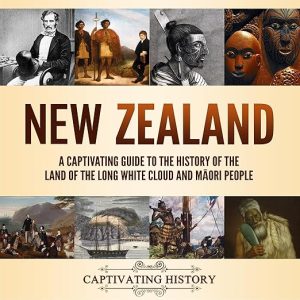
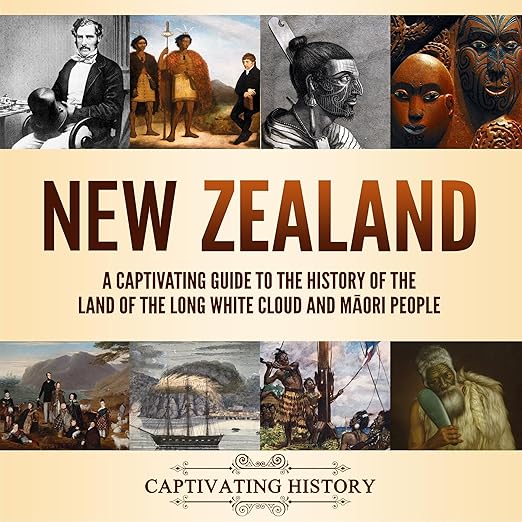
I want to be honest about what kind of book this is before I say anything else, because the mismatched expectations visible in its reviews are almost entirely a function of format confusion. New Zealand from Captivating History is two manuscripts bound together in a single audiobook, one covering New Zealand’s broader history, one focused specifically on the Maori people, and both are written in the house style of the Captivating History series: readable survey prose, organized around bullet-pointed learning objectives, marketed as introductory guides rather than academic texts.
If that is what you need, an accessible orientation to New Zealand and Maori history before a trip, or a framework before reading something more substantial, then this eight-and-a-half hour double bill delivers exactly what it promises. If you want the depth of specific scholarship, or prose that brings the past to life rather than catalogues it, you will need to look elsewhere. The one-star reviewer who noted that the writing felt like a summary of articles was not wrong, but was also describing a feature of the format rather than a flaw unique to this production.
Two Books, Two Different Strengths
The dual-manuscript structure is worth understanding before you commit. The first part, on New Zealand’s general history, moves from the arrival of the Polynesians through Maori Musket Wars, European colonization, and into the 20th century. It covers the expected ground, Abel Tasman and James Cook, the Treaty of Waitangi, the New Zealand Wars, with efficiency and reasonable accuracy. It is not the place to find nuanced argument, but it gives you a reliable chronological skeleton.
The second part, focused specifically on Maori history, is in some ways the stronger of the two. By narrowing its scope to the indigenous perspective, it allows more room to trace the development of Maori civilization before European contact, the dynamics of the isolation period, and the specific mechanisms by which European presence disrupted Maori social structures. The sections on Maori heroes who resisted colonial settlers and the eventual path toward what the book calls newfound prosperity are handled with more texture than the first manuscript’s parallel coverage of the same period.
What Narration Can and Cannot Do with This Material
Jason Zenobia reads with professional clarity and a pace that works for this kind of informational content. He has the kind of voice that suits survey nonfiction, steady, organized, never rushing, but the format does not give him much to work with in terms of dramatic range. When the content shifts from describing the moa’s extinction to detailing the Maori Musket Wars, Zenobia’s delivery does not shift with it, which is partly a narration choice and partly an unavoidable consequence of the writing’s consistent register. This is not a criticism of his performance so much as a note about what the combination of this narrator and this material produces.
The Captivating History series produces these dual bundles at scale, which means any individual title benefits from the series’ polish and suffers from its limitations. The limitation that shows most in this particular title is geographical: the writing is thin on the maps and spatial context that would help a listener who doesn’t already know where the Waikato is or how the geography of the North Island shaped the New Zealand Wars. A print reader has access to whatever maps the edition includes; an audio listener has only the prose, and this prose does not always compensate for the absence of visual orientation.
The Honest Assessment
I would position this alongside the Captivating History offerings on other nations: useful, reliable at the introductory level, and best paired with something more specific once it has oriented you. For Maori history with more depth, Ranginui Walker’s Ka Whawhai Tonu Matou is the natural follow-up. For New Zealand’s colonial history with more narrative texture, Michael King’s The Penguin History of New Zealand is the obvious upgrade. What this audiobook does well is the panoramic orientation, it covers a lot of ground without getting lost in it.
The Treaty of Waitangi and What the Format Can Hold
One of the more interesting tests for any introductory New Zealand history is how it handles the Treaty of Waitangi, the foundational and deeply contested 1840 agreement between the British Crown and Maori chiefs that became the basis for New Zealand colonial governance. The Captivating History format covers the Treaty in both manuscripts, with the Maori-focused section giving it slightly more weight. The coverage is accurate at the factual level and appropriately notes that the Treaty interpretation has been contested ever since its signing. What it cannot do, within this format, is convey the ongoing political and legal weight of the Treaty in contemporary New Zealand, the way it continues to shape land rights, government policy, and the bicultural compact that distinguishes New Zealand approach to indigeneity from those of comparable settler nations. That deeper context is available in other books, and this one will point you toward them.
Who Should Listen and Who Should Skip
Well suited for travelers preparing for a New Zealand trip who want historical context without committing to a longer work, and for listeners who want to sketch the shape of Maori history before going deeper. Skip it if you are already familiar with the subject at any level beyond complete novice, the material will cover nothing you don’t already know, or if you need argumentation and scene-setting that distinguishes narrative history from a well-organized summary.
Frequently Asked Questions
Are the two manuscripts in this audiobook connected, or can I listen to just one?
They are thematically related but structurally independent. The first covers New Zealand’s general history and the second focuses specifically on the Maori people. You can listen to either without the other, though listening to both gives you a more complete picture.
Does the Maori history section cover the Treaty of Waitangi in depth?
It covers the Treaty and its consequences, including the shift in Maori-European relations that followed, but not in the depth of dedicated scholarship. It is an introductory overview rather than an analysis of the Treaty’s contested interpretations.
Is this audiobook suitable for younger students or teenagers?
The prose is accessible and the format is introductory, which makes it workable for older teenagers or adults with no background in the subject. It is not written specifically for children, but the content is appropriate for motivated younger readers.
How does this compare to other Captivating History titles in terms of accuracy?
The series as a whole is reliable at the factual level for introductory purposes. The main criticism is thinness of argument and occasional lack of source attribution, not factual error. For a general orientation it is serviceable.