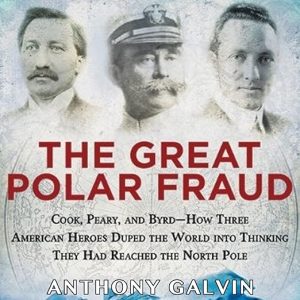
Quick Take
- Narration: James Patrick Cronin handles both the adventure and the forensic detail with a measured, authoritative voice that suits the investigative tone.
- Themes: Fraud and ambition in exploration history, the politics of geographical claims, Amundsen’s overlooked primacy
- Mood: Gripping and quietly outraged, like a cold case finally cracked
- Verdict: A revisionist history of North Pole exploration that is more compelling than most fiction, essential for anyone who thought the story of polar conquest was settled.
Somewhere in the middle of this book, around the hour where Anthony Galvin walks through the mathematical impossibility of Robert Peary’s claimed daily distances across the polar ice, I had one of those moments where the bottom quietly drops out of something you thought you knew. I had grown up with Peary as the man who reached the North Pole. Most people have. The badge on the school hallway map said so. What Galvin argues with patient, meticulous logic is that Peary almost certainly never got there, that the man who ratified his claim was operating under institutional and financial incentives that had nothing to do with truth, and that the actual first person to reach the North Pole by any route did so quietly, almost by accident, in an airship three days after an American aviator faked his own log.
That American aviator was Richard Byrd. The man in the airship was Roald Amundsen. And if Galvin is right, the entire edifice of North Pole mythology has been built on three layers of fraud and self-deception stacked on top of each other.
Three Frauds, One Pole
The book’s architecture is admirably clean. Galvin takes Cook, Peary, and Byrd in turn, laying out their claims and then systematically dismantling them using evidence that, in many cases, has been available for decades but has not been assembled into a single compelling narrative before. Frederick Cook’s claim was dismissed relatively quickly, partly because Cook had already been exposed in a separate scandal involving a fraudulent ascent of Denali. But his dismissal was used by Peary’s supporters as a kind of rhetorical shield, implying that where Cook had failed to prove his case, Peary had succeeded. Galvin shows that this is not a logical inference.
The Byrd section is the most technically precise, and it is where the book does its most original work. Byrd’s flight in 1926 was celebrated at the time and backed by the National Geographic Society, which had also backed Peary. Galvin walks through the fuel mathematics and navigation records to demonstrate that Byrd’s plane simply could not have made the journey he claimed with the fuel he carried. A reviewer on Audible noted that this reads more like an adventure novel than a history, and I understand the impulse behind that description even if I think it slightly misses the point. The pleasure here is not really adventure. It is forensics.
Amundsen as the Reluctant Protagonist
The real emotional engine of the book is Amundsen himself, who enters and exits the narrative at several points before his vindication in the final chapters. The man who reached the South Pole first in 1911 began the North Pole chapter of his career as a victim of fraud, receiving news of Cook’s and Peary’s claims while his own expedition was already underway. That deflection eventually sent him south, where he beat Scott and became famous. But the North Pole remained unfinished business, and Galvin’s argument is that Amundsen resolved it in 1926 aboard the airship Norge, crossing directly over the pole from Svalbard to Alaska and therefore unknowingly completing what Peary had falsely claimed fifteen years earlier.
The irony is considerable. The man who held ten expeditionary records is not the name most people associate with the North Pole. The name they associate with it belongs to a man who, by Galvin’s reconstruction, was hundreds of miles short on his best day.
The National Geographic Society’s Role
One of the book’s more pointed arguments concerns the institutional machinery that converted Peary’s claim into historical fact. The National Geographic Society, which had helped fund Peary’s expedition, subsequently endorsed his claim in ways that Galvin characterizes as neither independent nor disinterested. When the Society was later asked to review the evidence, it relied on a committee that had pre-existing ties to Peary and his backers. That circle of validation, Galvin argues, is how a claim that could not withstand scientific scrutiny became official history for decades. The same institution then endorsed Byrd’s claim in 1926, extending the pattern. Galvin does not frame this as corruption exactly, but as the way institutions protect investments, financial and reputational, even when the evidence would require a different conclusion.
Scope and Limitations
A reviewer flagged some editorial flaws, and they are real. The book occasionally circles back on itself, and some passages feel like they are making the same point twice. The absence of maps is a genuine limitation that reviewers mention, and in audio format this gap becomes more pronounced during the navigation and distance-calculation sections. Listeners who struggle to visualize polar geography without a map may find those passages harder to follow than they need to be.
Galvin writes in a register that is accessible without being dumbed down, and James Patrick Cronin’s narration honors that register. The tone is investigative rather than sensational, which is the correct choice for material that is trying to revise history rather than simply scandalize readers about it. At twelve hours, the book is substantial enough to develop its argument properly without becoming exhausting.
Who Should Listen and Who Should Skip
This is essential listening if you have any interest in polar exploration, the history of geographical discovery, or the mechanics of how institutional fraud gets legitimized over decades. Pair it with Hampton Sides’ In the Kingdom of Ice for a fuller picture of the Arctic’s hold on the Western imagination.
Skip it if you are looking for a straightforward adventure narrative rather than a forensic argument. The book does tell a story, but its primary mode is evidence and analysis, not drama and action.
Frequently Asked Questions
Does the book take a clear position on whether Cook, Peary, and Byrd all committed fraud, or does it present multiple views?
Galvin takes a clear position. He argues that all three claims are fraudulent or at minimum unsubstantiated, and that Amundsen’s 1926 airship crossing represents the legitimate first. The book presents the counter-arguments but does not treat them as equally valid.
Is this a revisionist history that has been contested by polar historians?
The arguments Galvin makes draw on scholarship that has been building since the 1980s. The doubts about Peary’s distances and Byrd’s fuel mathematics are not new, though Galvin synthesizes them accessibly for a general audience. Serious polar historians have been aware of these problems for decades.
How does Galvin treat Frederick Cook, who is sometimes seen as a victim of Peary’s political machine?
Fairly, but not uncritically. Galvin acknowledges that Cook was treated harshly and that his Denali fraud was used unfairly to discredit his polar claim by association. But he also concludes that Cook’s claim is not supportable, and that being a victim of institutional politics does not make the underlying claim true.
Does the book cover what happened to Byrd’s reputation after the questions about his flight emerged?
Yes, Galvin follows the aftermath of Byrd’s claim through to the modern reassessment. Byrd died with his reputation largely intact, partly because the technical analysis of his fuel logs came after his death and partly because American institutions had strong incentives to maintain the narrative they had built around him.