Quick Take
- Narration: John Chancer handles the military and scholarly register with authority, giving the battle sequences kinetic energy without losing the analytical distance Cole and Livingston maintain throughout.
- Themes: A single geographic site across 2,500 years of conflict, the mythology versus the reality of martial sacrifice, terrain as a historical constant
- Mood: Propulsive and intellectually rigorous, like a battlefield tour led by two historians who have actually read the primary sources in the original languages
- Verdict: A genuinely original contribution to ancient military history that earns its premise by delivering on 27 battles rather than just the famous one.
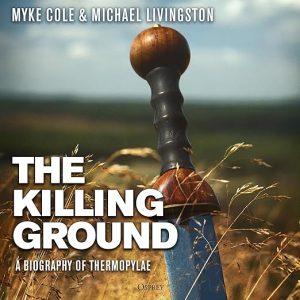
I was skeptical going in. Another Thermopylae book. Another treatment of the 300 Spartans and the pass and the Persian tide. I have read three separate accounts of the 480 BC battle and felt, honestly, that the ground had been covered. What changed my mind about The Killing Ground was a single line in the synopsis: Cole and Livingston cover 27 battles and holding actions at Thermopylae, from the first clash through to the two desperate struggles against German occupying forces during World War II. That was not a premise I had encountered before, and it turned out to be exactly as interesting as it sounds.
The argument Cole and Livingston are making, unstated but structurally present throughout, is that Thermopylae is not primarily a Greek story or a Spartan story. It is a geography story. The pass exists. It constrains movement in specific ways that have been militarily relevant for 2,500 years. Armies that have understood those constraints have exploited them; armies that have not have died in the attempt. Leonidas knew the ground. So, it turns out, did the Byzantine commanders who held it against the Huns. So did the Greek resistance fighters who delayed the German advance in 1941. The continuity is not poetic, it is practical, and Cole and Livingston pursue it with the rigor of scholars who have actually surveyed the terrain.
Twenty-Seven Battles and the Scholarship Behind Them
The note in the synopsis about Cole and Livingston’s command of multiple ancient and medieval languages is not boilerplate. It has direct consequences for the book’s quality. Most English-language treatments of Thermopylae rely on a small set of translated sources, Herodotus, primarily, with Diodorus Siculus and a few others. Cole and Livingston can go to the Byzantine chronicles, the medieval Latin accounts, and the Ottoman records directly, and they provide their own translations of source material throughout the text. The reviewer who praised uncompromising scholarship woven into compelling narrative is describing this specifically, and it holds up.
Tom Holland’s endorsement, brilliantly demonstrated, is worth flagging for listeners who follow his work. Holland is not a generous blurber. He knows his ancient history and he knows what rigorous popular history looks like. His presence on this book is a genuine quality signal.
John Chancer’s narration is well-matched to the material. The book moves between analytical and narrative registers frequently, sometimes within the same chapter, as Cole and Livingston describe the topography of the pass, explain the strategic logic of a holding action, and then render the actual engagement with enough detail to visualize the fighting. Chancer navigates these transitions cleanly, finding the appropriate pace for each mode without losing the listener in the shift.
The Battles Most Readers Do Not Know Exist
The Roman and Byzantine sections are the book’s most revelatory for a general listener. Most people know, intellectually, that the Byzantine Empire continued for nearly a thousand years after the fall of Rome, but the specific military history of that continuity is largely invisible in popular culture. Cole and Livingston bring the same rigor to Byzantine and medieval engagements at Thermopylae that they apply to the classical period, treating each battle on its own terms rather than as a lesser echo of the famous one.
The World War II chapters are different in tone, the sources are denser, the tactical situation more complex, and the weight of knowing the outcome sits differently with modern readers, but they complete the argument the book has been making. The pass does not care about mythology. It cares about geography. And the Greek resistance fighters of 1941 were doing what soldiers at that location had been doing since the Bronze Age: using the terrain to force an asymmetric engagement against a numerically superior force.
Who Should Listen, Who Should Skip
This is the right audiobook for military history listeners who have read the standard accounts of 480 BC and want something genuinely new, for anyone interested in how a single geographic feature shapes history across millennia, and for listeners who value scholarly rigor in their popular history. It is not the book for listeners looking for a narrative account of the famous 300, that story is here, but it is one chapter among 27. If Thermopylae matters to you primarily as mythology rather than as military history, this approach will feel corrective rather than comfortable. It should.
Frequently Asked Questions
Does the book spend most of its time on the 480 BC battle, or is coverage genuinely distributed across 27 engagements?
The coverage is genuinely distributed. The famous 480 BC engagement gets detailed treatment, but Cole and Livingston spend comparable time on the Roman, Byzantine, and World War II battles. The book’s argument depends on treating all 27 engagements seriously rather than treating the classical battle as the main event.
Do I need to know ancient Greek or Roman history to follow the less famous battles?
No specific prior knowledge is required. Cole and Livingston provide the political and military context for each battle before describing the engagement. Listeners with existing familiarity with the relevant periods will get more from the analytical sections, but the book is designed to be accessible to a general reader.
How does John Chancer’s narration handle the shift between analytical and narrative modes?
Chancer navigates the shifts cleanly. The book moves frequently between topographical description, strategic analysis, and battle narrative, and the narration finds the appropriate pace for each mode without losing continuity. He is a strong match for the scholarly-accessible register Cole and Livingston use throughout.
Is this the same Myke Cole who writes fantasy fiction, and does his military background affect the history writing?
Yes, Myke Cole has both a fiction career and a background in military and national security work. The combination gives the battle sequences a practical quality, he understands the physical reality of combat in a way that purely academic historians sometimes do not. Co-author Michael Livingston provides the deep classical and medieval scholarship.