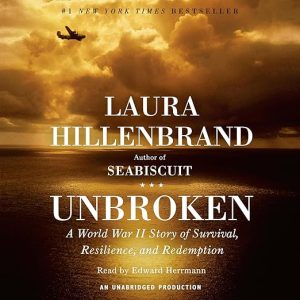
Survival narratives usually stop at the rescue, which is exactly where this one turns difficult. Laura Hillenbrand's audiobook follows Louis Zamperini from an incorrigible boyhood through the Berlin Olympics, into a bomber that crashed into the Pacific, across thousands of miles of open ocean on a foundering raft, and then into something worse. Edward Herrmann reads the thirteen hours and fifty-six minutes. Random House Audio released the file in November 2010, and the record has been accumulating responses from four different countries ever since.
Prose the Copy Calls Ferociously Cinematic
Structure is what makes this more than an endurance catalog. Hillenbrand front-loads a delinquent childhood and a running career, so that by the time the plane goes down you already know what kind of person is in the water: someone who stole, ran, and answered every constraint with defiance. The raft sequence, with its leaping sharks, its thirst and its enemy aircraft, then reads as character rather than as spectacle. What Zamperini does out there follows directly from what he was as a teenager.
Prose does the rest. People magazine's line about the writing being ferociously cinematic is quoted in the copy and it is not overstated: the sentences are built for momentum, and the incidents are extraordinary enough that restraint is the only workable technique. Hillenbrand rarely tells you how to feel about a scene, which on material this brutal is a mercy. The Wall Street Journal's phrase, a powerfully drawn survival epic, gets at the scale without capturing how controlled the writing actually is.
Meaning is where the book gets ambitious and where readers divide. A March 2014 response reads it through the vocabulary of Holocaust remembrance, taking the injunction against letting atrocity repeat itself in its broadest sense, applied to any group and any hatred. It is a big frame to put on one airman's life, and the book invites it. The last movement, covering the return home, the post-traumatic collapse and the encounter with Billy Graham that turns toward forgiveness, is what makes the frame stick.
Recruited to Record War Veterans, Then Stayed
Reluctant readers are the strongest evidence for this one. A September 2012 five-star opens by stating flatly that war books hold no appeal, that pain and suffering are roughly ninety-nine percent of this one, and that the usual reading diet runs to gentle series fiction and southern humor. That entry came to the book only because of a project recording the accounts of war veterans for an archive, and it stayed. Conversions like that tell you more than an enthusiast's five stars ever could.
Pacing suits the format unusually well. A childhood, an Olympic career, a crash, a long stretch adrift, years of captivity and a slow postwar recovery all fit inside the runtime without any one section overstaying. Hillenbrand moves in scenes with hard edges, and that episodic construction survives being listened to in fragments far better than a continuous argument would. Losing the thread is close to impossible, because the thread is one man and what happens to him next.
Recognition backs the enthusiasm up. The copy records a number one bestseller placing, a win at the Los Angeles Times Book Prize, and Time naming this the top nonfiction book of its year, alongside the two motion pictures it eventually produced. Prizes prove nothing about a listening experience, but the pattern is worth noting: this persuaded literary judges, general readers and Hollywood in roughly equal measure, which is unusual for material this unpleasant through the middle.
Peace That Arrives Late and Isn't Free
A single response here is not about the audio at all, and it says so in its opening line. A September 2014 entry from the United Kingdom argues at length that a paperback would have been more enjoyable than the digital edition it read, because the book carries photographs, references and chapter-end footnotes that reward flipping back and forth, and the format made that impossible. In audio the problem is total. Those photographs and notes simply are not there.
Language spread complicates the column further. Two of the five posted responses are written in languages other than English, one in French and one in Spanish, filed from marketplaces where this reached readers in languages other than the one it was written in. The rating you see aggregates all of it. Nothing on the page separates people who listened to this specific English-language recording from people who read a printed translation years apart.
Brutality deserves a plainer warning than the description offers. Starvation, dehydration, shark attack and sustained physical cruelty during captivity occupy the middle of the book, and the post-traumatic material afterward is bleak in a quieter register. Hillenbrand never lingers for effect, which somehow makes it land harder. This is not an uplifting story with difficult parts in it. What it reaches by the end resembles peace, but it arrives late and it is not free.
Fourteen Hours That Land Hard by the End
Listeners who normally avoid war writing are, oddly, the audience this serves best, because the war is a setting rather than a subject and the book is finally about what a person does with what was done to him. Anyone interested in the Pacific theater will find a great deal of it here. Readers who came from the films will get everything those films had to compress.
Nobody should come to this expecting military history with maps and orders of battle, since Hillenbrand stays at eye level throughout and the strategic picture arrives only where Zamperini can see it. Anyone who needs the photographs and source notes should buy a printed copy alongside the file. And anyone in a fragile stretch should wait, because fourteen hours of this lands hard, and the redemption at the end is earned slowly and at considerable cost.
Good to Know
Who narrates the Unbroken audiobook, and how long is it?
Edward Herrmann is the credited reader across thirteen hours and fifty-six minutes, on a file that came from Random House Audio in November 2010. The book moves in discrete episodes rather than one continuous argument, so listening across several sittings costs you very little in the way of continuity.
Where does Unbroken sit alongside Hillenbrand's Seabiscuit?
Entirely apart. No series field on this page links the two, and the copy invokes Seabiscuit only as a pedigree, calling this the work of its acclaimed author. Both are non-fiction built around one driven figure, but nothing here assumes any knowledge of the earlier book.
Does the audiobook cover what the two films leave out?
The description names both Unbroken and Unbroken: Path to Redemption as adaptations. Film compresses, and what tends to go is the boyhood and the long postwar recovery. Both survive intact here, which matters because the return home and the eventual turn toward forgiveness are where the book makes its case.
How graphic is the wartime material?
Very. Starvation, dehydration, shark attack and prolonged cruelty during captivity fill the central section, and the psychological aftermath is grim in a quieter register. The listing itself warns you about none of it, so expect something considerably heavier than a book to put on in the background.