
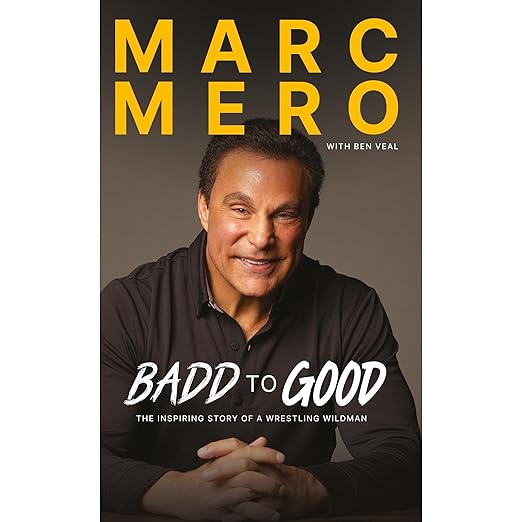
- Voice: Virtual Voice (AI-generated); delivers the text cleanly but struggles to carry the emotional weight of the memoir's harder passages
- Big ideas: Celebrity and its aftermath, addiction recovery, reinvention through purpose
- Atmosphere: Reflective and candid, with genuine emotional stakes beneath the wrestling nostalgia
- Worth it?: A wrestling memoir that earns its title by spending equal time on the man Marc Mero became after the spotlight moved on.
Johnny B. Badd's pyrotechnic entrance music was designed to make you forget the man behind the gimmick , and for years, it worked. Listening to this audiobook, I found myself returning to footage of Marc Mero's WCW run, then sitting with the stark contrast of who he became afterward. Marc Mero: From Badd To Good lands hardest not as a wrestling memoir but as a reckoning: with fame, with addiction, with a marriage that collapsed publicly, and with the kind of reinvention that only becomes possible after everything else has been stripped away. At just over ten hours, the narration through Virtual Voice moves at a steady clip, but the material carries enough weight that the pacing rarely feels rushed.
A Human Voice for Sitting in Hard Moments
Mero's story spans two very different careers. The first half covers the ring years: a four-time New York State Boxing Champion who caught Vince McMahon's eye, earned the first ever guaranteed WWF talent contract, and went on to win the WWE Intercontinental Championship alongside then-wife Rena 'Sable.' The storytelling here is vivid and specific. Mero places you in the locker rooms of the Attitude Era , sharing the squared circle with Stone Cold Steve Austin, Triple H, and Ric Flair , and he doesn't sanitize the backstage politics that eventually pushed him out. What distinguishes this memoir from the crowded field of wrestling biographies is the equal weight given to the second half: nearly two decades spent speaking to young people across the globe through his 'Champion of Choices' program. One reader described it as 'possibly the best wrestling bio I've read' after working through many of them. That's not an offhand compliment , it signals that the book succeeds on craft terms, not just on the strength of the name attached.
The section detailing Marc's relationship with his mother is consistently called out by readers as the emotional core of the book. One described crying all the way through that chapter. It's the kind of moment that transforms a celebrity memoir into something with genuine literary purpose , a passage about love, loss, and the debts we carry to the people who shaped us. The fact that Mero was willing to write it with that level of vulnerability says something about his state of mind when putting this together.
The Virtual Voice narration is AI-generated, and listeners familiar with that format will notice the absence of spontaneous emphasis and natural breath. For a memoir this emotionally layered, that is a real limitation. The material deserves a human voice capable of sitting in the harder moments rather than moving through them at a steady mechanical pace. That said, the text itself is written with enough clarity and flow that the story still comes through, and contributions from voices like Mick Foley, Eric Bischoff, and Justin Roberts add documentary texture that enriches the overall structure.
More Transformative Than Anything in the Ring
Wrestling memoirs tend to fall into a predictable rhythm: kayfabe stories, road tales, name-dropping. Badd To Good sidesteps that structure by treating the post-wrestling chapter as equally important , and frankly more transformative , than anything Mero accomplished in a ring. His 'Champion of Choices' work has reached students across dozens of countries, and the book frames that mission not as a pivot away from wrestling but as its logical continuation. The underlying thread throughout is resilience: how to absorb catastrophic loss, how to rebuild identity without the structure that fame provided, and how to turn public failure into private purpose. The forewords from Diamond Dallas Page and Lex Luger, two men who understand both the heights of WWE fame and the personal wreckage it can leave behind, give the book an immediate credibility among fans of the era. But you don't need to know who Johnny B. Badd was to find value in what Marc Mero did next.
Mero's candor about addiction is particularly unflinching. He doesn't frame his recovery through a redemption arc designed to make the reader feel comfortable. He sits with the damage honestly, acknowledging the costs to his marriage, his relationships, and his sense of self. That honesty is what separates this from memoirs that chase inspiration at the expense of truth.
Celebrity Is a Poor Substitute for Purpose
The chapters on the Attitude Era are dense with period-specific detail, and listeners who lived through that era of professional wrestling will find them irresistible. But the book's deeper argument , that celebrity is a poor substitute for purpose , only becomes clear about two-thirds of the way through. Listeners expecting a front-to-back wrestling story may find the shift in register jarring if they're not prepared for it. Lean into it. The second half is where the book earns its title. Also worth noting: the AI-narrated format means that letters and personal reflections, which would benefit enormously from human vocal interpretation, land with less emotional force than the writing likely intended. If you have the option to read the print version alongside the audiobook format, the more intimate passages reward that approach.
Skip This for an Uncritical Celebration
Wrestling fans from the WCW and Attitude Era are the obvious audience, and they will find the behind-the-scenes material exceptionally well-sourced and satisfying. But this audiobook reaches beyond that demographic. People navigating addiction recovery, anyone who has built an identity around a role that later disappeared, and readers drawn to faith-based personal reinvention stories will find Mero's account honest and grounding. Skip it if you want an uncritical celebration of the wrestling business , Mero pulls no punches about its darker corners, including what happened when the spotlight moved on.







