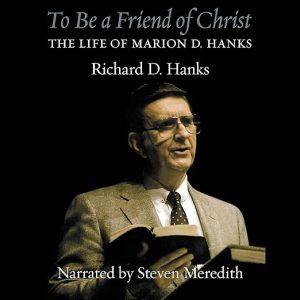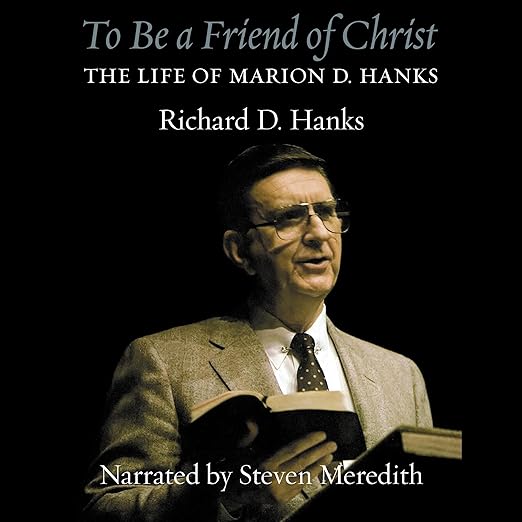
Marion Duff Hanks served as a General Authority of the Church of Jesus Christ of Latter-day Saints for forty years. This audiobook biography, narrated by Steven Meredith, covers a life of remarkable scope: five US presidents appointed Hanks to the President's Council on Physical Fitness and Sports, he led national organizations including Rotary International and the Boy Scouts of America, and he spoke from pulpits to enormous audiences on television and at international gatherings. And yet, when asked about his goals, Hanks replied that his strongest desire was to qualify to be a friend of Christ. Author Richard D. Hanks, writing his father's authorized biography, takes that answer seriously as the organizing principle for twenty-one hours of careful, archivally grounded narrative.
What distinguishes this biography from institutional hagiography is Richard Hanks's access. Drawing on previously unavailable primary sources, including journals, correspondence, notebooks, and recordings, this is an authorized biography that does not read like a commissioned tribute. The son writing about his father has privileged access to material that no other biographer could have reached, and he deploys it with what reviewer C.J. Clifford described as depth of character, motive, and moral center, without glorification or honorific adulation.
Completely Engaged by a Seventh-Grade Speech
Marion Duff Hanks was an institutional reformer operating within a conservative religious organization, which requires considerable navigational skill. Richard Hanks traces his father's advocacy for humanitarian efforts, refugee relief services, missionary community service, a focus on mercy for the sinner, and a churchwide emphasis on coming unto Christ. These were not radical proposals by outside standards, but within the context of mid-twentieth-century LDS institutional life, they represented a consistent pressure toward compassion and openness that shaped how the church engaged with the broader world.
The Renaissance man portrait that emerges from this biography is genuine rather than promotional. Duff Hanks's comfort moving between the corridors of national power and the individual struggling with a private problem is documented through specific anecdotes rather than general praise. The journals and correspondence Richard Hanks draws from allow readers to see his father's thinking in real time, not just through retrospective assessment. Reviewer David L. Cook described being completely engaged by a speech Duff Hanks gave to his seventh-grade class decades earlier, and that quality of complete presence comes through in the primary source material throughout the narrative.
Meredith's Steady Narration Carries Twenty-One Hours
Steven Meredith's narration is equal to a twenty-one-hour biographical audiobook's considerable demands. He handles the documentary texture of a biography built on archival research without turning it into recitation, and he brings appropriate emotional weight to the passages where the human cost of Duff Hanks's decades of service becomes apparent. The material includes significant historical breadth, covering national policy, international humanitarian work, and the internal history of one of America's most consequential religious institutions across most of the twentieth century, and Meredith maintains coherence and engagement throughout that span.
The audiobook format serves this kind of comprehensive biography well. The richness of the primary source material rewards sustained listening in ways that a print text does not always replicate. Reviewer David noted that Duff Hanks's insights and philosophy of living and serving are needed in the church and world today, and Meredith's steady narration makes those insights feel both historically grounded and presently relevant. At twenty-one hours and twenty-seven minutes, this is a substantial commitment that serious readers of American religious biography will find worthwhile.
Extensive Research and Cross-Referencing, Densely Sourced
This biography will mean most to listeners with some context for LDS Church history and structure. The General Authority role, the institutional changes Duff Hanks advocated for, and the significance of his position in mid-century LDS life are explained, but listeners completely unfamiliar with the Church of Jesus Christ of Latter-day Saints will need to orient themselves to a particular institutional context before fully appreciating the biographical arc. This is not a criticism of the biography itself but an honest note about its primary audience.
At twenty-one hours, the scope is comprehensive to the point where some listeners may find certain periods of Duff Hanks's career covered in more detail than others of equal interest. Reviewer C.J. Clifford praised the extensive research and cross-referencing, which reflects the scholarly rigor Richard Hanks brings to the project. Those same qualities mean some passages are more densely documentary than narrative, and listeners should expect a rhythm that alternates between biographical story and archival documentation. The sections covering Hanks's national policy work with Rotary International and the Boy Scouts of America are among the most densely sourced, and listeners primarily interested in the spiritual dimensions of his life may find themselves moving more quickly through those chapters. Both types of material are present in quantity throughout the twenty-one hours.
A Complete Portrait for Dedicated Listeners
Members and scholars of the LDS Church interested in twentieth-century institutional history and spiritual leadership will find this biography indispensable. General readers drawn to American religious biography, particularly biographies that document how individual leaders navigate tension between institutional conservatism and pastoral compassion, will also find considerable interest here. Listeners looking for an accessible entry point to LDS history rather than a deep authorized biography of a specific figure may want to begin elsewhere in the catalog. The twenty-one-hour runtime rewards dedicated listeners with a genuinely complete portrait of a significant life and a significant institution.
Good to Know
Does this audiobook cover Marion Duff Hanks's public service roles beyond the LDS Church?
Yes. His appointments to five presidents' Councils on Physical Fitness and Sports, his leadership roles with Rotary International and the Boy Scouts of America, and his engagement with national and international humanitarian causes all receive substantial coverage alongside his church responsibilities.
How does the authorized biography status of this audiobook affect the portrait of Duff Hanks?
Richard Hanks's position as son and authorized biographer gives him access to unpublished journals, correspondence, and recordings. Reviewer C.J. Clifford specifically praised the absence of glorification or honorific adulation, noting that the biography captures depth of character and motive without hagiographic softening.
At twenty-one hours, is this audiobook manageable for listeners without a dedicated daily commute?
It requires sustained commitment, but the archival richness and narrative variety across Hanks's long career make it well-suited to chapter-by-chapter listening across multiple sessions. Listeners interested in American religious history will find the investment worthwhile over two to three weeks of regular listening.