At a Glance
- Narration: Radclyffe's self-narration is the definitive version of this text, his controlled delivery and occasional unguarded pauses carrying emotional weight no third-party narrator could reproduce.
- Themes: Gender identity, class and privilege, the dissolution of a constructed life, and the slow, uncomfortable process of becoming your actual self.
- Mood: Dry, wry, and honest, a literary memoir that earns its emotional moments through restraint rather than amplification.
- Verdict: One of the more carefully crafted trans memoirs in recent years, and the audiobook format makes its best qualities more accessible than the print edition can.
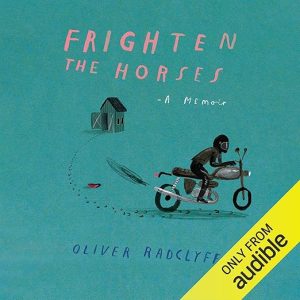
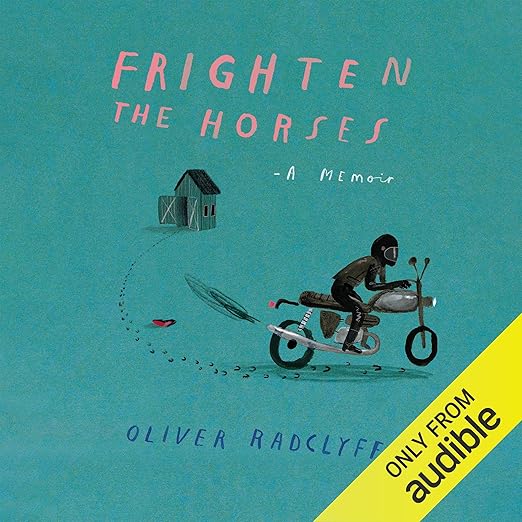
Radclyffe's memoir signals its literary intentions through sentence-level craft before it establishes its subject: the prose in Frighten the Horses is precise, dry, and shot through with a wit that keeps the most difficult passages from collapsing into sentiment. This audiobook, narrated by Oliver Radclyffe himself, chronicles a life assembled with apparent perfection: British parents, a handsome husband, four children, a golden retriever named Biscuit, a stately Connecticut home with a white-picket fence. Then it chronicles the decades-long internal fracture that eventually made that life unsustainable. What Radclyffe renders on the page, and in his own voice, is not a crisis narrative but a reckoning: the slow, uncomfortable work of recognizing that the self you have been performing is not the self you actually are.
Biscuit the Retriever as a Domestic Emblem
Memoirs of gender transition tend to settle into one of two modes: the celebratory arc toward authenticity, or the crisis narrative that foregrounds suffering. Radclyffe resists both. His account of coming out first as a lesbian and then gradually understanding himself as a trans man is neither triumphant nor harrowing in the way those categories are usually deployed. It is funnier than either, and more honest about ambivalence. He is clear-eyed about his own privilege, the resources that made his transition survivable in ways that most people's are not, without using that acknowledgment as a rhetorical shield against harder questions.
The four children are present throughout, not as props for emotional stakes but as people with their own confusion, their own adjustments, their own moments of grace and difficulty. The marriage, too, is handled with uncommon fairness to all parties. Radclyffe does not cast his ex-wife as an obstacle or a villain. The dissolution of their life together is rendered as genuinely painful for everyone involved, which makes it more affecting than a cleaner narrative would be. The golden retriever Biscuit, whose name surfaces at a specific point in the memoir, becomes an unlikely emblem of the domestic world Radclyffe was leaving behind: chosen, beloved, and ultimately insufficient as a reason to stay.
Radclyffe's Sentences Are Built to Be Heard
The case for this audiobook over the print edition is substantial. Radclyffe's self-narration carries something that a professional narrator could not replicate: the genuine weight of revisiting your own history in real time. His voice has a quality of careful control that occasionally slips, and those moments, a pause that runs slightly long, a sentence that lands differently than the text alone would suggest, add texture that the prose cannot contain on its own. At just under ten hours, the pacing is well calibrated. The memoir does not overstay its welcome.
Radclyffe is a genuinely good prose stylist, which matters more in audiobook form than on the page, where a reader can slow down or skip ahead. His sentences are built to be heard: compact, rhythmically varied, and constructed so that the humor arrives at the right moment to release tension without undercutting it. The wit is never defensive. It is the wit of someone who has processed enough of the material to look at it clearly. Reviewers describe the experience as important and moving while also genuinely funny, a combination that is harder to achieve than it sounds in memoir writing.
The Ending Is Open But Truthful
Listeners who come expecting a conventional coming-out narrative with a clean emotional journey from misery to liberation may find the book's ambiguity unsatisfying. Radclyffe is honest about what he gained and equally honest about what was lost and what remains unresolved. That honesty is the book's greatest strength and the quality most likely to frustrate readers looking for a more resolved arc.
The memoir focuses primarily on the period of Radclyffe's transition rather than its aftermath, which means some questions about his children's experiences and his current life go only partially answered. Listeners who follow him expecting complete resolution of every thread will find the ending appropriately open, truthful but possibly incomplete by certain readers' standards. The British-to-American cultural frame is also worth paying attention to. The Connecticut suburban world Radclyffe inhabited has its own specific class markers that provide important context for understanding the constraints he was navigating, both social and psychological.
The production quality is clean and consistent throughout. Self-narrated memoirs can suffer from uneven pacing or a narrator who sounds too close to the material to read it clearly. Radclyffe avoids both problems. He reads his own work with the controlled distance of someone who has come through the other side of the story he is telling, and that distance is precisely what lets the emotional content land without manipulation.
The book also benefits from Radclyffe's refusal to flatten the experience of transition into a single emotional register. Coming out first as a lesbian brought relief and community, but it also brought new pressures and new performances. The subsequent recognition of his trans identity was layered over that first emergence, adding complexity rather than simply replacing one story with a cleaner one. That accumulated complexity is what the memoir captures most honestly, and it is why the audiobook feels substantial rather than simply celebratory.
A Companion to Maggie Nelson's The Argonauts
This audiobook is strongly recommended for readers of literary memoir regardless of their familiarity with trans narratives. Radclyffe's voice and the quality of his prose place the book comfortably alongside the best contemporary memoirs in terms of craft. For listeners specifically interested in trans perspectives, it offers something relatively uncommon: a trans man's account written with literary seriousness and genuine ambivalence rather than advocacy framing. Listeners who appreciated memoirs like Maggie Nelson's The Argonauts in terms of their willingness to sit with unresolved complexity will find this a rewarding listen. Reviewer Seneca Spurling notes that the book helps you learn something essential whether or not you already know a trans person, and that observation captures its broader accessibility well.
Does this audiobook work if I have no prior knowledge of Oliver Radclyffe?
Yes, this is a standalone memoir. No prior familiarity with Radclyffe or his other work is needed. The book introduces its subjects and context fully from the first chapter, including the life he built and the process of leaving it.
Is the Frighten the Horses audiobook appropriate for listeners who are not part of the LGBTQ+ community?
Absolutely. Multiple reviewers note that the memoir expanded their understanding regardless of their own identity. The writing quality and the universal themes of self-deception and authenticity make it accessible to any thoughtful listener.
How does Oliver Radclyffe's self-narration compare to a professional narrator for this audiobook?
The self-narration is a clear asset. Radclyffe reads with the dry precision of a skilled prose stylist, and moments where his voice carries something beyond the text, a pause, a shift in register, add a layer that a professional narrator simply could not provide.
Does the audiobook cover Radclyffe's life after transition or primarily the transition process itself?
The memoir focuses primarily on the period leading up to and through Radclyffe's transition, from his life as a Connecticut housewife through coming out as a lesbian and eventually as a trans man. The ending is open rather than fully resolved, which is intentional and truthful.