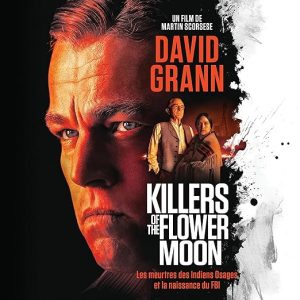
The language field on this record reads French, and so does every sentence of the description, down to a closing line that finally says so in English. That line sits last on the page. Above it you get an English title, an English byline, and an audiobook running eight hours and twenty-five minutes that a buyer in the United States can order in one click. At least two people did exactly that, found a file in a language they do not read, and left a single star each. Neither of them is wrong about what happened to them.
La Note Americaine Hides Behind an English Title
Underneath the packaging sits one of the strongest true crime subjects of the last century, and the description lays it out without decoration. Oklahoma, 1921. The Osage have been pushed onto dry reservation land that turns out to be floating on oil. Money arrives, and so do the people the copy calls white vultures, thirsty for black gold. The wealthiest members of the tribe start disappearing one after another: a bullet, a poisoning, a fire. Washington has no choice but to open an investigation, and hands it to an ambitious John Edgar Hoover, who intends to make the case his own step up toward glory and who cannot crack it without working alongside the Osage themselves.
That material is the same material in any language. What changes is who can actually receive it. A four-star filed in December 2023 explains the trap more clearly than the disclosure does: the French edition of this book normally carries the title La note americaine, and this listing kept the English one, so somebody searching by the name they know arrives at a recording they cannot follow. A one-star from January 2024 supplies the other half, having ordered in a language the buyer neither speaks nor reads.
I want to keep those two complaints apart, because the page scores them identically and they are not the same objection. One is aimed at a product description that saves its most load-bearing sentence for the end. The other is aimed at the reading, and exactly one entry on this whole page has anything to say about that. The reading credit goes to Damien Witecka, and Editions Theleme put the file out in May 2023.
Estates and Inheritances Land as Relationships
For a listener who reads French, this is a clean and unusually well-sized route into Grann's reporting. Eight and a half hours is short for a book of investigative history, and the shape of the case does most of the structural work an audio version needs: a sequence of deaths that keeps escalating, a jurisdictional vacuum, then a federal bureau being invented in real time around the people it is supposed to be helping. You are never more than a few minutes from the next thing going wrong, which is what keeps a nonfiction recording moving when a reader cannot flip back to check a name.
One of the two French five-stars on the page is worth more than its length suggests. It calls the book a deeply researched inquiry into the way certain Native populations were treated, and notes that the subject occupied the author for several years. That is the right compliment for this kind of work: not that it is exciting, though it is, but that somebody stayed with it long enough to earn the detail.
The other argument for the recording is quieter. Read aloud, the Osage names and the chain of estates, guardianships and inheritances land as human relationships and not as a chart, which is the part of this history a printed page tends to flatten. Whether that survives the delivery is the question the next section has to answer.
One Pair of Ears Calls It Unlistenable
The only description of the performance on this page is hostile. A one-star from May 2024 says the voice and manner of speaking would suit a funny children's story and not a subject this grave, calls the result unlistenable, and wishes a different reader had been chosen. That is one pair of ears and it should be weighed as one pair of ears. Still, the specific mismatch it names, a light delivery over an account of serial killing for profit, is the exact failure mode that ruins true crime in audio, so sample before you commit.
Then count what the visible column actually contains. Of five written responses, one objects to the language, one objects to the reading, one is a four-star warning about the title, one praises the research, and one grades a physical object: it matches the photo, it arrived in good condition. A parcel can match a photo. A download cannot, so at least one grade feeding this average was awarded to something the buyer of this file will never receive.
Behind the badge, eighty-one people have graded this and seventy-six of them left no sentence at all, so the 4.4 is carried almost entirely by voters whose reasons are invisible. Given that two of the five visible reasons concern language and not the book, treat the number as noisy in both directions.
Read the Last Line Before You Buy
Francophone listeners who want an American true crime landmark in their own language should be here, with the caveat that the delivery has drawn at least one furious objection and deserves a sample first. So should anyone who came to this story through the film and wants the reporting underneath it, again in French. The tribal history, the oil money and the birth of a federal police force make a strong case for the eight hours.
Everyone else should read the last line of the description before they spend anything. If you want this book in English, this is not that file, and no amount of goodwill toward the material changes the fact. The page is doing a poor job of telling you so, which is a failure of the listing and not of the book inside it.