
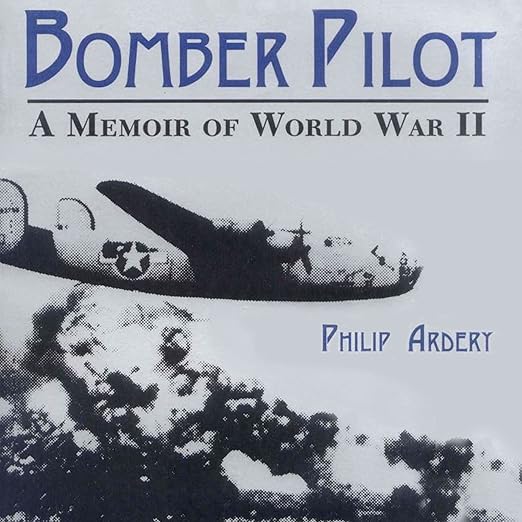
- Performance: James Killavey has sole charge of the recording, and across eighty-one grades not one listener has described the result, which leaves the sample doing all the work.
- What it covers: the Ploesti refinery raid, command guilt, fear and homesickness, grief for lost crews, training as its own danger.
- Feel: Plainspoken, unsparing and quietly exhausted.
- Our call: One of the better bomber memoirs on the shelf, provided you want the cost of the missions and not the glory of them.
Ploesti comes first in this description, and so do the losses: 446 airmen and 53 planes gone after a single low-level raid on the oil refineries, with the sky, in the line the copy leads on, full of dying airplanes. Philip Ardery's Liberator came home. That is the opening move of a nine hour and forty minute audiobook that then keeps going, through many more raids over Hitler's Europe and out to air cover for the Normandy landings, and the choice to put the worst day at the front tells you what kind of memoir this intends to be. Nothing is being held back for a climax.
Liberators are the whole world of this book, and the specificity is what makes it hold up decades on. Ardery came to the war as a pilot and left it as a commander, which means the account moves between the cockpit and the decisions that put other men in cockpits, and the second of those is the harder thing to write honestly. One entry, from somebody who identifies as a pilot, a veteran and a long-standing reader of World War II history, traces the arc it valued most: fledgling days as a student, then the Ploesti raid, then everything after. That reader was reading professionally, in a sense, and still came away moved.
Ardery is candid in a register that postwar memoirs often avoid. The description promises fear, longing for home, and grief for fallen comrades, and it presents those as the substance of the testimony, not an interlude between missions. Air war memoirs tend to split into two piles, the technical and the elegiac, and this one refuses to choose. A reader looking for engine settings and bombing altitudes will find them. A reader looking for what it costs to send a formation out knowing what the flak over a refinery does will find that too, and the book does not sequence them tidily.
Eighty-One Grades and Zero Words About the Voice
Training gets real attention here, which is rarer than it should be. One response walks the route the memoir takes before any combat begins, from cadet training at Randolph and Kelly Fields in Texas through to B-24s flying out of North Africa and England, and makes the point that the odds of injury or death were constant for every man on the crew whether they were in training, crossing flak, dodging German fighters or simply trying to avoid a mid-air collision in bad weather. That last category is the one popular accounts leave out. This memoir puts it where it belongs, alongside the enemy. The same entry frames the training chapters as the part that explains everything afterward, and that is the right way in: by the time the formations reach Romania, a listener already understands what these crews had been asked to learn and how little of it could protect them.
Nobody in this column has written a word about the recording. Eighty-one grades, five written entries, and not one sentence anywhere about a voice, a pace or a running time. James Killavey is the name attached to the recording, from the first minute to the last, and the page offers a buyer nothing else about that assignment. What the material asks of a reader is restraint: a text this plainspoken about dead friends collapses the moment somebody starts performing the grief, and it goes flat if nobody feels it at all. The sample is where you find out which way it went.
The Written Column Reaches Back Before the Recording
Kentucky turns up twice on this record and only one of those is about the book. The last line of the description announces that the book is published by The University Press of Kentucky, complete with a typo in the word published, on a listing whose publisher field reads University Press Audiobooks. That sentence was written for a printed edition and never rewritten. The recording is dated June 2015 while the written column beneath it reaches back more than a decade before that, so the 4.4 average across eighty-one grades has been accumulating around a book that existed in print long before anybody could listen to it.
Quarter of the way through is where one four-star stopped to write. That entry came to the memoir as research, from somebody preparing a father's 145 wartime letters and mission notes for publication, then admits to having been caught by the story itself and files a verdict before finishing. It is an honest and slightly disarming thing to do, and it is also a reminder of what these numbers are made of. Several of the responses here are from people with a personal stake in the period, reading to understand a relative. That is a warm audience, and warm audiences grade generously. None of which makes the 4.4 wrong. It does mean the number is measuring gratitude alongside craft, and those two things do not always move together.
The Ploesti Figures Shadow Everything After Them
Aviation readers get the most out of this, and the memoir assumes a little knowledge without demanding it. Anyone with a family connection to a bomber crew will recognize the register immediately: one response describes reading it while thinking of an uncle believed to be of the same character and valor, and rates the writing alongside Pulitzer winners for what it teaches. That comparison is generous but the instinct behind it is sound. The book earns its place through accumulated detail, not through a single dramatic set piece. The aeronautical book award named at the top of the description points at the same quality: this was recognized by people who knew whether the flying rang true.
Grief is what you should be prepared for. Readers who want a triumphant war story will find the Ploesti figures sitting in the first paragraph and everything after them shadowed by that arithmetic. Readers who want a technical history of the bomber offensive will find one man's line of sight instead of a campaign map. What the recording delivers is nine hours and forty minutes of somebody who flew the missions and later had to order them, telling it without decoration and without ever quite recovering from it.







