The Short Version
- Read by: Zach Hoffman delivers Foster's clear, specific prose without added sentiment, letting the events and choices carry the emotional weight rather than interpretive emphasis.
- At its heart: Disability and competitive advantage, narrative self-construction, institutional navigation
- Vibe: Direct and analytically engaged
- Short version: A disability memoir that earns its professional framework by grounding every insight in the specifics of Foster's actual experience.
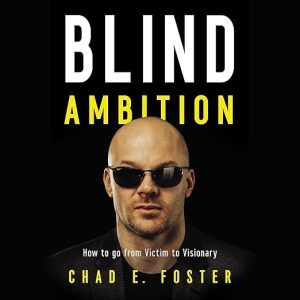
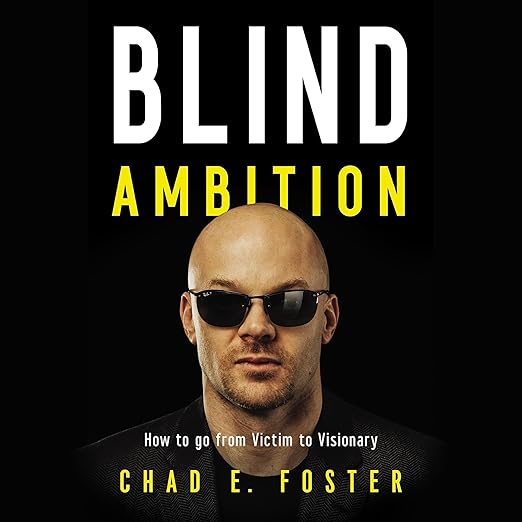
Chad E. Foster was watching his world fade to black. That is not a metaphor. The gradual loss of his vision began while his peers were preparing for adult life in the conventional sense, and by the time it was complete, he was navigating a world that had not been built with him in mind. What makes Blind Ambition, the audiobook narrated by Zach Hoffman, genuinely interesting rather than simply motivating is Foster's insistence on examining the internal architecture of how a person chooses what story to tell themselves about an irreversible loss. This is a memoir that takes a structural interest in its own central question: not just what happened to Chad Foster, but how the narratives we construct about our circumstances either open possibilities or close them.
Foster's credentials in the formal sense are considerable. He became the first blind person to complete Harvard Business School's leadership program. He built customer relationship software for the visually impaired that Oracle had declared impossible, and he did so as a finance and sales executive in the competitive technology industry. But Blind Ambition is not primarily a success-story catalogue. It is a more interior project than that, and Hoffman's narration serves that interiority well.
Converting Limitation Into Competitive Insight
The book's most distinctive contribution to the disability memoir genre is its treatment of competitive advantage. Foster does not argue that blindness was secretly a gift in a way that papers over its genuine difficulty; he argues, more carefully, that the adaptations and perspective shifts forced by vision loss created specific capabilities that sighted people do not develop in the same way. That is a more nuanced claim, and it is also a more honest one. The mental models Foster developed for managing frustration and converting perceived limitation into competitive insight are the practical core of the book, and they transfer beyond the disability context into general professional and personal life.
One reviewer, who read the book after discovering Foster was speaking at their company conference, described it as an inspirational and powerful book for leaders and everyday people looking to overcome obstacles. Another said they opened the book and did not put it down until they finished it cover to cover. That level of reader engagement with a memoir of this kind suggests that Foster's narrative voice generates genuine momentum, and Hoffman's performance sustains it. The 5-hour-and-52-minute runtime is well-paced for the material: substantial enough to develop the narrative with real depth, contained enough to complete in a few listening sessions.
Hoffman's Restraint Matches Foster's Blunt Prose
Zach Hoffman brings a direct quality to the narration that matches Foster's own prose style. Foster writes without excessive ornamentation; his language is clear, specific, and occasionally blunt, and Hoffman does not layer sentiment on top of it that is not already there. The emotional weight in the book comes from the events and the choices, not from interpretive emphasis, and that restraint is the right call for material that is already inherently affecting. The passages describing the process of going blind, what it felt like psychologically and practically, are among the book's most vivid, and Hoffman delivers them with appropriate gravity without veering into performance.
The structural decision to weave practical frameworks throughout the narrative, rather than saving them for a concluding chapter, is a meaningful asset. Each section of Foster's story is accompanied by the mental model or insight it generated, which means the audiobook functions simultaneously as memoir and as applicable guidance. Listeners who come to the book primarily for inspiration will find the narrative compelling. Those who come for the professional frameworks will find the memoir context gives those frameworks genuine weight that abstracted self-help material cannot provide.
The Software Oracle Called Impossible
The Harvard Business School sequence is a notable highlight. Foster's account of becoming the first blind person to complete that program is not simply a triumph narrative; he examines the specific adaptations, negotiations, and choices that made it possible, and he is candid about what the experience cost as well as what it produced. For listeners interested in the mechanics of navigating institutional environments that were not designed to accommodate them, this section is particularly instructive.
The Oracle story, the development of customer relationship software for the visually impaired that the company had declared impossible, is the book's central professional achievement and is handled with the detail it deserves. Foster explains both the technical dimensions and the organizational resistance he encountered, and his account of how he moved through that resistance without requiring the organization to change its core assumptions is one of the more practically sophisticated sections of the audiobook. The contrast between those external achievements and the internal recalibration Foster describes throughout creates a memoir with genuine double-layered interest. Foster is direct about the difference between the public narrative of his success and the private cost of the adaptations that made it possible, and that candor distinguishes Blind Ambition from the more sanitized version of this kind of story that the genre sometimes produces.
More Than a Single Keynote Can Cover
Readers and listeners drawn to disability memoirs that are analytically rigorous as well as personally compelling will find this audiobook a strong choice. Business and leadership audiences who respond to frameworks drawn from lived experience rather than abstraction will find Foster's mental models genuinely useful. Chad E. Foster's story has obvious relevance for anyone navigating the gap between a circumstance they did not choose and a life they are actively constructing, which is a fairly universal situation. Zach Hoffman's narration makes the audio format a natural fit for Foster's direct, story-centered approach. Those who come to the book having encountered Foster as a keynote speaker, as several reviewers report, will find the audiobook extends the argument considerably beyond what a single presentation can accommodate, with the full narrative arc giving the frameworks considerably more weight than the summary versions permit.
Good to Know
Does this audiobook require any prior knowledge of the technology or finance industries Foster worked in?
No. Foster explains the professional context clearly enough for general listeners. The Oracle software development story and the HBS program are rendered accessibly, and the relevance of both extends well beyond those specific industries.
At under 6 hours, is this audiobook long enough to develop its story with real depth?
Yes. Foster uses the 5-hour-and-52-minute runtime efficiently, moving between the narrative and the frameworks without either feeling rushed. The length is actually well-matched to the material: substantial enough to follow the full arc, compact enough to complete in a weekend.