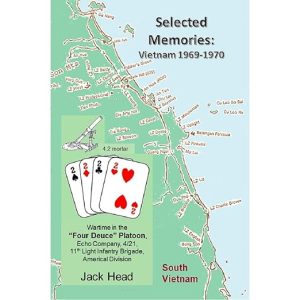
Good Will Ambassador is how the description labels a draftee's tour with the 11th Light Infantry Brigade, and the sarcasm in that phrase sets the temperature for the whole audiobook. Jack Head was drafted after college and run through stateside training at speed, so the Army could have a body in country for the 1969 TET offensive. What came back was a settled opinion about the people who arranged it. Ten hours and forty-one minutes of specific, unglamorous recollection follow, and the book describes itself as time spent wiping out communism while faith in the Washington leadership was being destroyed. That is the register: plain sentences, no uplift, and a grudge held with some precision.
A Mortar Crew and Waiting, at the Same Pitch
Recognition is what the response column keeps recording. The July 2020 entry, five stars, comes from somebody who served across those same two years, and it says the book brought back a great deal, then tells a story about being informed that the war was effectively over by 1970 and answering with a casualty figure for exactly that window. The person being corrected walked away. That is not a book review in any normal sense. It is a veteran using a stranger's memoir as the occasion for something that has been waiting fifty years to be said, which tells you what this writing does for the readers closest to it.
Voice is the first practical problem, and it is a large one. The reading credit on this release goes to Virtual Voice, which is a synthetic reader rather than a person, applied to more than ten hours of first-person war memoir. An independently published book often has no other route into audio, and the economics are easy to understand. What the technology cannot do is the thing this material most needs, which is a human being deciding where to slow down. The paragraphs about a mortar crew and the paragraphs about waiting arrive at the same speed and the same pitch, and the listener has to supply every difference between them.
Reading Classmates' Obituaries and Learning They Served
Coming home is where this stops being one more tour narrative. In May 2020 somebody graded it five under a title that answers itself, then described decades of not feeling like a person the country valued, and reading the obituaries of school classmates fifty years later to learn only then that they had served too. The memoir gets credit from that reader for naming the mechanism: the way returning soldiers were handed back to civilian life was wrong, everyone involved knew it, and nobody said so at the time. Very few books about that war spend real pages on the return.
Continuity is the structural virtue. Four stars, January 2022, from a reader who was in South Vietnam in the same places at the same times: that response singles out the second half, the part covering the author's return, as the more interesting stretch and calls it a difficult period for everybody. The memoir does not end at the plane. It follows the same person into a country that had moved on, and the disillusion the description promises turns out to be aimed less at the enemy than at the planning. Reading the two halves together is what makes the second one land.
A Memoir Verdict Covering Zero Listening Minutes
Pacing is the standing complaint, and it comes from a sympathetic source. An October 2019 five-star says the book starts slowly, with a good deal of unneeded detail about time spent in basic training, and picks up speed and relevance once the author reaches Vietnam. In print a slow opening costs a few skimmed paragraphs. In audio it costs whatever it costs in real minutes, and this is a ten-hour file with a synthetic reader and a description too short to tell you where the training section ends. Budget for a patient first hour.
Chronology matters before you read those grades as grades on this recording. All five visible responses were filed between 2019 and 2022. The audio went on sale in March 2026. Not one of the five mentions listening to anything; every entry discusses a book that was read, several of them years before this file existed. So the 4.2 average across 84 grades is a verdict on the memoir, and by the look of the column a deserved one, while carrying no information whatever about the ten hours and forty-one minutes actually on sale here.
A Voice That Never Changes Its Mind
Veterans of that war, and the families of veterans who never talked about it, are the audience this was written for and the audience that has answered. Anyone tracing a relative's service will find the unit and the division named precisely, along with dates specific enough to line up against a discharge record. Readers who want the ordinary shape of a conscript's year rather than a commander's account of a campaign will get exactly that, including the tedium, which is part of the argument rather than a failure of editing.
Analysis is not on offer, and anyone wanting it should look elsewhere, since this makes no attempt at a general history and its judgments about Washington are the judgments of someone who was there rather than conclusions built from documents. Anyone sensitive to machine narration should also think twice, because ten hours is a long time with a voice that never changes its mind. Even the title on this listing carries a stray space before the second date, a small sign of a book that reached audio without much editorial attention. Nothing in the production respects this material, and the material survives it anyway.
At a Glance
- Themes: Conscription and the 1969 TET buildup, the ordinary texture of a tour, homecoming and failed reintegration
- Mood: Plain, unsentimental, quietly furious at the people in charge
- Verdict: Testimony worth having, sold with a machine reading it and a response column that belongs to the printed book.
Questions Listeners Ask
Is the audiobook worth it for a listener with no military background?
On the evidence of one January 2022 five-star, yes. That response comes from a reader too young to have been drafted, who credits the book with making the history legible from a personal angle and with changing how they regard the people sent to fight it. The memoir assumes no prior knowledge of the war.
Does the audiobook cover anything beyond the tour itself?
Yes. The description frames the book around two losses running in parallel, the year spent in Southeast Asia and the collapse of any confidence in how the war was being run from Washington. That second thread does not end when the tour does, and it shapes the later sections as much as the combat material shapes the early ones.
How political is the book?
Openly, though out of experience rather than theory. The description states plainly that faith in the ability of the leadership to fight a non-traditional enemy was destroyed, and the sarcasm in how the posting itself is labeled supplies the tone. Expect verdicts on command decisions rather than a partisan argument about the era.