
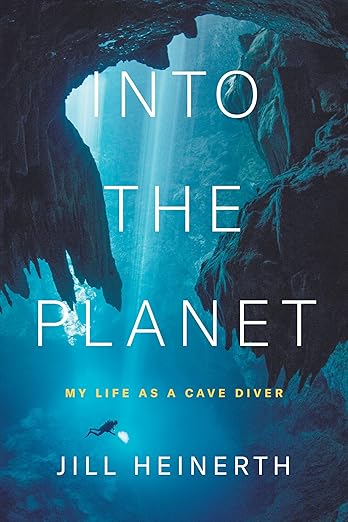
Quick Take
- Read by: Heinerth narrating her own memoir is genuinely the only casting that works - her voice carries the particular calm authority of someone who has made peace with mortal risk as a professional condition.
- At its heart: cave diving and extreme exploration, women in male-dominated fields, freshwater science and environmental stakes
- Vibe: Tense, intimate, and luminous in its descriptions of unseen landscapes
- Short version: A cave diving memoir that earns both its adventure sequences and its quieter reflections on mortality, fear, and what drives people toward the most dangerous places on earth.
I started Into the Planet on a Tuesday afternoon and did not surface, so to speak, until evening. There is something about cave diving narratives that creates an almost physiological response in certain readers - a tightening of the chest, an awareness of breath. Jill Heinerth is one of the most celebrated cave divers in the world, and in this memoir she writes about what it means to spend a career in places that have killed many of the people she trained alongside.
The audiobook runs just over ten hours. Heinerth narrates herself, and that decision shapes everything. Her voice has the particular quality of someone who has practiced radical calm as a survival technique - unhurried, precise, grounded. This is not a performance of bravery. It is the voice of someone who has processed fear so thoroughly that it has become information rather than obstacle.
Where This One Lands
Heinerth is both a scientist's instrument and a storyteller, and the memoir holds those two roles in productive tension. In her working life she has explored underwater conduits in volcanoes, swum through cracks in the world's largest iceberg, and discovered new species in freshwater cave systems beneath populated land. The environmental stakes she raises are not incidental: she writes about finite freshwater reserves with the specific concern of someone who has literally seen the aquifer systems that supply drinking water to millions of people. The adventure and the science are not separate threads here.
Self-narration is the right call for a memoir this specifically embodied. One reviewer who had read many diving books noted that Heinerth's writing is lively and interesting with vibrant language, unlike the usually dry technical prose of the genre. That liveliness comes through in the audio even more than on the page. When she describes the process of moving through a passage so narrow that you must remove equipment to fit through it, or the moment when a line breaks and you are left in absolute darkness in an underwater cave, the prose does not dramatize the fear - it observes it, which is far more effective.
Before You Commit to Into the Planet
Heinerth is honest about the deaths. Cave diving has an extraordinarily high mortality rate among practitioners, and several of the people she describes - people she dove with, trained with, cared about - did not come back from specific dives. The memoir does not dwell in grief but it does not minimize it either, and listeners who prefer adventure narratives that bracket their danger should know this book holds the cost of the work in view throughout. One reviewer mentioned wishing there were more photos - the physical book includes some, but the audio edition is purely auditory, which means you must do more imaginative work to visualize the environments Heinerth describes.
Recommended For
Adventure memoir readers who want a genuine sense of what the most dangerous form of diving actually entails will find this among the most immersive accounts available. Environmental science readers interested in freshwater systems will find the scientific dimension substantive rather than decorative. Women interested in narratives of expertise in male-dominated fields will find Heinerth's account honest and unsentimental - she neither dramatizes the gender dynamics nor pretends they were not present. Anyone with claustrophobia who is curious about that claustrophobia should perhaps approach with care - this book has been known to make that relationship more complicated. And for listeners simply looking for writing that makes an invisible world visible through the precision of language alone, Heinerth's descriptions of underwater cave systems rank among the finest environmental writing I have encountered in audio form. And for listeners simply looking for writing that makes an invisible world visible through the precision of language alone, Heinerth's descriptions of underwater cave systems rank among the finest environmental writing I have encountered in audio form.
Does Jill Heinerth narrate Into the Planet herself?
Yes. Heinerth narrates her own memoir, which is the right choice for this material. Her calm, precise voice reflects the self-mastery that cave diving requires and gives the adventure sequences an authority no hired narrator could replicate.
Do I need any prior knowledge of cave diving or diving generally to enjoy this audiobook?
No. Heinerth writes for a general audience and explains the technical elements of cave diving as they become relevant to the narrative. Prior diving experience will enrich some details but is not required.







