
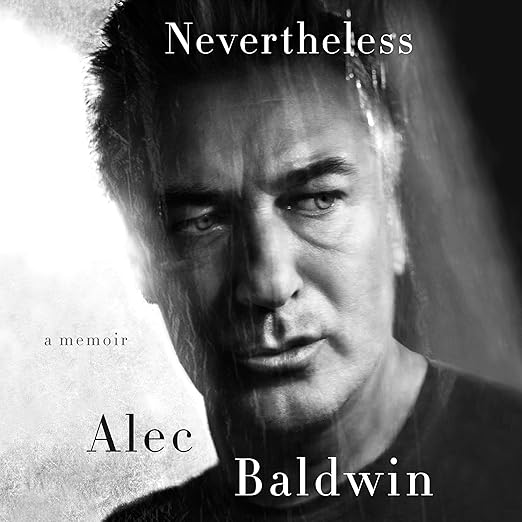
Quick Take
- Read by: Alec Baldwin self-narrates, and the self-narration is the central argument for choosing this audiobook: his voice, timing, and candor transform the memoir in ways a proxy narrator could not replicate.
- At its heart: Acting as vocation and identity, addiction and the long work of recovery, public persona as construction versus private self as ongoing project
- Vibe: Candid and discursive, sometimes rant-adjacent but always specific, with the comedian's rhythm surfacing in unexpected places
- Short version: Nevertheless is more interesting as a document of how a certain kind of American actor thinks about his craft than as a conventional celebrity memoir, and Baldwin's own narration voice is what makes that worthwhile.
Alec Baldwin's memoir Nevertheless arrived in 2017, and its audiobook version rewards return visits precisely because Baldwin self-narrates. The memoir covers a life that is genuinely more layered than the public persona suggests: a Long Island childhood defined by financial strain and a parents' marriage that did not hold, a stint in Washington DC preparing for a political career that pivoted instead to acting, three decades of film and television work spanning Beetlejuice, Working Girl, Glengarry Glen Ross, The Cooler, Martin Scorsese's The Departed, 30 Rock, and his Saturday Night Live portrayal of Donald Trump, and a private life that includes addiction, failed marriage, recovery, and the building of a second family. That is a substantial amount of life to compress into eight hours and twenty-five minutes, and Baldwin does not manage it at equal depth across all sections.
The title comes from what the memoir presents as Baldwin's defining characteristic: a fearlessness, or at least a refusal to stop, regardless of what the situation costs him. The book traces this quality across contexts as different as his early soap opera career spent learning from giants of the theater, his alcoholism and the long road through sobriety, his battles with tabloid culture and public controversy, and his relationship to the political moment that made his Trump impression a cultural touchstone reaching well beyond his previous work. Reviewer J.A. Gordon described it at times as a rant, at times a review of major players in the thespian world, a rags-to-riches story of sorts, which captures the memoir's range without quite capturing its tonal shifts. Baldwin writes with a candor that occasionally tips into score-settling, and reviewer Adam L. noted a frustration with the way the memoir sometimes glosses over the parts a reader most wants access to in favor of sections that feel like a resume. Those are legitimate criticisms of the book's structural choices, and they do not disappear in audio format.
The memoir's structure is less linear than a conventional celebrity biography. Baldwin moves between periods and themes with more associative than chronological logic, which works well in some sections and creates a sense of incompleteness in others. The Long Island childhood sections and the early career years are the most vivid, where the texture of specific memories gives the prose genuine life. Reviewer J.A. Gordon cited a remarkable memory for the accumulated experience of a long career, and that quality comes through most clearly in the theater and early film sections where detail and specificity are most abundant.
Why It Works in Audio
What the audio version adds is everything that Baldwin's specific voice carries in the self-narration. His timber and cadence are distinctive enough that the audiobook format transforms passages that might feel dry or self-justifying on the page. His comic timing, built across decades of screen performance, surfaces in unexpected places throughout the narration. The sections on his craft and his relationships with major theater and film figures, which reviewer Adam L. found most interesting for listeners who care about acting as a discipline rather than as celebrity biography, land differently when delivered in the voice that inhabited Jack Donaghy's compressed, high-status comedy for seven seasons of 30 Rock. Reviewer Carly noted the conversational tone and found the audiobook enjoyable as a document of a career and a period in American entertainment, and that conversational register is exactly what the self-narration achieves most consistently and most successfully.
What to Watch For in Nevertheless
The later sections covering Baldwin's public controversies are more guarded than the early sections, which several readers experienced as the memoir not quite delivering on its implicit promise of full candor about the hardest parts of his public life. For listeners specifically interested in the craft of acting, however, the sections on Baldwin's theatrical education and his relationships with giants of the stage are substantive and specific in ways that celebrity memoirs almost never manage. His experiences learning from the generation of theater practitioners who preceded him, rendered in the conversational self-narration voice, constitute the audiobook's most genuinely valuable material. Reviewer J.A. Gordon described the whole as a rags-to-riches story of sorts, and Baldwin's own voice in the narration gives that arc a specific weight that the print version can only approximate.
The memoir also functions as an inadvertent document of a specific moment in American celebrity culture, the years when an actor of Baldwin's generation could still move between the theater, film, and television without those worlds requiring him to become a different kind of public figure in each. That window has largely closed now, and Baldwin's account of navigating it, with all its professional seriousness and personal chaos, captures something about the period that a more conventional celebrity memoir would not think to record.
Who Will Get the Most From It
Listeners who responded to Baldwin's screen work and want to understand the thinking behind it, particularly the craft-level engagement with acting that drove his choices across a long career, will find this audiobook more rewarding than a conventional celebrity biography in the format. Fans of 30 Rock specifically will recognize the self-narrated voice immediately and find it an interesting counterpoint to Jack Donaghy's particular brand of constructed self-certainty. Listeners who expect full transparency about the most controversial episodes in Baldwin's public life will be disappointed: the memoir practices selective candor with some consistency. The self-narration is the strongest argument for choosing the audio format here. A proxy narrator would reduce Nevertheless to its text, and the text alone is uneven. Baldwin reading Baldwin in his own voice is a meaningfully different object.
Before You Listen
Does Alec Baldwin's self-narration make a significant difference to this audiobook?
It is the central reason to choose the audio format. Baldwin's voice, timing, and candor transform passages that might read as dry or self-justifying on the page. His decades of screen performance surface in the narration's rhythm in ways a proxy narrator could not replicate. The memoir's conversational structure suits self-narration particularly well throughout the eight-hour runtime.
Does the Nevertheless audiobook cover Baldwin's full career including 30 Rock and Saturday Night Live?
Yes, though unevenly. The memoir covers his television work including 30 Rock and his Emmy and Golden Globe-winning performance as Jack Donaghy, as well as his SNL Trump portrayal. The theatrical and early film career sections tend to be more detailed and specific than the later career coverage, which some reviewers found frustrating.
Is this audiobook primarily about acting craft or does it cover Baldwin's personal life as well?
Both, though the proportions vary by section. The memoir addresses addiction and recovery, his first marriage and its difficulties, his Long Island family background, and his later relationship and second family. Some readers found the personal sections less candid than expected, while the acting craft sections on theatrical training and working with major stage figures are substantive and specific.
How long is the Nevertheless audiobook and does it hold up across the full runtime?
The audiobook runs eight hours and twenty-five minutes. The memoir's associative rather than strictly chronological structure means some sections hold engagement better than others. The early career and Long Island childhood sections are the most consistently vivid. Listeners primarily interested in a specific period of Baldwin's career may find the format somewhat uneven overall.







